
Mindmap
Structural Adaptations for Flight
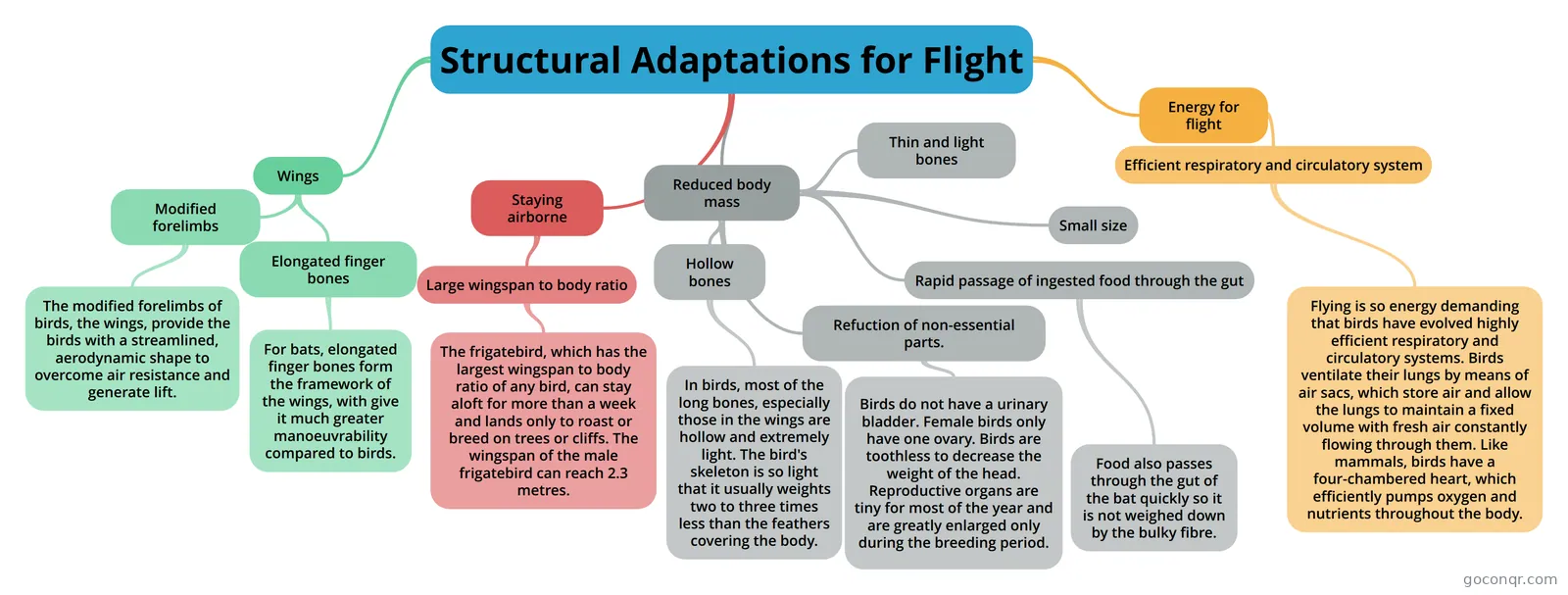
Mind map: Structural adaptations for flight
Inhalt der Mindmap
Structural Adaptations for Flight
Wings
- Elongated finger bones
- For bats, elongated finger bones form the framework of the wings, with give it much greater manoeuvrability compared to birds.
- Modified forelimbs
- The modified forelimbs of birds, the wings, provide the birds with a streamlined, aerodynamic shape to overcome air resistance and generate lift.
- Elongated finger bones
Staying airborne
- Large wingspan to body ratio
- The frigatebird, which has the largest wingspan to body ratio of any bird, can stay aloft for more than a week and lands only to roast or breed on trees or cliffs. The wingspan of the male frigatebird can reach 2.3 metres.
- Large wingspan to body ratio
Reduced body mass
- Hollow bones
- In birds, most of the long bones, especially those in the wings are hollow and extremely light. The bird's skeleton is so light that it usually weights two to three times less than the feathers covering the body.
- Refuction of non-essential parts.
- Birds do not have a urinary bladder. Female birds only have one ovary. Birds are toothless to decrease the weight of the head. Reproductive organs are tiny for most of the year and are greatly enlarged only during the breeding period.
- Small size
- Thin and light bones
- Rapid passage of ingested food through the gut
- Food also passes through the gut of the bat quickly so it is not weighed down by the bulky fibre.
- Hollow bones
Energy for flight
- Efficient respiratory and circulatory system
- Flying is so energy demanding that birds have evolved highly efficient respiratory and circulatory systems. Birds ventilate their lungs by means of air sacs, which store air and allow the lungs to maintain a fixed volume with fresh air constantly flowing through them. Like mammals, birds have a four-chambered heart, which efficiently pumps oxygen and nutrients throughout the body.
- Efficient respiratory and circulatory system
Informationen
- Beschreibung
- Mindmap am Structural Adaptations for Flight, erstellt von Genevieve Ng Kim Sim am 26/04/2015.
- Erstellt von
- Genevieve Ng Kim Sim
- Aufrufe
- 0
- Bewertung