
Mindmap
Glycoconjugates
Inhalt der Mindmap
Glycoconjugates
one or more carbohydrate chains
- covalently linked to protein or lipid
Glycoproteins
- Contain
- oligosaccharide chains
- glycosylation pattern depends on
- pattern of expression of glycosyltransferases
- glycoprotein synthesis
- affinity of glycosyltransferases for substrates
- substrate for glycoprotein synthesis
- corresponding sugar nucleotide
- UDP uridine diphosphate
- GDP guanosine diphosphate
- CMP cytidine monophosphate
- corresponding sugar nucleotide
- substrate for glycoprotein synthesis
- relative availability of carbohydrate substrates
- pattern of expression of glycosyltransferases
- 8 carbohydrate molecules
- glucose
- galactose
- mannose
- fructose
- xylose
- N-acetylgalactosamine GalNAc
- N-acetylglucosamine
- N-acetylneuraminic acid NeuAc
- termini of oligosaccharide chains
- sulfate often found in glycoproteins
- attached to
- N-acetylglucosamine
- N-acetylgalactosamine
- attached to
- 1-30 or more chains
- Form
- linear
- branched
- glycosylation pattern depends on
- amino acid
- oligosaccharide chains
- sugar attachment
- glycosylation
- enzymic
- glycation
- Nonenzymic
- glycosylation
- Main types
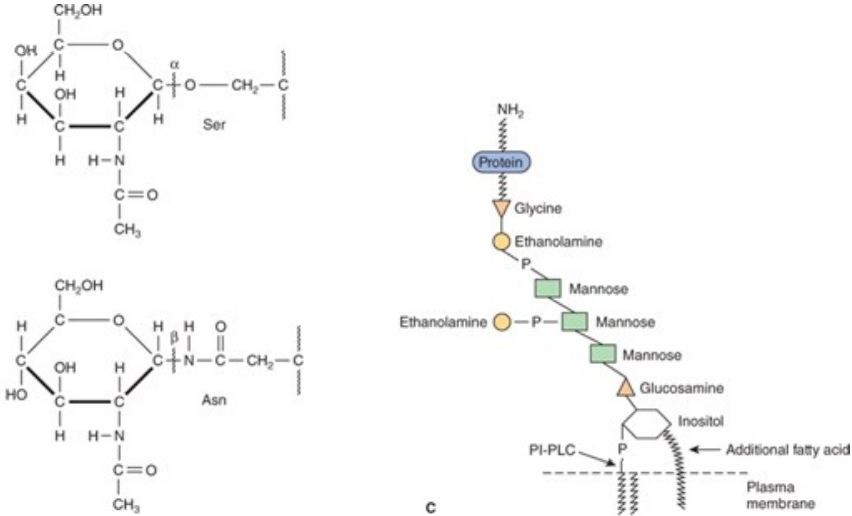
- O-glycosidic linkage
- amino acid hydroxyl groups
- modified residues
- hydroxyproline
- hydroxylysine
- threonine
- serine
- modified residues
- N-acetylgalactosamine
- subclasses
- N-acetylgalactosamine-Ser(Thr)
- N-acetylgalactosamine linked to
- galactose
- N-acetylneuraminic acid
- found in mucins
- N-acetylgalactosamine linked to
- Proteoglycans
- galactose-galactose-xylose trisaccharide
- attached to serine
- galactose-galactose-xylose trisaccharide
- Collagens
- galactose-hydroxylysine linkage
- nuclear and cytosolic proteins
- single N-acetylglucosamine attached to residues
- serine
- threonine
- single N-acetylglucosamine attached to residues
- N-acetylgalactosamine-Ser(Thr)
- amino acid hydroxyl groups
- N-glycosidic linkage
- N-acetylglucosamine
- usually poly-N-acetyllactosaminoglycans
- asparagine
- amino group
- Location
- bound to membrane
- circulating
- Classes
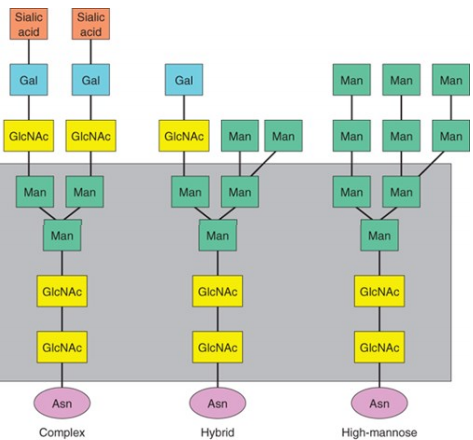
- Man3GlcNAc2 bound to asparagine
- differ in outer branches
- complex
- 2-5 outer branches (antennae)
- terminate in
- galactose
- fucose
- blood group substances
- high-mannose
- 2-6 additional mannose residues
- hybrid
- features of both classes.
- complex
- differ in outer branches
- Man3GlcNAc2 bound to asparagine
- N-acetylglucosamine
- glycosylphosphatidylinositol (GPI) linkage
- N-acetylglucosamine
- link a glycan chain with a variety of sugars
- linked via phosphorylethanolamine
- to the carboxyl-terminal amino acid
- linked via phosphorylethanolamine
- link a glycan chain with a variety of sugars
- phosphatidylinositol (PI)
- link proteins to membrane's luminal leaflet
- Functions
- polarized epithelial cells
- direct glycoproteins to plasma membrane
- basolateral
- apical
- direct glycoproteins to plasma membrane
- enhanced protein mobility in the membrane
- GPI anchor attached only to outer leaflet
- freer to diffuse
- facilitating rapid responses to stimuli.
- GPI anchor attached only to outer leaflet
- signal transduction pathways
- proteins without transmembrane domain
- receptors for
- hormones
- other cell surface signals
- receptors for
- proteins without transmembrane domain
- polarized epithelial cells
- commonly anchored to cell membranes
- N-acetylglucosamine
- O-glycosidic linkage
- Biochemical Roles
- Mucins
- Location
- Lungs
- saliva
- digestive tract
- connective tissue
- Functions
- Lubrication
- lungs
- connective tissue
- protection from bacterial invasion
- digestive tract
- Lubrication
- Increased
- Cancers
- pancreas
- lung
- breast
- ovary
- colon
- lung diseases
- asthma
- bronchitis
- chronic obstructive pulmonary disease
- cystic fibrosis
- Cancers
- Decreased
- cause ulcerative colitis
- Location
- Antibodies & major histocompatability complex
- Location
- White blood cells
- Functions
- Specific glycosylated proteins
- recognition/ activation molecules for immune cells
- Specific glycosylated proteins
- Location
- Glycoprotein IIb/IIIa
- Location
- Platelets
- Functions
- Platelet aggregation
- clot formation
- Deficiency
- bruising/ bleeding problems
- Glanzmann’s thrombasthenia
- idiopathic thrombocytopenic purpura
- bruising/ bleeding problems
- Location
- Transferrin
- Location
- Blood
- Function
- Iron transport
- Location
- ceruloplasmin
- Location
- Blood
- Function
- copper transport
- Location
- Calnexin & calreticulin
- Location
- Endoplasmic reticulum
- Function
- newly synthesized glycoproteins
- Ensure proper
- folding
- glycosylation
- Ensure proper
- newly synthesized glycoproteins
- Location
- Notch glycoproteins (receptors)
- Locations
- Nerve
- arteries
- heart
- pancreas
- intestines
- bone
- mammary glands
- cytoskeleton
- Functions
- cell development
- dierentiation in many tissues
- Alterations cause
- multiple sclerosis
- Tetralogy of Fallot
- Alagille syndrome
- certain leukemias
- Locations
- glycoprotein receptors and membrane-bound molecules
- Location
- Sperm egg interaction
- glycoprotein ZP3
- O-linked glycoprotein
- acts as sperm receptor
- acrosomal reaction
- sperm passes zona pellucida
- acrosomal reaction
- acts as sperm receptor
- O-linked glycoprotein
- glycoprotein ZP3
- virus coats
- attachment to infect host cells
- bacterial coats
- lectins
- selectins
- bind sialylated & fucosylated oligosaccharides
- found in
- Leukocytes
- neutrophils
- activated
- neutrophils
- endothelial cells
- cancer cells
- metastasis
- invasion
- Leukocytes
- found in
- bind sialylated & fucosylated oligosaccharides
- carbohydrate-binding proteins (some are glycoproteins)
- not Immunoglobulins
- at least 2 sugar-binding sites
- Function
- precipitate glycoconjugates
- agglutinate cells
- purify glycoproteins
- probing the glycoprotein profiles of cell surfaces,
- reagents for generating mutant cells deficient in certain enzymes
- Function
- Example
- asialoglycoprotein receptor
- Liver cells
- recognizes galactose moiety
- from desialylated plasma proteins
- endocytosis and catabolism
- from desialylated plasma proteins
- recognizes galactose moiety
- Liver cells
- asialoglycoprotein receptor
- Found in
- animals
- plants
- phytohemagglutinins
- agglutinate red blood cells
- undercooked legumes
- Undenatured lectins
- agglutinating the mucosal cells
- stripping of the intestinal mucosa
- agglutinating the mucosal cells
- Undenatured lectins
- phytohemagglutinins
- microorganisms
- selectins
- drugs
- hormones
- Sperm egg interaction
- Functions
- cell recognition
- cell attachment
- initiation of biological processes by signaling
- Location
- Hormones
- Follicle-stimulating hormone
- luteinizing hormone
- thyroid-stimulating hormone
- human chorionic gonadotropin
- α-fetoprotein
- erythropoietin
- collagens
- Structural molecule
- Mucins
- Contain
Glycolipids
- lipids with an attached carbohydrate or carbohydrate chain
- mostly in outer leaflet of the plasma membrane
- glycocalyx
- human glycolipid
- glycerol backbone
- generally replaced by sphingosine backbone
- made from
- palmitate
- serine
- Sphingolipid
- remaining hydroxyl (OH) group
- amino (NH3 ) group
- bound to another fatty acid
- ceramide
- molecules bind to the ceramide hydroxyl (OH)
- carbohydrate molecules
- glycosphingolipid
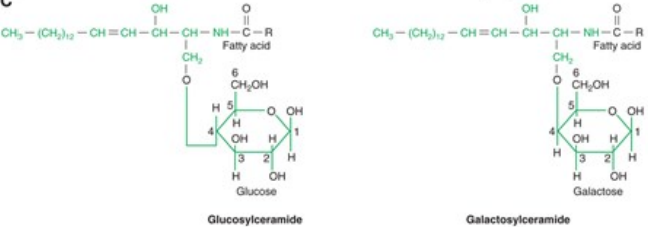
- Cerebrosides
- Ceramide attached to
- 1 glucose residue
- glucosylceramide
- the most predominant in extraneural tissues
- glucosylceramide
- 1 galactose residue
- galactosylceramide
- C24 fatty acids
- cerebronic acid.
- converted to
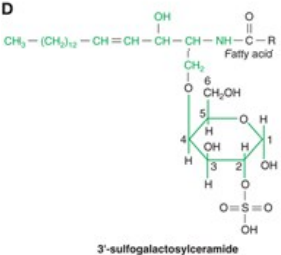
- sulfogalactosylceramide in myelin
- C24 fatty acids
- galactosylceramide
- 1 glucose residue
- plasma membranes
- muscle
- nerve cells
- myelin
- covers nerve axons
- for conduction of nerve impulses
- fast
- efficient
- for conduction of nerve impulses
- covers nerve axons
- myelin
- opiates binding
- Ceramide attached to
- Sulfatides
- Galactose-based glycosphingolipid molecules
- SO4−2 in place of the phosphorous
- mainly in
- nervous system
- central
- peripheral
- nervous system
- Functions
- Regulate
- cell growth
- cell signaling
- affect Na & K transportation in cells
- platelets
- blood clots
- help form
- break down
- blood clots
- platelets
- adhesion molecule
- binding and replication of influenza viruses
- recruitment of immune cells
- Regulate
- Changes in production
- Alzheimer’s early sign
- Galactose-based glycosphingolipid molecules
- Globosides
- N-acetyl-galactosamine with 2 or more other carbohydrate molecules
- found in
- red blood cells
- serum
- liver
- spleen
- found in
- role in cell receptors
- Escherichia coli's binding
- in urinary tract infections
- Escherichia coli's binding
- N-acetyl-galactosamine with 2 or more other carbohydrate molecules
- Gangliosides
- with 1 or more sialic acid molecules
- often N-acetylneuraminic acid NANA
- Functions
- cell
- binding
- immune cells
- influenza virus
- cholera's toxin
- GM1
- recognition
- signaling
- binding
- cell
- abundant in nervous system
- Functions
- often N-acetylneuraminic acid NANA
- Many types
- differ in
- carbohydrate & NANA molecules
- number
- location
- carbohydrate & NANA molecules
- differ in
- with 1 or more sialic acid molecules
- Cerebrosides
- glycosphingolipid
- carbohydrate molecules
- molecules bind to the ceramide hydroxyl (OH)
- ceramide
- bound to another fatty acid
- made from
- generally replaced by sphingosine backbone
- glycerol backbone
- mostly in outer leaflet of the plasma membrane
- lipids with an attached carbohydrate or carbohydrate chain
Proteoglycans
- proteins that contain covalently linked
- Glycosaminoglycans GAGs
- unbranched polysaccharides
- made up of repeating disaccharides
- amino sugar
- D-glucosamine
- D-galactosamine
- uronic acid
- except keratan sulfate
- all the GAGs contain sulfate groups
- except hyaluronic acid
- N-sulfate
- O-esters
- except hyaluronic acid
- ones present in proteoglycans are polyanions
- bind polycations
- osmotic pressure
- bind polycations
- seven GAG
- Keratan sulfate I & II
- Location
- Cartilage
- Eye
- Function
- Component of cartilage
- Cornea of the eye
- Location
- Hyaluronic acid
- Location
- synovial fluid
- bone
- cartilage
- vitreous humor
- embryonic tissues
- Skin
- Function
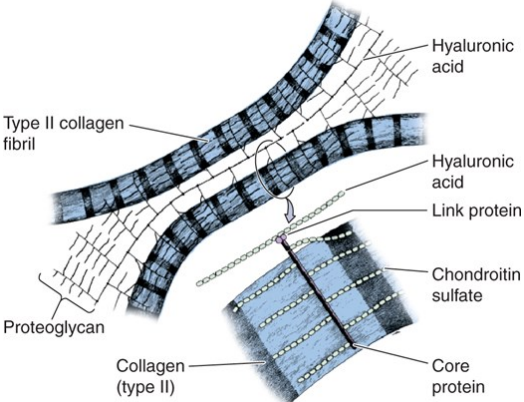
- Component of proteoglycan binding to collagen
- ECM in joints
- collagen binding in cornea
- Location
- Chondroitin sulfate
- Location
- Cartilage
- bone
- CNS
- Function
- Structural component and attachment point to collagen
- Location
- Dermatan sulfate
- Location
- Skin
- Eye
- circulatory system
- Function
- Structural component of skin
- collagen binding in cornea
- clot formation regulation
- Location
- Heparin
- Location
- Mast cells
- liver
- lung
- skin
- Regulates
- immune response
- blood clot formation
- Location
- Heparan sulfate
- Location
- Skin
- kidney
- collagen attachment
- Location
- Keratan sulfate I & II
- amino sugar
- made up of repeating disaccharides
- enzymes that degrade GAGs
- endoglycosidases
- Deficiencies
- Mucopolysaccharidoses
- Deficiencies
- exoglycosidases
- Deficiencies
- endoglycosidases
- unbranched polysaccharides
- Glycosaminoglycans GAGs
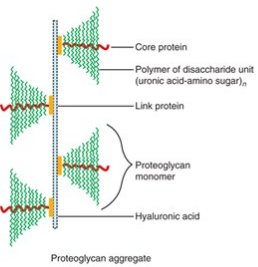
- consists of
- core protein bound covalently to GAGs
- large complexes
- bottlebrush structure
- link proteins attach noncovalently
- from which other GAGs project
- large complexes
- core protein bound covalently to GAGs
- 30 have been characterized
- found in every tissue of the body
- major component of extracellular matrix
- associated with each other and other structural components of the matrix
- collagen
- elastin
- bind growth factors
- TGF-β
- adhesive proteins
- fibronectin
- laminin
- sieves for macromolecules into the ECM
- associated with each other and other structural components of the matrix
- major component of extracellular matrix
- proteins that contain covalently linked
Bilder und Dateien der Mindmap
Informationen
- Beschreibung
- Medicina Mindmap am Glycoconjugates, erstellt von Valentina Ardila Mora am 12/10/2020.
- Erstellt von
- Valentina Ardila Mora
- Aufrufe
- 0
- Bewertung