
Carbohydrates and Glycobiology
106 resources created by 96 users
This Carbohydrates and Glycobiology page on GoConqr gathers community-made quizzes, mind maps, flashcards and notes, from monosaccharides and starch to glycoconjugates and glycan-binding proteins. It's built for university students revising a topic and teachers after ready-made material. There are over 100 resources here, including more than 15 quizzes, over 40 mind maps and more than 35 flashcard decks, all at university level. Open a mind map for an overview, then try a quiz to see what you remember.
Top Carbohydrates and Glycobiology resources
Quizzes
See all 17 quizzes-
17 questionsCarbohydrates
-
66 questionsMidterm 2 Prep What is starch made from?
-
15 questionsCarbohydrate Structure and Function When glucose is in a straight-chain formation, it:
-
27 questionsCarbohydrate quiz
-
56 questionsChapter 11 Monosaccharides are the simplest carbohydrates
-
29 questionsUntitled
-
37 questionsBT2 (Q121 - 157) The enzyme alcohol dehydrogenase uses a zinc ion for structural support and folding. If this zinc is remove...
-
26 questionsUntitled The following two compounds are: https://moodle.oakland.edu/pluginfile.php/3553447/question/questiontext/29...
Mind maps
See all 42 mind mapsFlashcards
See all 37 flashcards-
49 cardsCarbohydrates II What are polysaccharides/glycans?
-
36 cardsMCDB 108C: Lecture 15 - Starch, Sucrose, Cellulose Amylopectin vs Glycogen
-
18 cardsSugars
-
13 cardsCarbohydrates List the Functions of Carbohydrates
-
88 cardsSugars and polysaccharides What are the three monosaccharides?
-
124 cardsLecture 7-Carbohydrate and glycobiology Carbohydrates have a molecular formula
-
90 cardsBiochem Module 5-2 carbohydrates contain with elements?
-
26 cardsBiochem Test 3: Quiz 1 Polysaccharides What is glycan? Why polysaccharides do not have a defined weight?
Flowcharts
Notes
-
Untitled Biochemistry: Carbohydrates & Glycobiology Carbohydrate Roles, Structure, Stereochemistry, Glycosidic BondsCarbohydrates are found in: polymers store in muscle and liver cells Bacterial cell walls (PG) Attached to spe...
-
Simple Carbohydrates They are distributed widely in nature and are a key intermediate of metabolism. Polysaccharides are involved in cell to cell recognition. Small chains that are covalently bound by glycosidic links to hydroxyl groups o...
-
Carbohydrates - created from Mind Map Definition Importance Monosaccharides
-
Untitled Biochemistry: Carbohydrates & Glycobiology Carbohydrate Roles, Structure, Stereochemistry, Glycosidic BondsCarbohydrates are found in: polymers stores in muscle and liver cells Bacterial cell walls (PG) Attached to sp...
-
Monosaccharides Know and recognize aldose/ketose, hexose/pentose, pyranose/furanose, α/β. Know that D/L-enantiomers are mirror images. Know and recognize the anomeric carbon in a saccharide. Understand what a reducing sugar is. Recog...
-
Monosaccharides and Disaccharides Word List Aldose Ketose Hemiacetals Hemiketals Enantiomers Epimers Anomers Anomeric carbon Furanose Pyranose Fischer projection Formula Haworth perspective formula Mutarotation Aldonic acid Ironic acid Conventi...
Slides
Topics in Carbohydrates and Glycobiology
More Biochemistry topics
About Carbohydrates and Glycobiology
GoConqr OriginalWhat the resources cover
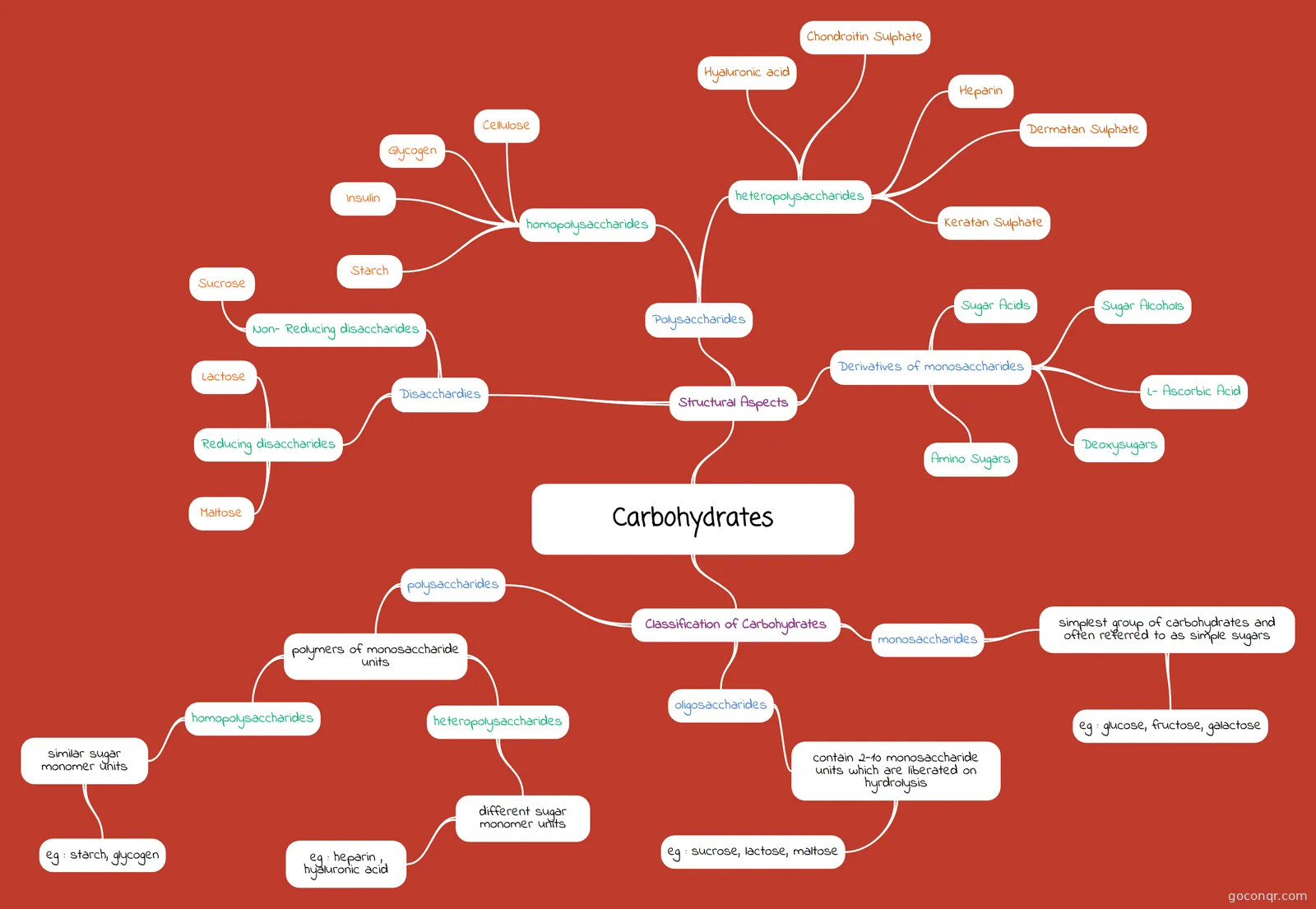
The page starts with the basics. The Mind Map titled Carbohydrates sorts sugars into monosaccharides, oligosaccharides and polysaccharides, with glucose and fructose as simple-sugar examples. Other maps and decks cover the structural features of monosaccharides, sugars, oligosaccharides and glycans.
Polysaccharides get their own attention. The flashcard deck on starch, sucrose and cellulose asks how amylopectin differs from glycogen, and why sugars are added to only one end of the chain. Another deck, Carbohydrates II, asks what glycans are, how they vary and what roles they play.
Glycoconjugates and glycobiology
Many mind maps here are titled Glycoconjugates. They describe carbohydrate chains covalently linked to proteins or lipids, and they separate glycoproteins, glycolipids and proteoglycans. Because several users made their own versions, you can compare how each one organises composition, function and location.
For the wider biology of sugars, look at the Mind Map and flashcards called Glycobiology: Glycan Function in Health and Disease, plus the maps on glycan structure and glycan binding proteins.
Where to start
- Read the Carbohydrates mind map for the big picture.
- Work through the flashcards on monosaccharides and disaccharides.
- Move on to polysaccharides: starch, glycogen and cellulose.
- Finish with the Glycoconjugates maps and the glycobiology material.
Using quizzes and maps together
Use a map to see how ideas connect, then take a quiz to test it. The Carbohydrates quiz, for example, asks how hydroxyl groups in a Fischer projection translate to the Haworth view. If a question catches you out, go back to the map or the structural flashcards and look again.
Teachers can pick maps for a class overview and use quizzes as quick checks.
Where it fits
This unit sits in the Structure and Function of Biomolecules strand of Biochemistry. Choose one map or deck today and see how far you get.
Frequently asked questions
Which resource should I open first?
Start with the Mind Map called Carbohydrates. It sets out the classification into monosaccharides, oligosaccharides and polysaccharides, with simple sugars such as glucose and fructose as examples. After that, move to the flashcards on monosaccharides and disaccharides, then on to starch and glycogen.
What do the Glycoconjugates mind maps cover?
They cover carbohydrate chains covalently attached to proteins or lipids. Different maps list glycoproteins, glycolipids, proteoglycans and lipopolysaccharides, and several set out composition, function and location. Because different users made them, reading a few side by side shows different ways to organise the same topic.
Are the resources free to use?
Yes. Every resource listed here is free to open, study and take, with no account needed. They were made by GoConqr users rather than by GoConqr itself, so it's worth checking that a map or deck matches your own course notes.
What level are these resources?
All of the resources on this page are at university level. They suit university students studying biochemistry and teachers looking for ready-made material on carbohydrates and glycobiology, from sugar structure to glycan function.
Can I save my quiz scores or make my own material?
A free account saves your quiz scores and lets you make your own quizzes, mind maps, flashcards and notes. That's handy if you want to adapt a listed resource to your course, or build a deck on a part of the topic you find hardest.
What if the topic I need is missing?
Try the related titles on the page first, since sugars, glycans and oligosaccharides are covered under several names. If a topic still isn't there, you can make your own mind map or flashcards, using the listed resources as a guide.