
Mindmap
GCSE AQA Physics
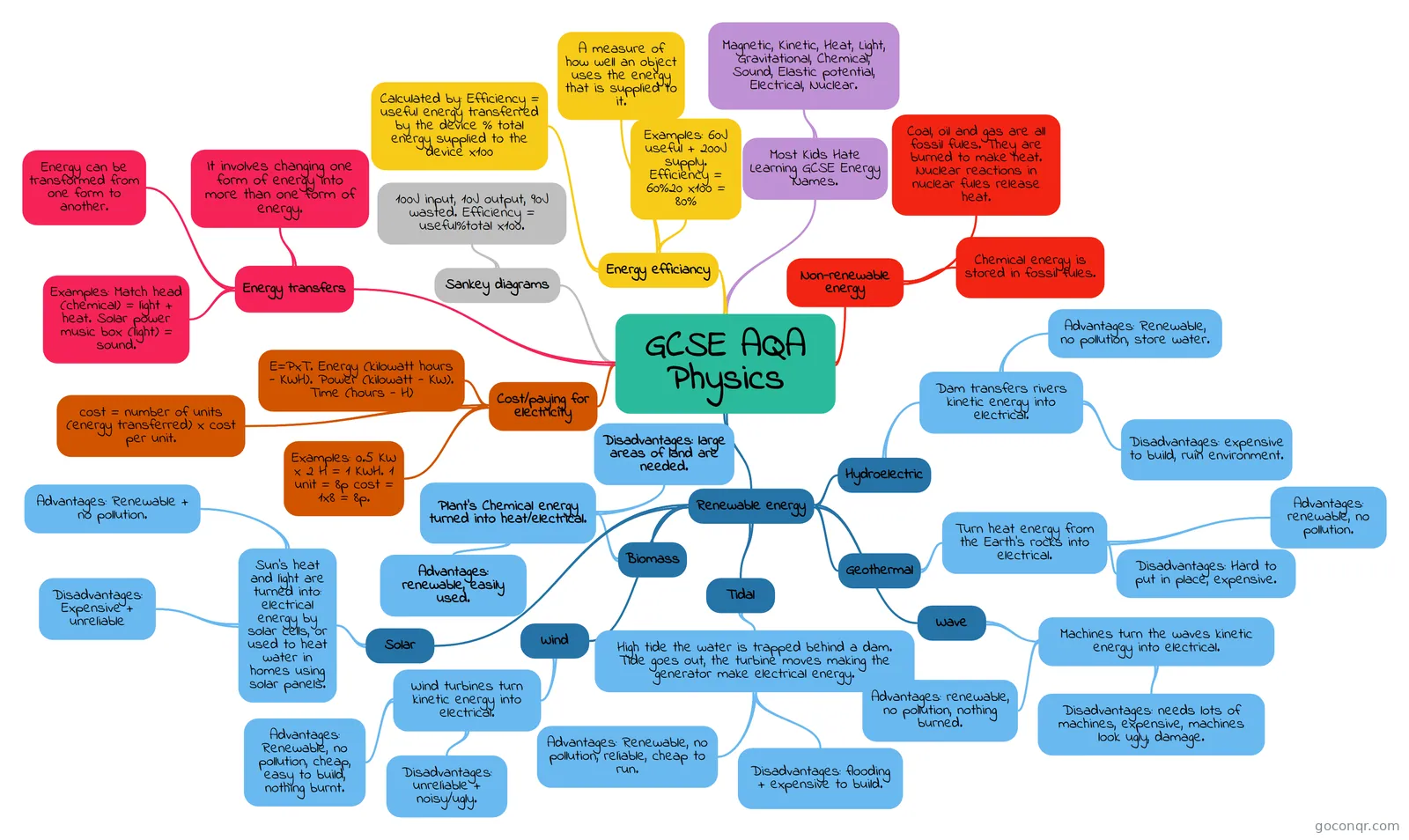
Mind map: GCSE AQA Physics energy
Inhalt der Mindmap
GCSE AQA Physics
Energy transfers
- Energy can be transformed from one form to another.
- It involves changing one form of energy into more than one form of energy.
- Examples: Match head (chemical) = light + heat. Solar power music box (light) = sound.
Energy efficiancy
- A measure of how well an object uses the energy that is supplied to it.
- Calculated by: Efficiency = useful energy transferred by the device % total energy supplied to the device x100
- Examples: 60J useful + 200J supply. Efficiency = 60%20 x100 = 80%
Cost/paying for electricity
- E=PxT. Energy (kilowatt hours - KWH). Power (kilowatt - KW). Time (hours - H)
- cost = number of units (energy transferred) x cost per unit.
- Examples: 0.5 KW x 2 H = 1 KWH. 1 unit = 8p cost = 1x8 = 8p.
Most Kids Hate Learning GCSE Energy Names.
- Magnetic, Kinetic, Heat, Light, Gravitational, Chemical, Sound, Elastic potential, Electrical, Nuclear.
Sankey diagrams
- 100J input, 10J output, 90J wasted. Efficiency = useful%total x100.
Renewable energy
- Solar
- Sun's heat and light are turned into: electrical energy by solar cells, or used to heat water in homes using solar panels.
- Advantages: Renewable + no pollution.
- Disadvantages: Expensive + unreliable
- Sun's heat and light are turned into: electrical energy by solar cells, or used to heat water in homes using solar panels.
- Wind
- Wind turbines turn kinetic energy into electrical.
- Advantages: Renewable, no pollution, cheap, easy to build, nothing burnt.
- Disadvantages: unreliable + noisy/ugly.
- Wind turbines turn kinetic energy into electrical.
- Tidal
- High tide the water is trapped behind a dam. Tide goes out, the turbine moves making the generator make electrical energy.
- Advantages: Renewable, no pollution, reliable, cheap to run.
- Disadvantages: flooding + expensive to build.
- High tide the water is trapped behind a dam. Tide goes out, the turbine moves making the generator make electrical energy.
- Geothermal
- Turn heat energy from the Earth's rocks into electrical.
- Advantages: renewable, no pollution.
- Disadvantages: Hard to put in place, expensive.
- Turn heat energy from the Earth's rocks into electrical.
- Biomass
- Plant's Chemical energy turned into heat/electrical.
- Advantages: renewable, easily used.
- Disadvantages: large areas of land are needed.
- Plant's Chemical energy turned into heat/electrical.
- Hydroelectric
- Dam transfers rivers kinetic energy into electrical.
- Advantages: Renewable, no pollution, store water.
- Disadvantages: expensive to build, ruin environment.
- Dam transfers rivers kinetic energy into electrical.
- Wave
- Machines turn the waves kinetic energy into electrical.
- Advantages: renewable, no pollution, nothing burned.
- Disadvantages: needs lots of machines, expensive, machines look ugly, damage.
- Machines turn the waves kinetic energy into electrical.
- Solar
Non-renewable energy
- Coal, oil and gas are all fossil fules. They are burned to make heat. Nuclear reactions in nuclear fules release heat.
- Chemical energy is stored in fossil fules.
Informationen
- Beschreibung
- GCSE Science Mindmap am GCSE AQA Physics, erstellt von Kate Ordidge am 05/05/2015.
- Erstellt von
- Kate Ordidge
- Aufrufe
- 20
- Bewertung