
Mindmap
4.4 Atomic Structure
Inhalt der Mindmap
4.4 Atomic Structure
Basic structure of atom
- consist of three basic particles: protons, electrons, and neutrons
- The outermost regions of the atom are called electron shells and contain the electrons (negatively charged).
Definitions
- Electrons
- a charge of negative electricity, found in all atoms and acting as the primary carrier of electricity in solids.
- Symbol
- e⁻ or β⁻
- Symbol
- Charge
- Negative
- a charge of negative electricity, found in all atoms and acting as the primary carrier of electricity in solids.
- Neutrons
- same mass as a proton but without an electric charge, present in all atomic nuclei except those of ordinary hydrogen.
- Charge
- Neutral
- Protons
- an elementary particle that is identical with the nucleus of the hydrogen atom, that along with the neutron
- Charge
- Positive
- Isotopes
- variants of a particular chemical element which differ in neutron number, and consequently in nucleon numbe
- All isotopes of a given element have the same number of protons
- Differemt numbers of neutrons
- All isotopes of a given element have the same number of protons
- Charge
- negative or positive charge.
- variants of a particular chemical element which differ in neutron number, and consequently in nucleon numbe
- Ions
- an atom or group of atoms that carries a positive or negative electric charge as a result of having lost or gained one or more electrons.
- Charge
- Negative
- Positive
- Half-life
- the time taken for the radioactivity of a specified isotope to fall to half its original value.
- contamination
- Suitable protection
- When a radioactive source is in contact with an object or person
- Irradiation
- Suitable protection
- When an object or person is exposed to radiation
- Suitable protection
- Electrons
Penetration of particles
- Alpha particles
- Range
- 2 cm to 10 cm
- ionising power
- highly ionising because of their double positive charge
- Skin/paper
- highly ionising because of their double positive charge
- Range
- Beta particles
- Range
- about one metre
- ionising power
- Low
- 3 mm aluminium foil
- Low
- Range
- Gamma rays
- Range
- very large distances.
- ionising power
- Very low
- Lead/concreate
- Very low
- Range
- Best source of radiation for certain situations
- Alpha
- treat various forms of cancer
- smoke detectors
- were used for artificial heart pacemakers
- Beta
- tracers
- monitoring the thickness of materials.
- eye and bone cancer
- Gamma
- Medicine ( radiotherapy)
- Industry srerilization and disinfection
- Alpha
- Alpha particles
Why you should publish the finding of studies and let other scientists peer review them
- Putting up your findings for other scientists to look at stops any false evidence or fake results from being used in University papers, or by other scientists
How atomic model has changed over time
- James Chadwick
- found evidence for the existence of particles in the nucleus with mass but no charge. These particles are called neutrons.
- This led to another development of the atomic model, which is still used today.
- found evidence for the existence of particles in the nucleus with mass but no charge. These particles are called neutrons.
- James Chadwick
How to determine the radioactive of an isotope
Describing Nuclear fusion
- he process in which two atomic nuclei are fused together into a larger single nucleus, releasing energy in the process
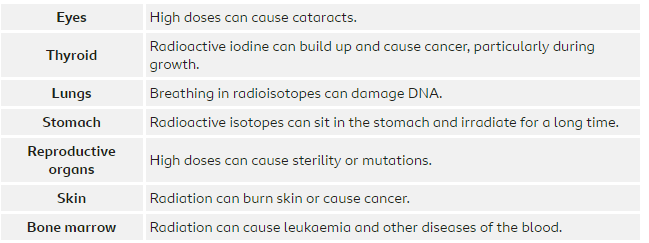
Perceived risks of using nuclear radiation
- Can ionise chemicals within a body
- Deposits large amounts of energy into the body ( can cause damage or destroy cells completely)
Bilder und Dateien der Mindmap
Informationen
- Beschreibung
- GCSE Physics Mindmap am 4.4 Atomic Structure, erstellt von Matthew Monaghan am 08/11/2020.
- Erstellt von
- Matthew Monaghan
- Aufrufe
- 0
- Bewertung