
27425637


Agile
- Is
Anmerkungen:
- Is to possess the ability to both, create and respond to chage in order to profit in a turbulent environment.
- Cutting Edge
- Shrinking the "time to market"
- Reduction of cost (similations and automation)
- Customer value is a delivered
- Adaptive
- Principles
- Customer Satisfaction
Anmerkungen:
- Satisfy the customer through early and continues delivery of throuble software.
- Welcome changing requirements
Anmerkungen:
- Essential to approach product development in an adaptive manner that enables change incorporation and fast product lifecycles.
- Deliver working software frecuency
Anmerkungen:
- Delivering working in increments
- Work together daily
Anmerkungen:
- Collaborate enviroment
- Build projects around motivated individuals
Anmerkungen:
- Give them the enviroment and support they need, and trust them to get the job done.
- Face to face
Anmerkungen:
- The most effective method team, is face to face.
- Working is the mesuare of progress
Anmerkungen:
- The mayor value is develop process
- Sustainable development
Anmerkungen:
- The sponsors, developers, and users shoukd be able to maintain a constant pace indefinitely
- Technical excellence and good design enhances Agility
Anmerkungen:
- Some of the ways of ensuring this area continuous integration, refactoring, and incremental re-architecture.
- Simplicity
Anmerkungen:
- The art of monitorizing the amount of work not done-is essencial, Small feature sets, focusing on client due, ensuring good upfront desing/model, etc.
- Self-organizing teams
Anmerkungen:
- Trust in team for develop key projects solutions.
- Regular intervals
Anmerkungen:
- Reflects on how to become more effective and then tunes and adjusts its behavior accordingly.
- Customer Satisfaction
- Changed
- Waterfall model
Anmerkungen:
- For ordered and predictable projects in which all the requiremets are cleary defined and can be estimated accurately.
- Inspect-adapt cycles as
opposed the
command-and-control
structures.
- Emphasis
- People
- People
- Suited for
- Unpredictable domains
- Iterative style
Anmerkungen:
- Shippable deliverable
- Unpredictable domains
- Waterfall model
- Methods
- Agile Manifesto
- Lean Kanban
- Singboard assist and track producction
- Singboard assist and track producction
- Xtreme Programming
- Makes possible to keep the cost of changing
- Increment development
- Flexibility scheduling
- Automated test codes
- Close collaboration
- All involved
- Increment development
- Makes possible to keep the cost of changing
- Crystal methods
- People centric, lightweight and easy to adapt
- People centric, lightweight and easy to adapt
- FDD
- Fast process
- Fast process
- Test Diven Devolopment
- Fist codes the test
- Fist codes the test
- TDD
- ATDD
- Acceptance test
- Acceptance test
- DTDD
- Developer test
- Developer test
- ATDD
- Adaptive software
development
Anmerkungen:
- constant adaption of processes to work at hand.
- Grew out of rapid application
- Agile Unified Process
- Work in the best quality
- Work in the best quality
- Domain value
- Lean Kanban
- Agile Manifesto
- Aspects
Anmerkungen:
- Must be addressed and managed throughout a Scrum project
- Organization
- Roles
- Core Roles
Anmerkungen:
- -Are involved in producing the project's product or service. -Individuals assigned are fully committed to the project. -Responsible for the success of each project iteration and of project as a whole.
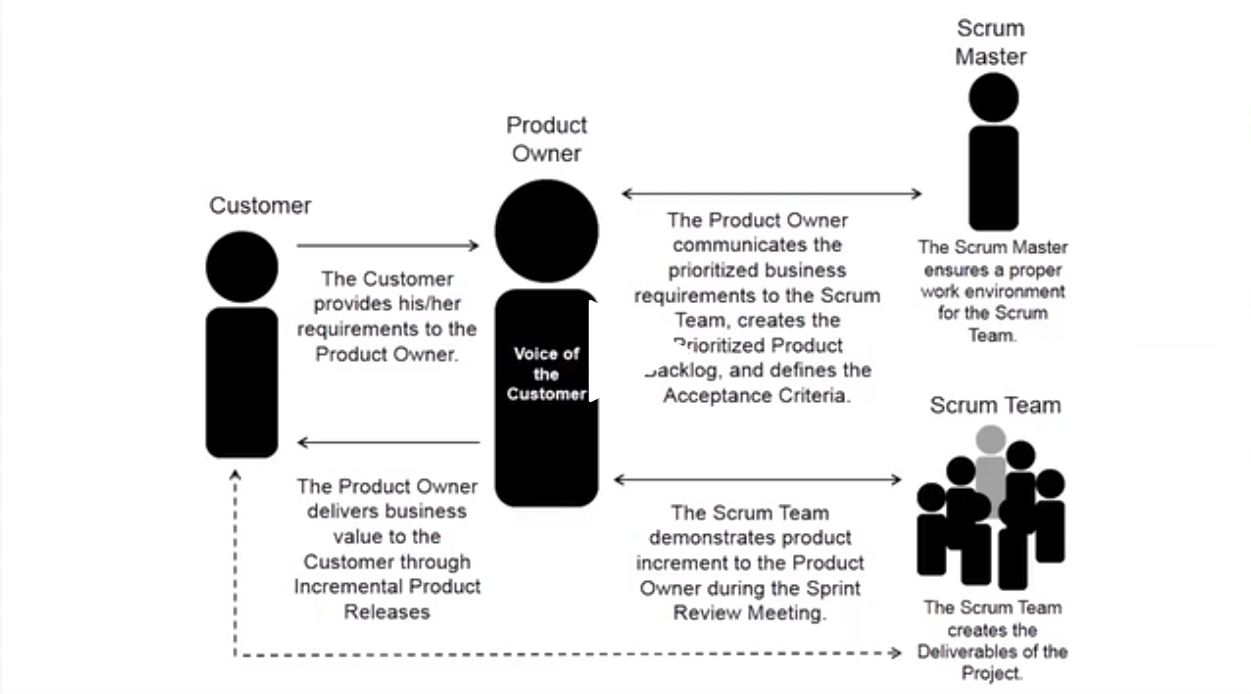
- Product Owner
- Maximun business value
- Customer requirements
- Business justification
- Voice of customer
- Maximun business value
- Scrum Master
- Appropriate environment
- Guides, facilites and teaches
- Clear impediments
- Scrum processes are being followed
- Appropriate environment
- Scrum Team
- Understant Product Owner specified requirements
- Deliverables
- Understant Product Owner specified requirements
- Non-Core Roles
Anmerkungen:
- Optional and may include all team members who are interested in the project. No formal role in the project main, but may interface with the team. Not be responsible for the success of the project.
- Optional, no formal role, but may interface with the team. Not be responsible for the success of the project.
- Stakaholders(s)
- Customer, Users and Sponsors
- Interface Scrum Core Team
- Collaborative benefits
- Customer, Users and Sponsors
- Vendors
- Individual organization
- Provide products and services
competencies
- Individual organization
- Scrum Guidance Body
- Documents & grop of experts
- Defining objectives
- Guides Product Owner, Scrum Master & Scrum Team
- Documents & grop of experts
- Core Roles
- Roles
- Business justification
Anmerkungen:
- Business assessment. Key decision makers to business need
- Product Owner is the maximum responsable
- Value-driven delivery
- Uncertainty of results or outcomes
- Impossible to guarantee Project's sucess and completion
- Scrum attempts to start delivering results as
early in the project as possible
- This provides an opportunity for reinvestment
- This provides an opportunity for reinvestment
- Scrum attempts to start delivering results as
early in the project as possible
- Impossible to guarantee Project's sucess and completion
- Uncertainty of results or outcomes
- Change
Anmerkungen:
- Maximize benefits change minimize negative impacts
- Requirements Churn
- Welcome changes
- Scrum Team members view
deliverables to change requirements
- Scrum Team members view
deliverables to change requirements
- Welcome changes
- Risk
Anmerkungen:
- Uncertain event
- Positive impact
Anmerkungen:
- Opportunities
- Negative impact
Anmerkungen:
- Threats
- lifecycle
- Identified
- Evaluated
- Proper course of
action is determined
upon and acted upon
- Identified
- Assessed & Respond
- Probability
- Possible impact
- High probability & impact value detmined multiplying factors
- Once identified - important to understand
- Once identified - important to understand
- Probability
- Quality
Anmerkungen:
- The ability to completed deliverables and acceptance criteria
- Prioritized Product Backlog
- Incremental fashion Sprints
- Errors
- Quality part of Sprint
- Issues are listed in the Product Backlog
- Constant discussions between
Scrum Core Team and
Skateholders, customers and users
- Constant discussions between
Scrum Core Team and
Skateholders, customers and users
- Issues are listed in the Product Backlog
- Quality part of Sprint
- Errors
- Incremental fashion Sprints
- Process
Anmerkungen:
- Product Backlog of priorized requirement. Product owner for priorized requirements.
- 19 process grouped into 5 phases.
- 5 Phases
- Inputs
- Tools
- Outputs
- On particular
project,
organization or
Indistry
- Scrum Process
- Initiate
- Create Project
Vision
Anmerkungen:
- First process Project Business is reviewed to create Project Vision Statement Product Owner
- Identified Scrum
Master and
Skateholders
Anmerkungen:
- Scrum Master is identified
- Form Scrum
Team
Anmerkungen:
- Scrum Team members are identified Product Owner responsible for selecting team members, often does so in collaboration with the Scrum Master
- Develop Epic (s)
Anmerkungen:
- Project Vision Statement serves as the basis for deveping Epic User Group Meetings may held to develop Epic(s)
- Create
Prioritized
Product
Backlog
Anmerkungen:
- Epic(s) and Unrefined User Stories refined and elaborated and prioritized to create a Prioritized Product Backlog
- Conduct
Release
Planning
Anmerkungen:
- Scrum Core Team reviews the User Stories in the Prioritized Product Backlog to develop a Release Planning Schedule
- Create Project
Vision
- Project
Plan and
Estimate
- Create User
Stories
Anmerkungen:
- User Stories and their related User Story Acceptance Criteria are created Usually written by Product Owner Designed to ensure that the customer's requirements are clearly depicted and understood Involves Scrum Team members creating the User Stories Incorporated into the Prioritized Product Backlog
- Inputs
- Scrum Core Team
- User Stories
- Scrum Core Team
- Tools
- Numerous estimation methods
- Wideband Delphi
Anmerkungen:
- Is a group-based estimation technique Who long is the work Individual within a team anonymously provide estimations for each item Initial estimates are plotted on a chart Teamdiscusses the factors that influenced their estimates Rounds for final estimate
- Planning Poker
Anmerkungen:
- Uses concensus Estimate relative sizes of User Stories Effort requiered to create them
- Fist of Five
Anmerkungen:
- Group concensus building technique After initial discussion on a given item for estimation Scrum Team members are each asked to vote. Value in using this technique is not only consensus building. Driving discussion because team members are asked to explain the reason for their estimates. Team members vote bases on their level of agreement and desire for discussion.
- Discussion Product Owner will indicate some sizing categories on the wall (Small, Medium, Large) or numbered. Transparent, visible to everyone, easy to conduct.
- Affinity Estimation
Anmerkungen:
- Used to quickly estimate large nu Team places User Stories on a wall or other surface, in order from small to large Each team members begins with a subset of User Stories from the overall Prioritized Product Backlog to place by relative size
- Numerous estimation methods
- Outpts
- Estimate User Stories
- Estimate User Stories
- Estimate User Stories
- Commit User Stories
- Identify Task processes
- Approve,
Estimate, and
Commit User
Stories
- Create Tasks
- Create User
Stories
- Impliment
- Review and
Restropect
- Realese
- Initiate
- Inputs
Medienanhänge
Möchten Sie kostenlos Ihre eigenen Mindmaps mit GoConqr erstellen? Mehr erfahren.