
Mindmap
Meta Ethics-1
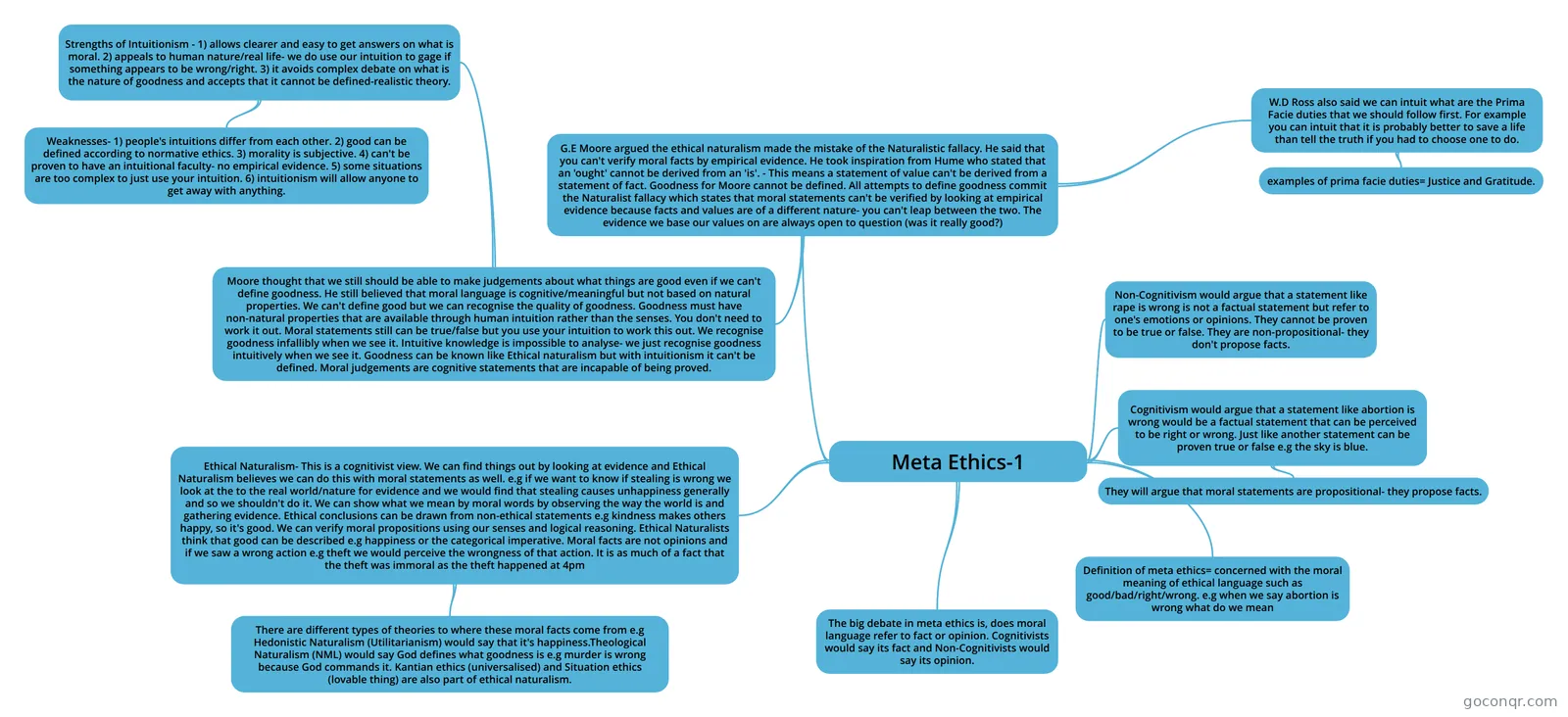
Mind map: Meta ethics
Inhalt der Mindmap
Meta Ethics-1
Definition of meta ethics= concerned with the moral meaning of ethical language such as good/bad/right/wrong. e.g when we say abortion is wrong what do we mean
The big debate in meta ethics is, does moral language refer to fact or opinion. Cognitivists would say its fact and Non-Cognitivists would say its opinion.
Cognitivism would argue that a statement like abortion is wrong would be a factual statement that can be perceived to be right or wrong. Just like another statement can be proven true or false e.g the sky is blue.
- They will argue that moral statements are propositional- they propose facts.
Non-Cognitivism would argue that a statement like rape is wrong is not a factual statement but refer to one's emotions or opinions. They cannot be proven to be true or false. They are non-propositional- they don't propose facts.
Ethical Naturalism- This is a cognitivist view. We can find things out by looking at evidence and Ethical Naturalism believes we can do this with moral statements as well. e.g if we want to know if stealing is wrong we look at the to the real world/nature for evidence and we would find that stealing causes unhappiness generally and so we shouldn't do it. We can show what we mean by moral words by observing the way the world is and gathering evidence. Ethical conclusions can be drawn from non-ethical statements e.g kindness makes others happy, so it's good. We can verify moral propositions using our senses and logical reasoning. Ethical Naturalists think that good can be described e.g happiness or the categorical imperative. Moral facts are not opinions and if we saw a wrong action e.g theft we would perceive the wrongness of that action. It is as much of a fact that the theft was immoral as the theft happened at 4pm
- There are different types of theories to where these moral facts come from e.g Hedonistic Naturalism (Utilitarianism) would say that it's happiness.Theological Naturalism (NML) would say God defines what goodness is e.g murder is wrong because God commands it. Kantian ethics (universalised) and Situation ethics (lovable thing) are also part of ethical naturalism.
G.E Moore argued the ethical naturalism made the mistake of the Naturalistic fallacy. He said that you can't verify moral facts by empirical evidence. He took inspiration from Hume who stated that an 'ought' cannot be derived from an 'is'. - This means a statement of value can't be derived from a statement of fact. Goodness for Moore cannot be defined. All attempts to define goodness commit the Naturalist fallacy which states that moral statements can't be verified by looking at empirical evidence because facts and values are of a different nature- you can't leap between the two. The evidence we base our values on are always open to question (was it really good?)
- Moore thought that we still should be able to make judgements about what things are good even if we can't define goodness. He still believed that moral language is cognitive/meaningful but not based on natural properties. We can't define good but we can recognise the quality of goodness. Goodness must have non-natural properties that are available through human intuition rather than the senses. You don't need to work it out. Moral statements still can be true/false but you use your intuition to work this out. We recognise goodness infallibly when we see it. Intuitive knowledge is impossible to analyse- we just recognise goodness intuitively when we see it. Goodness can be known like Ethical naturalism but with intuitionism it can't be defined. Moral judgements are cognitive statements that are incapable of being proved.
- Strengths of Intuitionism - 1) allows clearer and easy to get answers on what is moral. 2) appeals to human nature/real life- we do use our intuition to gage if something appears to be wrong/right. 3) it avoids complex debate on what is the nature of goodness and accepts that it cannot be defined-realistic theory.
- Weaknesses- 1) people's intuitions differ from each other. 2) good can be defined according to normative ethics. 3) morality is subjective. 4) can't be proven to have an intuitional faculty- no empirical evidence. 5) some situations are too complex to just use your intuition. 6) intuitionism will allow anyone to get away with anything.
- Strengths of Intuitionism - 1) allows clearer and easy to get answers on what is moral. 2) appeals to human nature/real life- we do use our intuition to gage if something appears to be wrong/right. 3) it avoids complex debate on what is the nature of goodness and accepts that it cannot be defined-realistic theory.
- W.D Ross also said we can intuit what are the Prima Facie duties that we should follow first. For example you can intuit that it is probably better to save a life than tell the truth if you had to choose one to do.
- examples of prima facie duties= Justice and Gratitude.
- Moore thought that we still should be able to make judgements about what things are good even if we can't define goodness. He still believed that moral language is cognitive/meaningful but not based on natural properties. We can't define good but we can recognise the quality of goodness. Goodness must have non-natural properties that are available through human intuition rather than the senses. You don't need to work it out. Moral statements still can be true/false but you use your intuition to work this out. We recognise goodness infallibly when we see it. Intuitive knowledge is impossible to analyse- we just recognise goodness intuitively when we see it. Goodness can be known like Ethical naturalism but with intuitionism it can't be defined. Moral judgements are cognitive statements that are incapable of being proved.
Informationen
- Beschreibung
- Mindmap am Meta Ethics-1, erstellt von meganhalse am 24/05/2015.
- Erstellt von
- meganhalse
- Aufrufe
- 0
- Bewertung