
Mindmap
Chapter 4: Functions
Inhalt der Mindmap
Chapter 4: Functions
Reflecting Graphs; Symmetry
Operations of Functions
- Sum of f and g: (f+g)(x)=f(x)+g(x) Difference of f and g: (f-g)(x)=f(x)-g(x) Product of f and g: (f*g)(x) = f(x)*g(x) Quotient of f and g: (f/g)(x)= f(x)/g(x)
- Composite of functions
- denoted f o g is defined by 2 conditions
- 1. (f o g )(x)=f(g(x)), which means f of g of x. 2. x is in the domain of g and g(x) is in the domain of f.
- denoted f o g is defined by 2 conditions
Properties of Functions
- A function assigns every element in the Domain set (x) to exactly one element in the Rang set (y)
- You can use the vertical line test to see if it is a function - If there are two intersections on a single vertical line by the graph, then it is not a function.
- The Zeroes of y= f(x) are the x-intercepts of the graph
- You can use the vertical line test to see if it is a function - If there are two intersections on a single vertical line by the graph, then it is not a function.
- A function assigns every element in the Domain set (x) to exactly one element in the Rang set (y)
Reflecting Graphs; Symmetry
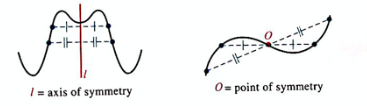
- An Axis of Symmetry of a graph is a line that acts as a perpendicular bisector of the graph
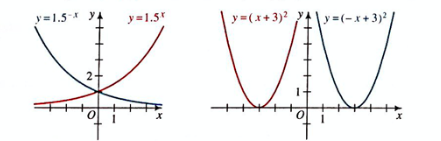
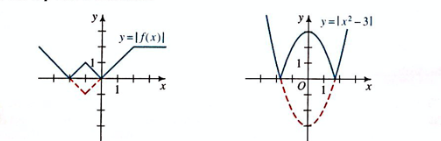
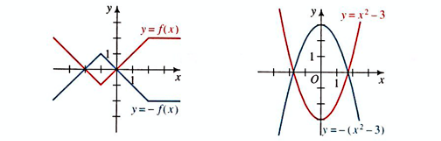
- 1. Reflection in the x-axis: The graph of y=-f(x) is obtained by reflecting the graph of y=f(x) in the x-axis. 2. Reflection when the graph of y=f(x) becomes y=|f(x)|, it means that the parts that dip below the x-axis in the previous graph, bends upward so that none crosses into the negative y-axis. 3. Reflection in the y-axis: the graph of y=f(-x) is obtained by reflecting the graph of y=f(x) in the y-axis. 4. Reflection on the line y=x --> you interchange the x and y coordinates
Periodic Functions; Stretching and Translating Garphs
- The function f is periodic if there is a positive number p, called a period of f, such that f(x+p)=f(x) for all x in domain of f. The smaller period of the function is called the fundamental period
- The Amplitude of a periodic function is given by: A= (M-m)/2 (for a fundamental period with highest point M and lowest point m)
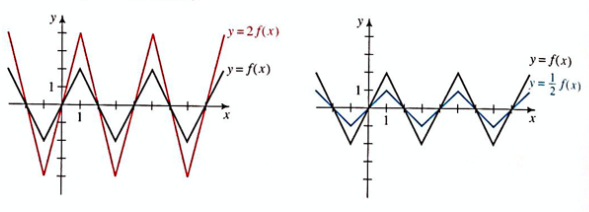
- Vertical Shrink: when y= f(x) becomes y= (1/2)f(x). Vertical Stretch: when y=f(x) becomes y=2f(x)
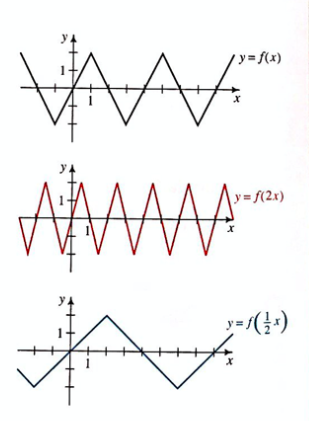
- Horizontal Shrink: when y=f(x) becomes y=f(2x) Horizontal Stretch: when y= f(x) becomes y= f(1/2 x)
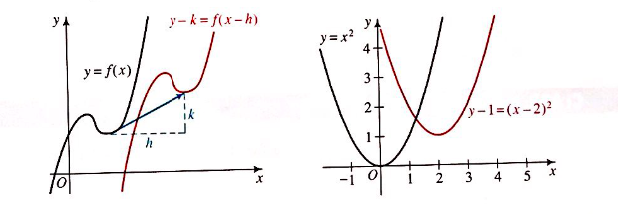
- Translating Graphs
- The graph of y-k=f(x-h) is obtained by translating the graph of y=f(x) horizontally by h units and vertically by k units.
Inverse Functions
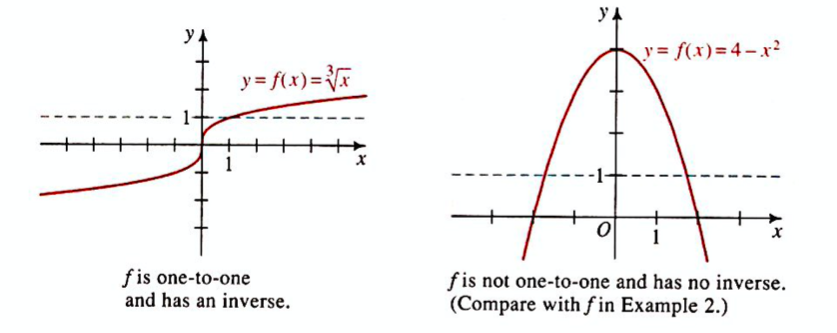
- in order to find the inverse function of y=f(x), swap the y and x coordinates and solve for y. An inverse is always a 1-to-1 function-- each y value corresponds to only 1 x value. (Thus, we must use the Horizontal Line test in order to determine that).
Forming Functions form Verbal descriptions
- Minimum and Maximum values: in many situations, a problem is modeled by a function of more than one variable. By expressing one variable in terms of another, a function of 2 variables can be transformed into a function of one variable.
Bilder und Dateien der Mindmap
Informationen
- Beschreibung
- Mathematics Mindmap am Chapter 4: Functions, erstellt von steph he am 23/12/2020.
- Erstellt von
- steph he
- Aufrufe
- 8
- Bewertung