
Mindmap
ENGLISH PHONETICS & PHONOLOGY
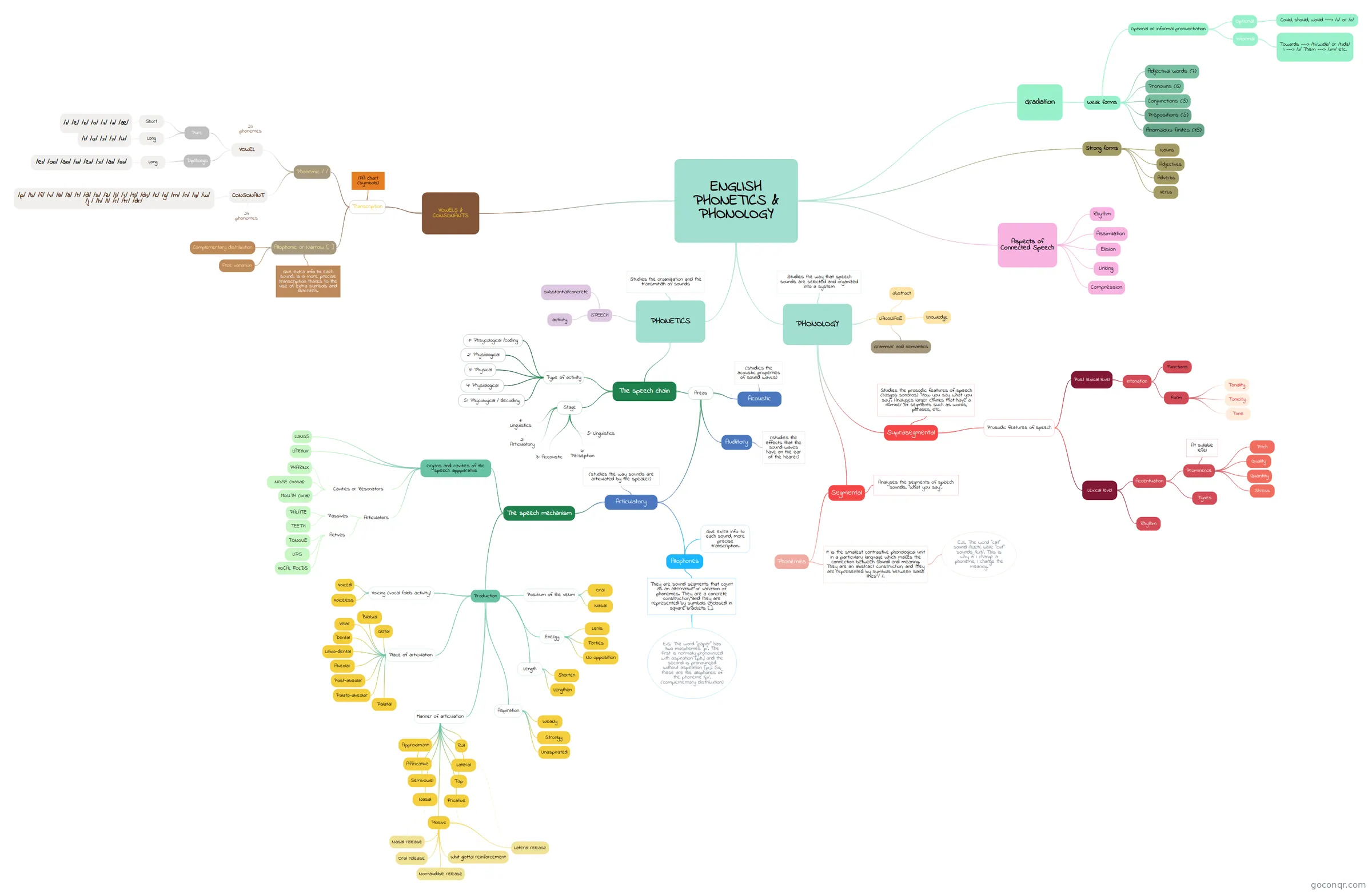
Mind map: English phonetics & phonology
Inhalt der Mindmap
ENGLISH PHONETICS & PHONOLOGY
PHONETICS
- SPEECH
- substantial/concrete
- activity
- Studies the organization and the transmition of sounds
- The speech chain
- Areas
- Acoustic
- (studies the acoustic properties of sound waves)
- Articulatory
- (studies the way sounds are articulated by the speaker)
- Allophones
- They are sound segments that count as an alternative or variation of phonemes. They are a concrete construction, and they are represented by symbols enclosed in square brackets [].
- E.G.: The word "paper" has two morphemes "p". The first is normally pronounced with aspiration [ph] and the second is pronounced without aspiration [p]. So, these are the allophones of the phoneme /p/. (complementary distribution)
- Give extra info to each sound, more precise transcription.
- They are sound segments that count as an alternative or variation of phonemes. They are a concrete construction, and they are represented by symbols enclosed in square brackets [].
- The speech mechanism
- Organs and cavities of the speech appparatus
- LUNGS
- LARYNX
- Cavities or Resonators
- PHARINX
- NOSE (nasal)
- MOUTH (oral)
- Articulators
- Passives
- PALATE
- TEETH
- Actives
- TONGUE
- LIPS
- VOCAL FOLDS
- Passives
- Production
- Place of articulation
- Bilabial
- Labio-dental
- Dental
- Alveolar
- Post-alveolar
- Palato-alveolar
- Palatal
- Velar
- Glotal
- Manner of articulation
- Nasal
- Affricative
- Plosive
- Oral release
- Non-audible release
- Whit glottal reinforcement
- Nasal release
- Lateral release
- Roll
- Tap
- Lateral
- Fricative
- Approximant
- Semivowel
- Voicing (vocal folds activity)
- Voiced
- Voiceless
- Energy
- Lenis
- Forties
- No opposition
- Positium of the velum
- Oral
- Nasal
- Length
- Shorten
- Lengthen
- Aspiration
- Stronlgy
- Unaspirated
- Weakly
- Place of articulation
- Organs and cavities of the speech appparatus
- Auditory
- (studies the effects that the sound waves have on the ear of the hearer)
- Acoustic
- Stage
- 1° Linguistics
- 2° Articulatory
- 3° Accoustic
- 4° Perseption
- 5° Linguistics
- Type of activity
- 1° Phsycological /coding
- 2° Physiological
- 3° Physical
- 4° Physiological
- 5° Phycological / decoding
- Areas
- SPEECH
PHONOLOGY
- LANGUAGE
- abstract
- knowledge
- Grammar and semantics
- Studies the way that speech sounds are selected and organized into a system
- Segmental
- Analyses the segments of speech sounds. "What you say".
- Phonemes
- It is the smallest contrastive phonological unit in a particulary language which makes the connection between sound and meaning. They are an abstract construction, and they are represented by symbols between slash lines / /.
- E.G.: The word "cat" sound /kæt/, while "cut" sounds /kʌt/. This is why, if I change a phoneme, I change the meaning.
- It is the smallest contrastive phonological unit in a particulary language which makes the connection between sound and meaning. They are an abstract construction, and they are represented by symbols between slash lines / /.
- Suprasegmental
- Studies the prosodic features of speech (rasgos sonoros) "How you say what you say". Analyses larger chunks that have a number of segments such as words, phrases, etc.
- Prosodic features of speech
- Lexical level
- Rhythm
- Accentuation
- Prominence
- At syllable level
- Pitch
- Quantity
- Quality
- Stress
- Tyoes
- Prominence
- Post lexical level
- Intonation
- Functions
- Form
- Tonality
- Tonicity
- Tone
- Intonation
- Lexical level
- LANGUAGE
VOWELS & CONSONANTS
- Transcription
- Phonemic / /
- VOWEL
- 20 phonemes
- Pure
- Short
- /ɪ/ /e/ /ɒ/ /ʊ/ /ʌ/ /ə/ /æ/
- Long
- /i:/ /ɑ:/ /ɔ:/ /ɜ:/ /u:/
- Short
- Dipthongs
- Long
- /eɪ/ /oʊ/ /aʊ/ /ɪə/ /eə/ /ɔɪ/ /aɪ/ /ʊə/
- Long
- CONSONANT
- 24 phonemes
- /p/ /b/ /f/ /v/ /θ/ /ð/ /t/ /d/ /s/ /z/ /ʃ/ /ʒ/ /tʃ/ /dʒ/ /k/ /g/ /m/ /n/ /ŋ/ /w/ /j / /h/ /l/ /r/ /tr/ /dr/
- VOWEL
- Allophonic or Narrow [ ]
- Give extra info to each sound. Is a more precise transcription thanks to the use of extra symbols and diacritics.
- Free variation
- Complementary distribution
- IPA chart (symbols)
- Phonemic / /
- Transcription
Aspects of Connected Speech
- Rhythm
- Assimilation
- Elision
- Linking
- Compression
Gradation
- Weak forms
- Adjectival words (7)
- Pronouns (6)
- Conjunctions (5)
- Prepositions (5)
- Anomalous finites (15)
- Optional or informal pronunctiation
- Optional
- Could, should, would ---> /ə/ or /ʊ/
- Informal
- Towards ---> /tʊ`wɔdz/ or /tɔdz/ I ---> /ə/ Them ---> /əm/ etc.
- Optional
- Weak forms
Strong forms
- Nouns
- Adjectives
- Adverbs
- Verbs
Informationen
- Beschreibung
- ingles Mindmap am ENGLISH PHONETICS & PHONOLOGY, erstellt von AGOSTINA GONZALEZ am 16/01/2021.
- Erstellt von
- AGOSTINA GONZALEZ
- Aufrufe
- 7
- Bewertung