
Mindmap
Pronunciation
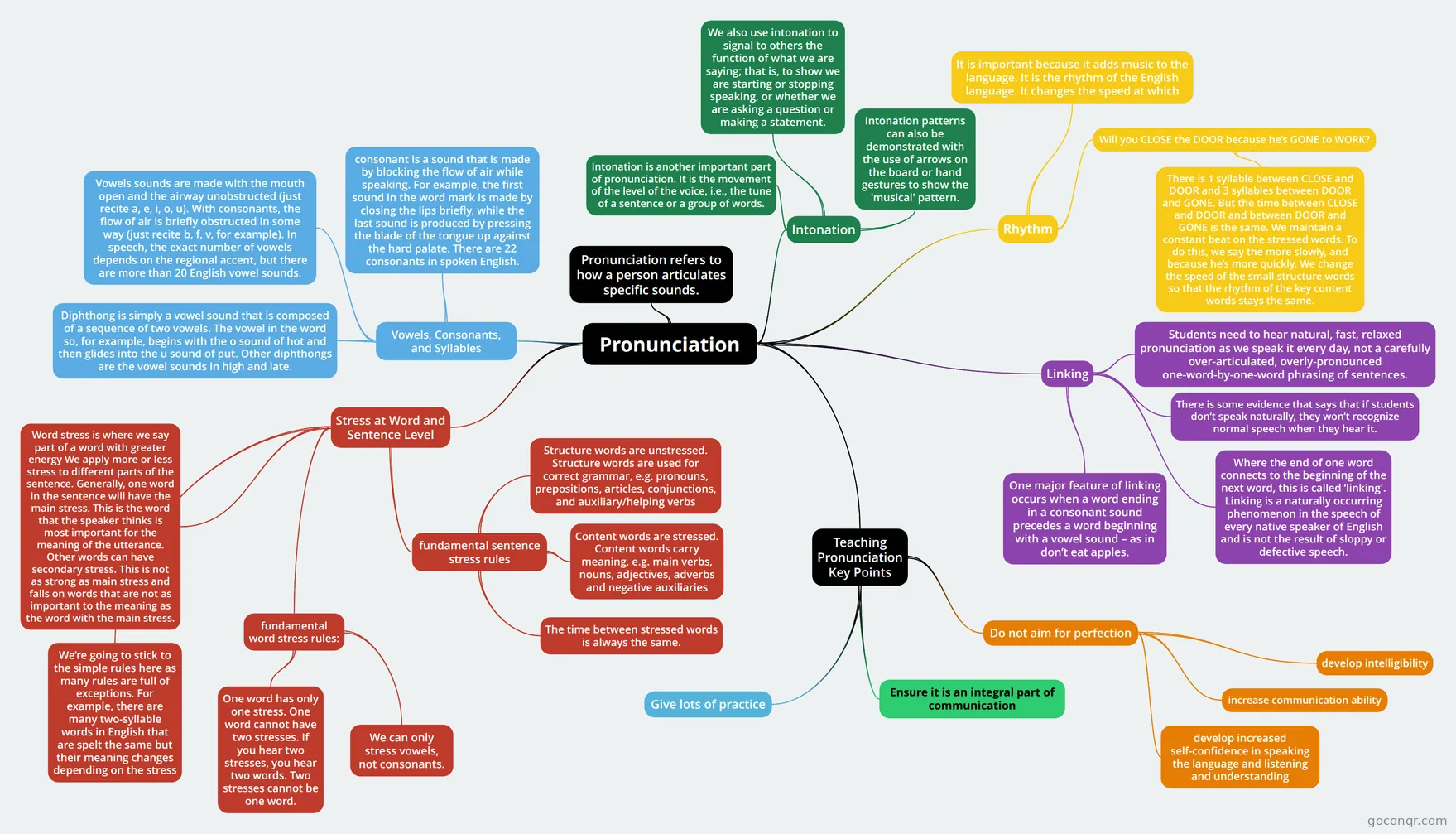
Mind map: English pronunciation
Inhalt der Mindmap
Pronunciation
Pronunciation refers to how a person articulates specific sounds.
Vowels, Consonants, and Syllables
- Vowels sounds are made with the mouth open and the airway unobstructed (just recite a, e, i, o, u). With consonants, the flow of air is briefly obstructed in some way (just recite b, f, v, for example). In speech, the exact number of vowels depends on the regional accent, but there are more than 20 English vowel sounds.
- Diphthong is simply a vowel sound that is composed of a sequence of two vowels. The vowel in the word so, for example, begins with the o sound of hot and then glides into the u sound of put. Other diphthongs are the vowel sounds in high and late.
- consonant is a sound that is made by blocking the flow of air while speaking. For example, the first sound in the word mark is made by closing the lips briefly, while the last sound is produced by pressing the blade of the tongue up against the hard palate. There are 22 consonants in spoken English.
Stress at Word and Sentence Level
- Word stress is where we say part of a word with greater energy We apply more or less stress to different parts of the sentence. Generally, one word in the sentence will have the main stress. This is the word that the speaker thinks is most important for the meaning of the utterance. Other words can have secondary stress. This is not as strong as main stress and falls on words that are not as important to the meaning as the word with the main stress.
- We’re going to stick to the simple rules here as many rules are full of exceptions. For example, there are many two-syllable words in English that are spelt the same but their meaning changes depending on the stress
- fundamental word stress rules:
- One word has only one stress. One word cannot have two stresses. If you hear two stresses, you hear two words. Two stresses cannot be one word.
- We can only stress vowels, not consonants.
- fundamental sentence stress rules
- Content words are stressed. Content words carry meaning, e.g. main verbs, nouns, adjectives, adverbs and negative auxiliaries
- Structure words are unstressed. Structure words are used for correct grammar, e.g. pronouns, prepositions, articles, conjunctions, and auxiliary/helping verbs
- The time between stressed words is always the same.
Intonation
- Intonation is another important part of pronunciation. It is the movement of the level of the voice, i.e., the tune of a sentence or a group of words.
- We also use intonation to signal to others the function of what we are saying; that is, to show we are starting or stopping speaking, or whether we are asking a question or making a statement.
- Intonation patterns can also be demonstrated with the use of arrows on the board or hand gestures to show the 'musical' pattern.
Rhythm
- It is important because it adds music to the language. It is the rhythm of the English language. It changes the speed at which
- Will you CLOSE the DOOR because he’s GONE to WORK?
- There is 1 syllable between CLOSE and DOOR and 3 syllables between DOOR and GONE. But the time between CLOSE and DOOR and between DOOR and GONE is the same. We maintain a constant beat on the stressed words. To do this, we say the more slowly, and because he’s more quickly. We change the speed of the small structure words so that the rhythm of the key content words stays the same.
Linking
- Students need to hear natural, fast, relaxed pronunciation as we speak it every day, not a carefully over-articulated, overly-pronounced one-word-by-one-word phrasing of sentences.
- There is some evidence that says that if students don’t speak naturally, they won’t recognize normal speech when they hear it.
- Where the end of one word connects to the beginning of the next word, this is called ‘linking'. Linking is a naturally occurring phenomenon in the speech of every native speaker of English and is not the result of sloppy or defective speech.
- One major feature of linking occurs when a word ending in a consonant sound precedes a word beginning with a vowel sound – as in don’t eat apples.
Teaching Pronunciation Key Points
- Ensure it is an integral part of communication
- Do not aim for perfection
- develop intelligibility
- increase communication ability
- develop increased self-confidence in speaking the language and listening and understanding
- Give lots of practice
Informationen
- Beschreibung
- TESOL Understand Key Language Elements Mindmap am Pronunciation, erstellt von Shannon McCall am 25/01/2021.
- Erstellt von
- Shannon McCall
- Aufrufe
- 0
- Bewertung