
Mindmap
Creating value through external intellectual property commercialization: a desorptive capacity view
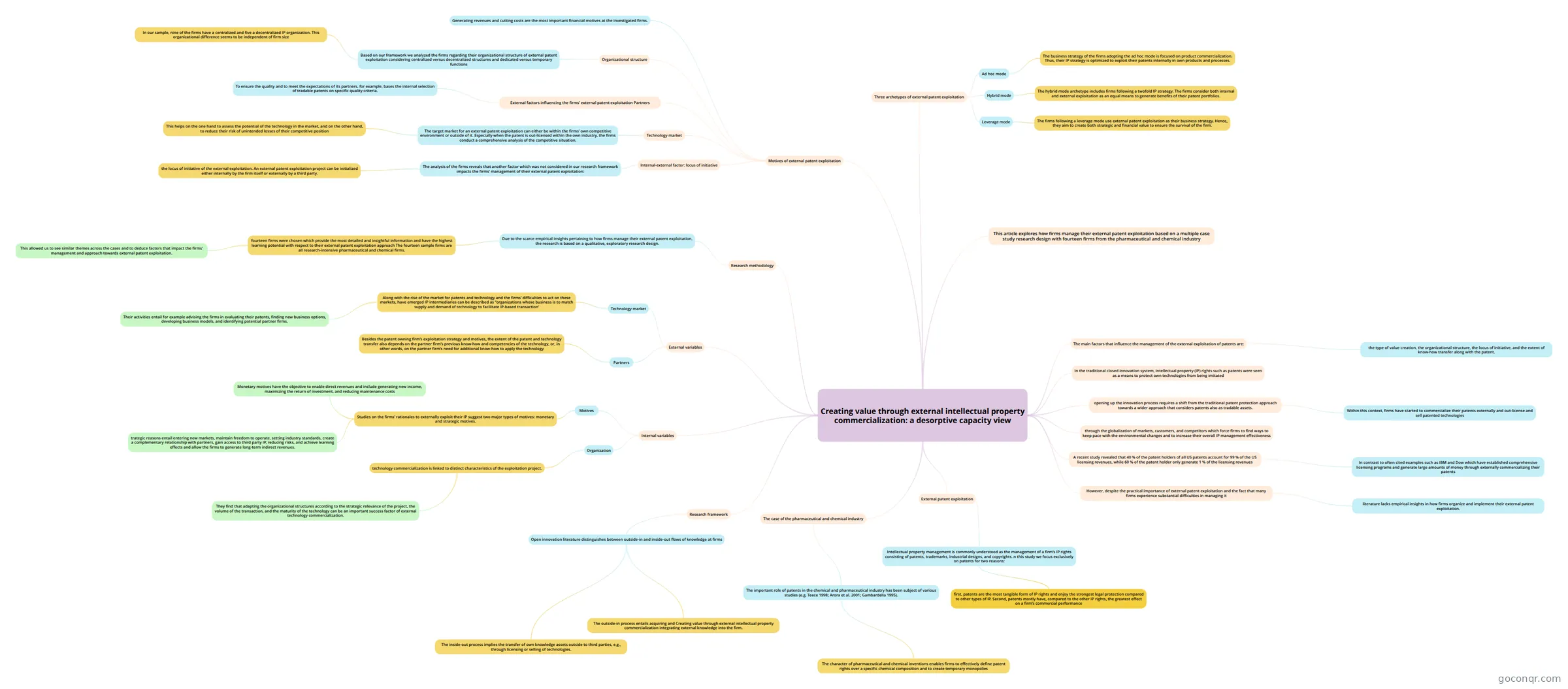
Mind map: external intellectual property commercialization
Inhalt der Mindmap
Creating value through external intellectual property commercialization: a desorptive capacity view
This article explores how firms manage their external patent exploitation based on a multiple case study research design with fourteen firms from the pharmaceutical and chemical industry
The main factors that influence the management of the external exploitation of patents are:
- the type of value creation, the organizational structure, the locus of initiative, and the extent of know-how transfer along with the patent.
In the traditional closed innovation system, intellectual property (IP) rights such as patents were seen as a means to protect own technologies from being imitated
opening up the innovation process requires a shift from the traditional patent protection approach towards a wider approach that considers patents also as tradable assets.
- Within this context, firms have started to commercialize their patents externally and out-license and sell patented technologies
through the globalization of markets, customers, and competitors which force firms to find ways to keep pace with the environmental changes and to increase their overall IP management effectiveness
A recent study revealed that 40 % of the patent holders of all US patents account for 99 % of the US licensing revenues, while 60 % of the patent holder only generate 1 % of the licensing revenues
- In contrast to often cited examples such as IBM and Dow which have established comprehensive licensing programs and generate large amounts of money through externally commercializing their patents
However, despite the practical importance of external patent exploitation and the fact that many firms experience substantial difficulties in managing it
- literature lacks empirical insights in how firms organize and implement their external patent exploitation.
External patent exploitation
- Intellectual property management is commonly understood as the management of a firm’s IP rights consisting of patents, trademarks, industrial designs, and copyrights. n this study we focus exclusively on patents for two reasons:
- first, patents are the most tangible form of IP rights and enjoy the strongest legal protection compared to other types of IP. Second, patents mostly have, compared to the other IP rights, the greatest effect on a firm’s commercial performance
- Intellectual property management is commonly understood as the management of a firm’s IP rights consisting of patents, trademarks, industrial designs, and copyrights. n this study we focus exclusively on patents for two reasons:
The case of the pharmaceutical and chemical industry
- The important role of patents in the chemical and pharmaceutical industry has been subject of various studies (e.g. Teece 1998; Arora et al. 2001; Gambardella 1995).
- The character of pharmaceutical and chemical inventions enables firms to effectively define patent rights over a specific chemical composition and to create temporary monopolies
- The important role of patents in the chemical and pharmaceutical industry has been subject of various studies (e.g. Teece 1998; Arora et al. 2001; Gambardella 1995).
Research framework
- Open innovation literature distinguishes between outside-in and inside-out flows of knowledge at firms
- The outside-in process entails acquiring and Creating value through external intellectual property commercialization integrating external knowledge into the firm.
- The inside-out process implies the transfer of own knowledge assets outside to third parties, e.g., through licensing or selling of technologies.
- Open innovation literature distinguishes between outside-in and inside-out flows of knowledge at firms
Internal variables
- Motives
- Studies on the firms’ rationales to externally exploit their IP suggest two major types of motives: monetary and strategic motives.
- Monetary motives have the objective to enable direct revenues and include generating new income, maximizing the return of investment, and reducing maintenance costs
- trategic reasons entail entering new markets, maintain freedom to operate, setting industry standards, create a complementary relationship with partners, gain access to third party IP, reducing risks, and achieve learning effects and allow the firms to generate long-term indirect revenues.
- Studies on the firms’ rationales to externally exploit their IP suggest two major types of motives: monetary and strategic motives.
- Organization
- technology commercialization is linked to distinct characteristics of the exploitation project.
- They find that adapting the organizational structures according to the strategic relevance of the project, the volume of the transaction, and the maturity of the technology can be an important success factor of external technology commercialization.
- technology commercialization is linked to distinct characteristics of the exploitation project.
- Motives
External variables
- Technology market
- Along with the rise of the market for patents and technology and the firms’ difficulties to act on these markets, have emerged IP intermediaries can be described as ‘‘organizations whose business is to match supply and demand of technology to facilitate IP-based transaction’
- Their activities entail for example advising the firms in evaluating their patents, finding new business options, developing business models, and identifying potential partner firms.
- Along with the rise of the market for patents and technology and the firms’ difficulties to act on these markets, have emerged IP intermediaries can be described as ‘‘organizations whose business is to match supply and demand of technology to facilitate IP-based transaction’
- Partners
- Besides the patent owning firm’s exploitation strategy and motives, the extent of the patent and technology transfer also depends on the partner firm’s previous know-how and competencies of the technology, or, in other words, on the partner firm’s need for additional know-how to apply the technology
- Technology market
Research methodology
- Due to the scarce empirical insights pertaining to how firms manage their external patent exploitation, the research is based on a qualitative, exploratory research design.
- fourteen firms were chosen which provide the most detailed and insightful information and have the highest learning potential with respect to their external patent exploitation approach The fourteen sample firms are all research-intensive pharmaceutical and chemical firms.
- This allowed us to see similar themes across the cases and to deduce factors that impact the firms’ management and approach towards external patent exploitation.
- fourteen firms were chosen which provide the most detailed and insightful information and have the highest learning potential with respect to their external patent exploitation approach The fourteen sample firms are all research-intensive pharmaceutical and chemical firms.
- Due to the scarce empirical insights pertaining to how firms manage their external patent exploitation, the research is based on a qualitative, exploratory research design.
Motives of external patent exploitation
- Generating revenues and cutting costs are the most important financial motives at the investigated firms.
- Organizational structure
- Based on our framework we analyzed the firms regarding their organizational structure of external patent exploitation considering centralized versus decentralized structures and dedicated versus temporary functions
- In our sample, nine of the firms have a centralized and five a decentralized IP organization. This organizational difference seems to be independent of firm size
- Based on our framework we analyzed the firms regarding their organizational structure of external patent exploitation considering centralized versus decentralized structures and dedicated versus temporary functions
- External factors influencing the firms’ external patent exploitation Partners
- To ensure the quality and to meet the expectations of its partners, for example, bases the internal selection of tradable patents on specific quality criteria.
- Technology market
- The target market for an external patent exploitation can either be within the firms’ own competitive environment or outside of it. Especially when the patent is out-licensed within the own industry, the firms conduct a comprehensive analysis of the competitive situation.
- This helps on the one hand to assess the potential of the technology in the market, and on the other hand, to reduce their risk of unintended losses of their competitive position
- The target market for an external patent exploitation can either be within the firms’ own competitive environment or outside of it. Especially when the patent is out-licensed within the own industry, the firms conduct a comprehensive analysis of the competitive situation.
- Internal-external factor: locus of initiative
- The analysis of the firms reveals that another factor which was not considered in our research framework impacts the firms’ management of their external patent exploitation:
- the locus of initiative of the external exploitation. An external patent exploitation project can be initialized either internally by the firm itself or externally by a third party.
- The analysis of the firms reveals that another factor which was not considered in our research framework impacts the firms’ management of their external patent exploitation:
Three archetypes of external patent exploitation
- Ad hoc mode
- The business strategy of the firms adopting the ad hoc mode is focused on product commercialization. Thus, their IP strategy is optimized to exploit their patents internally in own products and processes.
- Hybrid mode
- The hybrid mode archetype includes firms following a twofold IP strategy. The firms consider both internal and external exploitation as an equal means to generate benefits of their patent portfolios.
- Leverage mode
- The firms following a leverage mode use external patent exploitation as their business strategy. Hence, they aim to create both strategic and financial value to ensure the survival of the firm.
- Ad hoc mode
Informationen
- Beschreibung
- 20 admon Mindmap am Creating value through external intellectual property commercialization: a desorptive capacity view, erstellt von Fernanda Navarro am 08/02/2021.
- Erstellt von
- Fernanda Navarro
- Aufrufe
- 5
- Bewertung