
Mindmap
Dissolution of Relationships (Break Down)
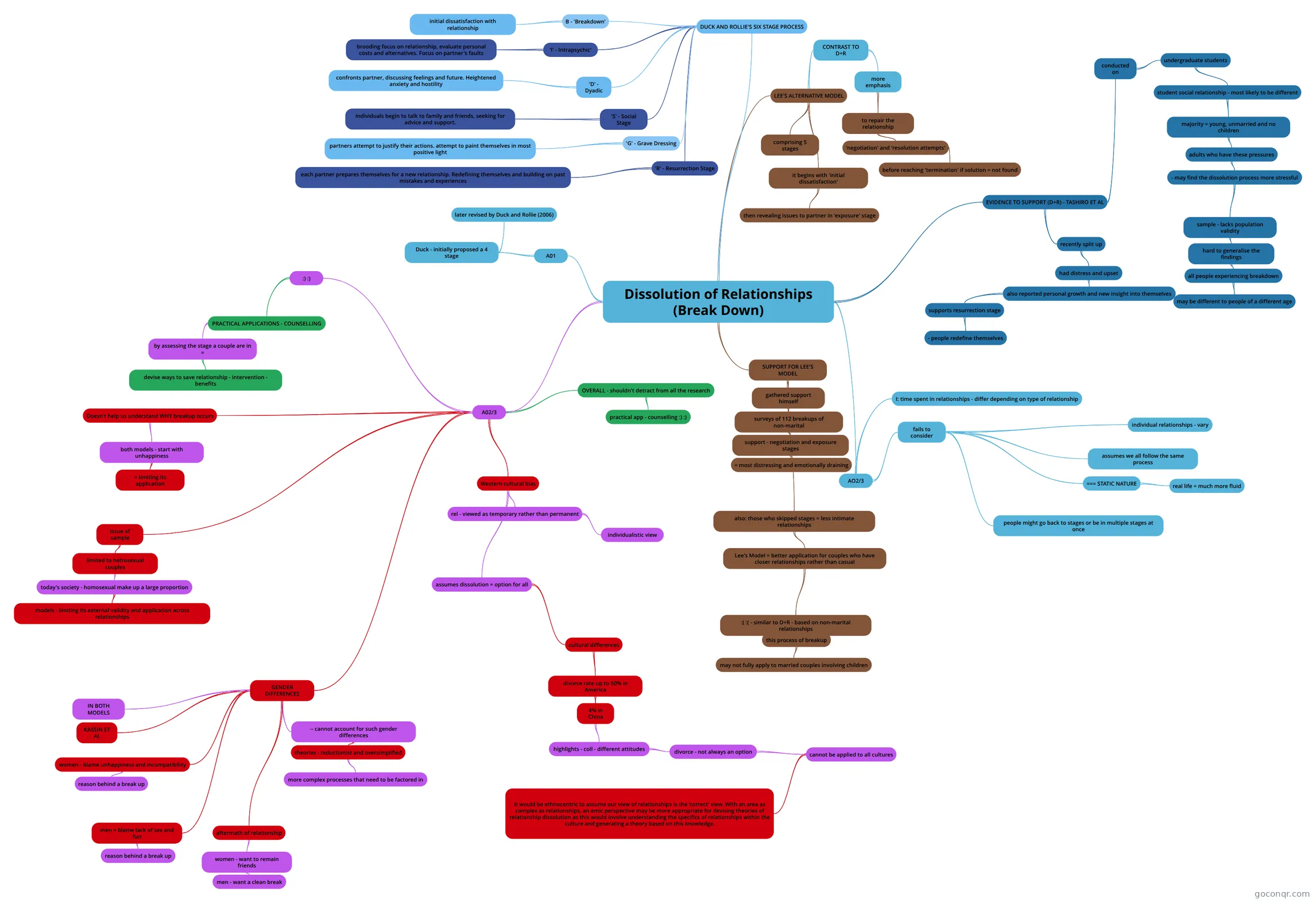
Mind map: Dissolution of relationships (break down)
Inhalt der Mindmap
Dissolution of Relationships (Break Down)
A01
- Duck - initially proposed a 4 stage
- later revised by Duck and Rollie (2006)
- Duck - initially proposed a 4 stage
DUCK AND ROLLIE'S SIX STAGE PROCESS
- B - 'Breakdown'
- initial dissatisfaction with relationship
- 'I' - Intrapsychic'
- brooding focus on relationship, evaluate personal costs and alternatives. Focus on partner's faults
- 'D' - Dyadic
- confronts partner, discussing feelings and future. Heightened anxiety and hostility
- 'S' - Social Stage
- Individuals begin to talk to family and friends, seeking for advice and support.
- 'G' - Grave Dressing
- partners attempt to justify their actions. attempt to paint themselves in most positive light
- 'R' - Resurrection Stage
- each partner prepares themselves for a new relationship. Redefining themselves and building on past mistakes and experiences
- B - 'Breakdown'
LEE'S ALTERNATIVE MODEL
- comprising 5 stages
- it begins with 'initial dissatisfaction'
- then revealing issues to partner in 'exposure' stage
- CONTRAST TO D+R
- more emphasis
- to repair the relationship
- 'negotiation' and 'resolution attempts'
- before reaching 'termination' if solution = not found
- 'negotiation' and 'resolution attempts'
- to repair the relationship
- more emphasis
EVIDENCE TO SUPPORT (D+R) - TASHIRO ET AL
- recently split up
- had distress and upset
- also reported personal growth and new insight into themselves
- supports resurrection stage
- - people redefine themselves
- supports resurrection stage
- also reported personal growth and new insight into themselves
- had distress and upset
- conducted on
- undergraduate students
- student social relationship - most likely to be different
- majority = young, unmarried and no children
- adults who have these pressures
- - may find the dissolution process more stressful
- sample - lacks population validity
- hard to generalise the findings
- all people experiencing breakdown
- may be different to people of a different age
- all people experiencing breakdown
- hard to generalise the findings
- sample - lacks population validity
- - may find the dissolution process more stressful
- adults who have these pressures
- majority = young, unmarried and no children
- student social relationship - most likely to be different
- undergraduate students
- recently split up
AO2/3
- I: time spent in relationships - differ depending on type of relationship
- fails to consider
- individual relationships - vary
- assumes we all follow the same process
- === STATIC NATURE
- real life = much more fluid
- people might go back to stages or be in multiple stages at once
SUPPORT FOR LEE'S MODEL
- gathered support himself
- surveys of 112 breakups of non-marital
- support - negotiation and exposure stages
- = most distressing and emotionally draining
- support - negotiation and exposure stages
- surveys of 112 breakups of non-marital
- also: those who skipped stages = less intimate relationships
- Lee's Model = better application for couples who have closer relationships rather than casual
- :( :( - similar to D+R - based on non-marital relationships
- this process of breakup
- may not fully apply to married couples involving children
- this process of breakup
- :( :( - similar to D+R - based on non-marital relationships
- Lee's Model = better application for couples who have closer relationships rather than casual
- gathered support himself
A02/3
- :) :)
- PRACTICAL APPLICATIONS - COUNSELLING
- by assessing the stage a couple are in =
- devise ways to save relationship - intervention - benefits
- by assessing the stage a couple are in =
- PRACTICAL APPLICATIONS - COUNSELLING
- Doesn't help us understand WHY breakup occurs
- both models - start with unhappiness
- = limiting its application
- both models - start with unhappiness
- issue of sample
- limited to hetrosexual couples
- today's society - homosexual make up a large proportion
- models - limiting its external validity and application across relationships
- today's society - homosexual make up a large proportion
- limited to hetrosexual couples
- GENDER DIFFERENCES
- IN BOTH MODELS
- KASSIN ET AL
- women - blame unhappiness and incompatibility
- reason behind a break up
- men = blame lack of sex and fun
- reason behind a break up
- aftermath of relationship
- women - want to remain friends
- men - want a clean break
- women - want to remain friends
- -- cannot account for such gender differences
- theories - reductionist and oversimplified
- more complex processes that need to be factored in
- theories - reductionist and oversimplified
- Western cultural bias
- rel - viewed as temporary rather than permanent
- individualistic view
- assumes dissolution = option for all
- cultural differences
- divorce rate up to 50% in America
- 4% in China
- highlights - coll - different attitudes
- divorce - not always an option
- cannot be applied to all cultures
- It would be ethnocentric to assume our view of relationships is the ‘correct’ view. With an area as complex as relationships, an emic perspective may be more appropriate for devising theories of relationship dissolution as this would involve understanding the specifics of relationships within the culture and generating a theory based on this knowledge.
- cannot be applied to all cultures
- divorce - not always an option
- highlights - coll - different attitudes
- 4% in China
- divorce rate up to 50% in America
- cultural differences
- rel - viewed as temporary rather than permanent
- OVERALL - shouldn't detract from all the research
- practical app - counselling :) :)
- :) :)
Informationen
- Beschreibung
- Mindmap am Dissolution of Relationships (Break Down), erstellt von emilie jones am 04/06/2015.
- Erstellt von
- emilie jones
- Aufrufe
- 0
- Bewertung
Mehr zu Relationship breakdown