
Mindmap
sexual selection and human reproductive behaviour
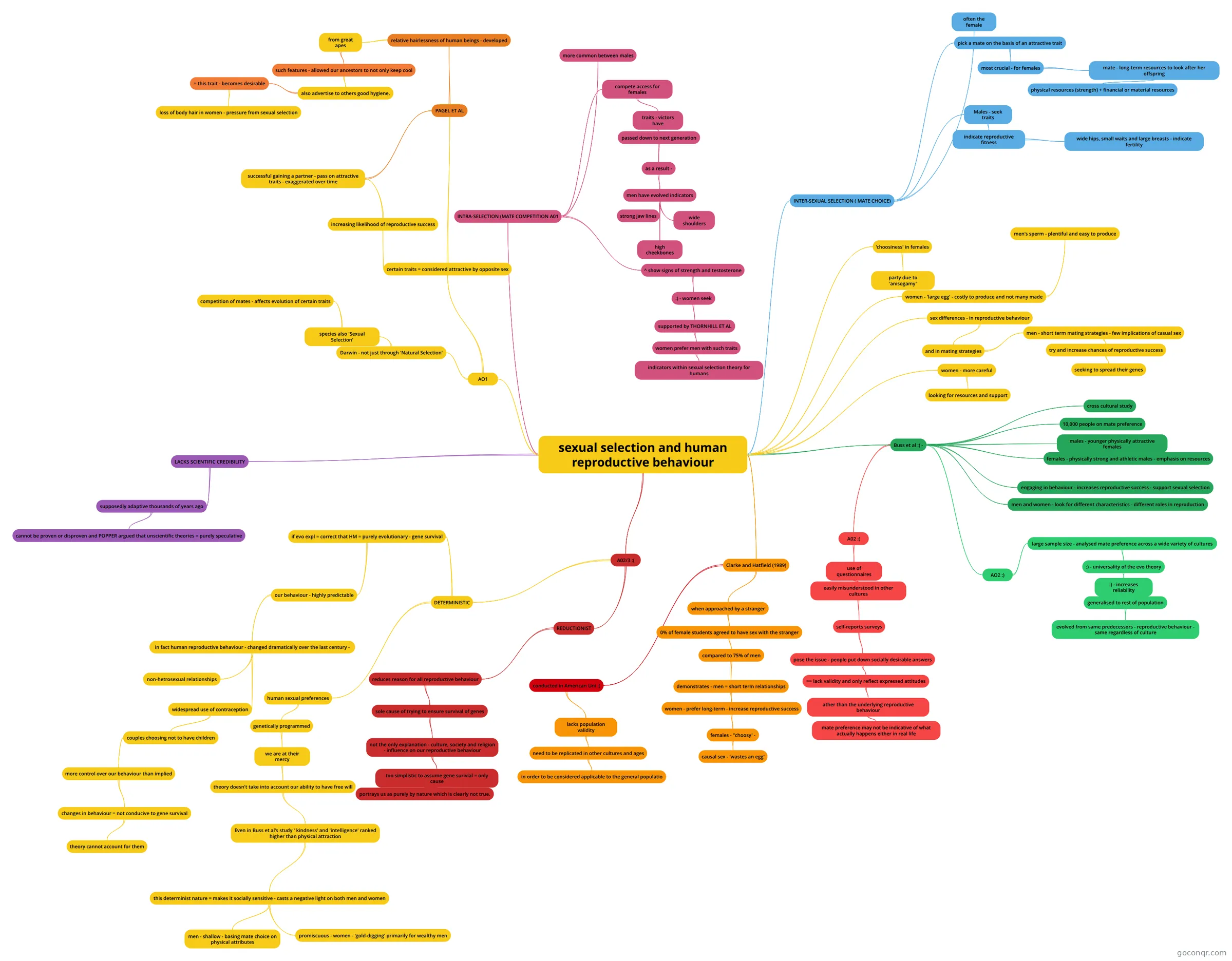
Mind map: sexual selection and human reproductive behaviour
Inhalt der Mindmap
sexual selection and human reproductive behaviour
AO1
- Darwin - not just through 'Natural Selection'
- species also 'Sexual Selection'
- competition of mates - affects evolution of certain traits
- species also 'Sexual Selection'
- certain traits = considered attractive by opposite sex
- increasing likelihood of reproductive success
- successful gaining a partner - pass on attractive traits - exaggerated over time
- PAGEL ET AL
- relative hairlessness of human beings - developed
- from great apes
- such features - allowed our ancestors to not only keep cool
- also advertise to others good hygiene.
- = this trait - becomes desirable
- loss of body hair in women - pressure from sexual selection
- = this trait - becomes desirable
- also advertise to others good hygiene.
- such features - allowed our ancestors to not only keep cool
- from great apes
- relative hairlessness of human beings - developed
- PAGEL ET AL
- successful gaining a partner - pass on attractive traits - exaggerated over time
- increasing likelihood of reproductive success
- Darwin - not just through 'Natural Selection'
INTRA-SELECTION (MATE COMPETITION A01
- more common between males
- compete access for females
- traits - victors have
- passed down to next generation
- as a result -
- men have evolved indicators
- strong jaw lines
- high cheekbones
- wide shoulders
- men have evolved indicators
- as a result -
- passed down to next generation
- traits - victors have
- ^ show signs of strength and testosterone
- :) - women seek
- supported by THORNHILL ET AL
- women prefer men with such traits
- indicators within sexual selection theory for humans
- women prefer men with such traits
- supported by THORNHILL ET AL
- :) - women seek
INTER-SEXUAL SELECTION ( MATE CHOICE)
- often the female
- pick a mate on the basis of an attractive trait
- most crucial - for females
- mate - long-term resources to look after her offspring
- physical resources (strength) + financial or material resources
- mate - long-term resources to look after her offspring
- most crucial - for females
- Males - seek traits
- indicate reproductive fitness
- wide hips, small waits and large breasts - indicate fertility
- indicate reproductive fitness
'choosiness' in females
- party due to 'anisogamy'
women - 'large egg' - costly to produce and not many made
- men's sperm - plentiful and easy to produce
sex differences - in reproductive behaviour
- and in mating strategies
- men - short term mating strategies - few implications of casual sex
- try and increase chances of reproductive success
- seeking to spread their genes
- try and increase chances of reproductive success
- men - short term mating strategies - few implications of casual sex
- and in mating strategies
women - more careful
- looking for resources and support
Buss et al :) -
- cross cultural study
- 10,000 people on mate preference
- males - younger physically attractive females
- females - physically strong and athletic males - emphasis on resources
- engaging in behaviour - increases reproductive success - support sexual selection
- men and women - look for different characteristics - different roles in reproduction
- AO2 :)
- large sample size - analysed mate preference across a wide variety of cultures
- :) - universality of the evo theory
- :) - increases reliability
- generalised to rest of population
- evolved from same predecessors - reproductive behaviour - same regardless of culture
- generalised to rest of population
- :) - increases reliability
- :) - universality of the evo theory
- large sample size - analysed mate preference across a wide variety of cultures
- A02 :(
- use of questionnaires
- easily misunderstood in other cultures
- self-reports surveys
- pose the issue - people put down socially desirable answers
- == lack validity and only reflect expressed attitudes
- ather than the underlying reproductive behaviour
- mate preference may not be indicative of what actually happens either in real life
- ather than the underlying reproductive behaviour
- == lack validity and only reflect expressed attitudes
- pose the issue - people put down socially desirable answers
- self-reports surveys
- easily misunderstood in other cultures
- use of questionnaires
Clarke and Hatfield (1989)
- when approached by a stranger
- 0% of female students agreed to have sex with the stranger
- compared to 75% of men
- demonstrates - men = short term relationships
- women - prefer long-term - increase reproductive success
- females - ''choosy' -
- causal sex - 'wastes an egg'
- females - ''choosy' -
- women - prefer long-term - increase reproductive success
- demonstrates - men = short term relationships
- compared to 75% of men
- 0% of female students agreed to have sex with the stranger
- conducted in American Uni :(
- lacks population validity
- need to be replicated in other cultures and ages
- in order to be considered applicable to the general populatio
- need to be replicated in other cultures and ages
- lacks population validity
- when approached by a stranger
A02/3 :(
- REDUCTIONIST
- reduces reason for all reproductive behaviour
- sole cause of trying to ensure survival of genes
- not the only explanation - culture, society and religion - influence on our reproductive behaviour
- too simplistic to assume gene surivial = only cause
- portrays us as purely by nature which is clearly not true.
- too simplistic to assume gene surivial = only cause
- not the only explanation - culture, society and religion - influence on our reproductive behaviour
- sole cause of trying to ensure survival of genes
- reduces reason for all reproductive behaviour
- DETERMINISTIC
- human sexual preferences
- genetically programmed
- we are at their mercy
- theory doesn't take into account our ability to have free will
- Even in Buss et al's study ' kindness' and 'intelligence' ranked higher than physical attraction
- this determinist nature = makes it socially sensitive - casts a negative light on both men and women
- men - shallow - basing mate choice on physical attributes
- promiscuous - women - 'gold-digging' primarily for wealthy men
- this determinist nature = makes it socially sensitive - casts a negative light on both men and women
- Even in Buss et al's study ' kindness' and 'intelligence' ranked higher than physical attraction
- theory doesn't take into account our ability to have free will
- we are at their mercy
- genetically programmed
- if evo expl = correct that HM = purely evolutionary - gene survival
- our behaviour - highly predictable
- in fact human reproductive behaviour - changed dramatically over the last century -
- non-hetrosexual relationships
- widespread use of contraception
- couples choosing not to have children
- more control over our behaviour than implied
- changes in behaviour = not conducive to gene survival
- theory cannot account for them
- changes in behaviour = not conducive to gene survival
- more control over our behaviour than implied
- couples choosing not to have children
- in fact human reproductive behaviour - changed dramatically over the last century -
- our behaviour - highly predictable
- human sexual preferences
- REDUCTIONIST
LACKS SCIENTIFIC CREDIBILITY
- supposedly adaptive thousands of years ago
- cannot be proven or disproven and POPPER argued that unscientific theories = purely speculative
- supposedly adaptive thousands of years ago
Informationen
- Beschreibung
- Mindmap am sexual selection and human reproductive behaviour, erstellt von emilie jones am 04/06/2015.
- Erstellt von
- emilie jones
- Aufrufe
- 1
- Bewertung
Mehr zu Sexual selection and partner preferences