
Mindmap
Energy from the nucleus
Inhalt der Mindmap
Energy from the nucleus
Atoms and radiation
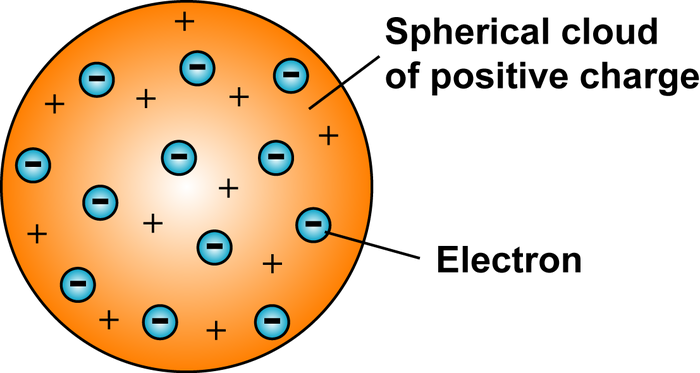
- Based on his discovery, Thompson adapted Dalton's model of the atom.
- He suggested that an atom is a positively-charged sphere with negative electrons distributed throughout it.
- Thomson's model became known as the plum pudding model.
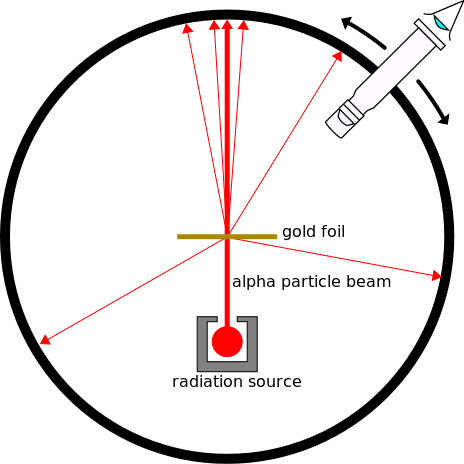
- Geiger and Marsden's experiment.
- 1. Most alpha particles went straight through the gold foil, without any deflection because the atom is mostly empty space.
- 2. Some alpha particles were slightly deflected by the gold foil.
- 3. A few alpha particles were bounced back from the gold foil.
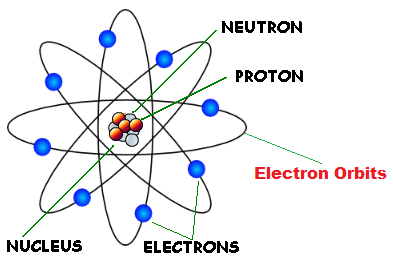
- Rutherford's nuclear model of the atom:
- He suggested that an atom is mostly empty space with its positive charge and most of its mass in a tiny central nucleus.
- Electrons orbited this nucleus at a distance, like the planets around the Sun.
- He suggested that an atom is mostly empty space with its positive charge and most of its mass in a tiny central nucleus.
Alpha, Beta and Gamma radiation
- Alpha decay is the release of an alpha particle, which consists of two protons and two neutrons.
- This occurs in heavy elements such as uranium and radium. Their nuclei are unstable and so, by releasing alpha particles, they become more stable.
- In beta decay, a neutron in the nucleus of an unstable atom spontaneously decays to form a proton and an electron.
- The "new" proton stays in the nucleus. The "new" electron is released from the nucleus and is called a beta particle.
- If a nucleus still has energy after releasing alpha or beta particles, it can get rid of the extra energy by releasing a gamma ray.
- Gamma rays are a form of electromagnetic radiation and may be emitted alongside alpha and beta particles.
- Alpha decay is the release of an alpha particle, which consists of two protons and two neutrons.
Half-life: The half-life of a radioactive element is the time that it takes half the atoms in a sample to decay.
- For example, the half-life of carbon-14 is 5,700 years. If a fossil bone has a count of 25 and a piece of bone from a living body has a count of 200, how old is the fossil?
- After one half-life, the count will decrease by half to 100.
- After the second half-life, the count decreases by half again to 50.
- After the third half-life, the count decreases to 25.
- Three half-lives of carbon-14 have passed, so 3 x 5,700 years makes the fossil 17,100 years old.
- After the third half-life, the count decreases to 25.
- After the second half-life, the count decreases by half again to 50.
- After one half-life, the count will decrease by half to 100.
- For example, the half-life of carbon-14 is 5,700 years. If a fossil bone has a count of 25 and a piece of bone from a living body has a count of 200, how old is the fossil?
Nuclear fission
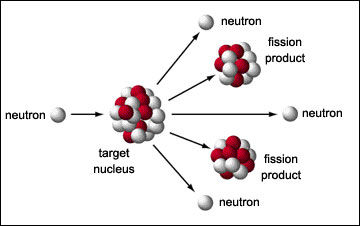
- 1. For nuclear fission to occur, the nucleus of an atom must first absorb a neutron. When the nucleus splits, it releases two or three neutrons. This is that start of a chain reaction.
- 2. The released neutrons can cause fission to occur in other nuclei. This produces even more neutrons, which can continue the chain reaction.
- 3. As each fission occurs, more and more neutrons are produced. If more neutrons are produced than are absorbed, the chain reaction can get out of control.
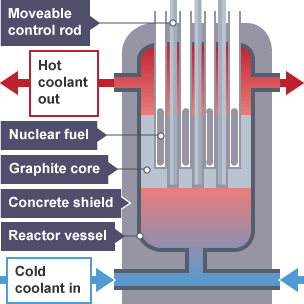
- For nuclear fission to start in a reactor, a uranium-235 atom must not absorb a low speed neutron. High speed neutrons are not as readily absorbed by uranium nuclei.
- However, high speed neutrons are released during fission. The reactor's graphite core slows down the released neutrons so the chain reaction can keep going.
- Control rods made of boron absorbs excess neutrons to prevent chain reactions getting out of control.
- However, high speed neutrons are released during fission. The reactor's graphite core slows down the released neutrons so the chain reaction can keep going.
Nuclear fusion
- 1. In a fusion reactor, nuclear fusion would involve two isotopes of hydrogen - deuterium and tritium.
- 2. The deuterium and tritium nuclei are forced together. The fused nuclei then break apart to form a helium nucleus and a neutron, which contains most of the energy released.
- Advantages:
- Abundant fuels - Deuterium can be extracted from water and tritium is made from lithium, which is readily available.
- Small amounts of fuel - 10g of deuterium and 15g of tritium could produce enough energy for the lifetime of an average person in an industrialised country.
- Clean - No greenhouse or other polluting gases are made.
- Safe - No need to keep chain reactions under control.
- Less radioactive waste - The products of nuclear fusion are not radioactive, although the reactor walls will absorb neutrons and become radioactive.
- No weapons material produced - The products are not suitable for making nuclear weapons.
Star cycle
- Nebula - A star is born in a huge, cold cloud of gas and dust called a nebula.
- Main sequence - Hydrogen fuses to form helium which releases energy and causes the star to shine.
- Red giants - When the hydrogen is used up, the helium core collapses and the outer layer expands and cools. The star shines less brightly and is now called a red giant.
- White dwarfs - After a small star, like our Sun, has become a red giant, its outer layer drifts away into space. The hot, dense core that remains is called a white dwarf.
- Black dwarf - The white dwarf cools and eventually stops shining.
- White dwarfs - After a small star, like our Sun, has become a red giant, its outer layer drifts away into space. The hot, dense core that remains is called a white dwarf.
- Red supergiant
- Supernova - The collapse of this core caused a huge explosion called a supernova.
- Black hole - The difference for really massive stars is that the core of the neutron star collapses further and this results in a black hole.
- Neutron star - The remains of the core forms a tiny, very dense neutron star.
- Supernova - The collapse of this core caused a huge explosion called a supernova.
- Red giants - When the hydrogen is used up, the helium core collapses and the outer layer expands and cools. The star shines less brightly and is now called a red giant.
- Main sequence - Hydrogen fuses to form helium which releases energy and causes the star to shine.
- Nebula - A star is born in a huge, cold cloud of gas and dust called a nebula.
Bilder und Dateien der Mindmap
Informationen
- Beschreibung
- Mindmap am Energy from the nucleus, erstellt von Emily852 am 14/06/2015.
- Erstellt von
- Emily852
- Aufrufe
- 0
- Bewertung