
Mindmap
data type
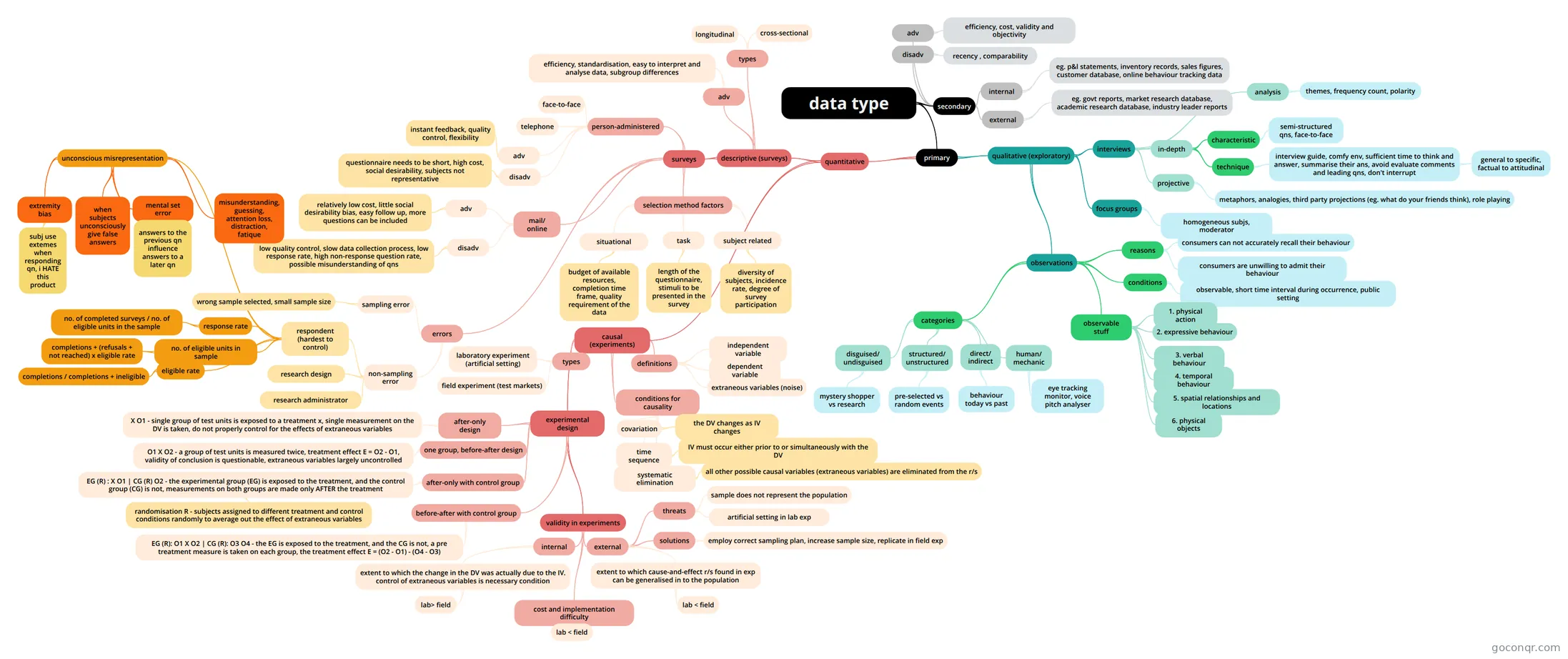
Mind map: data type
Inhalt der Mindmap
data type
secondary
- internal
- eg. p&l statements, inventory records, sales figures, customer database, online behaviour tracking data
- external
- eg. govt reports, market research database, academic research database, industry leader reports
- adv
- efficiency, cost, validity and objectivity
- disadv
- recency , comparability
- internal
primary
- qualitative (exploratory)
- interviews
- in-depth
- characteristic
- semi-structured qns, face-to-face
- technique
- interview guide, comfy env, sufficient time to think and answer, summarise their ans, avoid evaluate comments and leading qns, don't interrupt
- general to specific, factual to attitudinal
- interview guide, comfy env, sufficient time to think and answer, summarise their ans, avoid evaluate comments and leading qns, don't interrupt
- characteristic
- projective
- metaphors, analogies, third party projections (eg. what do your friends think), role playing
- analysis
- themes, frequency count, polarity
- in-depth
- focus groups
- homogeneous subjs, moderator
- observations
- reasons
- consumers can not accurately recall their behaviour
- consumers are unwilling to admit their behaviour
- conditions
- observable, short time interval during occurrence, public setting
- observable stuff
- 1. physical action
- 2. expressive behaviour
- 3. verbal behaviour
- 4. temporal behaviour
- 5. spatial relationships and locations
- 6. physical objects
- categories
- direct/ indirect
- behaviour today vs past
- disguised/ undisguised
- mystery shopper vs research
- human/ mechanic
- eye tracking monitor, voice pitch analyser
- structured/ unstructured
- pre-selected vs random events
- direct/ indirect
- reasons
- interviews
- quantitative
- descriptive (surveys)
- types
- cross-sectional
- longitudinal
- adv
- efficiency, standardisation, easy to interpret and analyse data, subgroup differences
- surveys
- person-administered
- face-to-face
- telephone
- adv
- instant feedback, quality control, flexibility
- disadv
- questionnaire needs to be short, high cost, social desirability, subjects not representative
- mail/ online
- adv
- relatively low cost, little social desirability bias, easy follow up, more questions can be included
- disadv
- low quality control, slow data collection process, low response rate, high non-response question rate, possible misunderstanding of qns
- adv
- selection method factors
- situational
- budget of available resources, completion time frame, quality requirement of the data
- task
- length of the questionnaire, stimuli to be presented in the survey
- subject related
- diversity of subjects, incidence rate, degree of survey participation
- situational
- errors
- sampling error
- wrong sample selected, small sample size
- non-sampling error
- respondent (hardest to control)
- response rate
- no. of completed surveys / no. of eligible units in the sample
- no. of eligible units in sample
- completions + (refusals + not reached) x eligible rate
- eligible rate
- completions / completions + ineligible
- unconscious misrepresentation
- when subjects unconsciously give false answers
- extremity bias
- subj use extemes when responding qn, i HATE this product
- misunderstanding, guessing, attention loss, distraction, fatique
- mental set error
- answers to the previous qn influence answers to a later qn
- response rate
- research design
- research administrator
- respondent (hardest to control)
- sampling error
- person-administered
- types
- causal (experiments)
- definitions
- independent variable
- dependent variable
- extraneous variables (noise)
- types
- laboratory experiment (artificial setting)
- field experiment (test markets)
- conditions for causality
- covariation
- the DV changes as IV changes
- time sequence
- IV must occur either prior to or simultaneously with the DV
- systematic elimination
- all other possible causal variables (extraneous variables) are eliminated from the r/s
- covariation
- experimental design
- after-only design
- X O1 - single group of test units is exposed to a treatment x, single measurement on the DV is taken, do not properly control for the effects of extraneous variables
- one group, before-after design
- O1 X O2 - a group of test units is measured twice, treatment effect E = O2 - O1, validity of conclusion is questionable, extraneous variables largely uncontrolled
- after-only with control group
- EG (R) : X O1 | CG (R) O2 - the experimental group (EG) is exposed to the treatment, and the control group (CG) is not, measurements on both groups are made only AFTER the treatment
- randomisation R - subjects assigned to different treatment and control conditions randomly to average out the effect of extraneous variables
- EG (R) : X O1 | CG (R) O2 - the experimental group (EG) is exposed to the treatment, and the control group (CG) is not, measurements on both groups are made only AFTER the treatment
- before-after with control group
- EG (R): O1 X O2 | CG (R): O3 O4 - the EG is exposed to the treatment, and the CG is not, a pre treatment measure is taken on each group, the treatment effect E = (O2 - O1) - (O4 - O3)
- validity in experiments
- internal
- extent to which the change in the DV was actually due to the IV. control of extraneous variables is necessary condition
- lab> field
- extent to which the change in the DV was actually due to the IV. control of extraneous variables is necessary condition
- external
- extent to which cause-and-effect r/s found in exp can be generalised in to the population
- lab < field
- threats
- sample does not represent the population
- artificial setting in lab exp
- solutions
- employ correct sampling plan, increase sample size, replicate in field exp
- extent to which cause-and-effect r/s found in exp can be generalised in to the population
- cost and implementation difficulty
- lab < field
- internal
- after-only design
- definitions
- descriptive (surveys)
- qualitative (exploratory)
Informationen
- Beschreibung
- Mindmap am data type, erstellt von Joline Lim am 16/06/2015.
- Erstellt von
- Joline Lim
- Aufrufe
- 1
- Bewertung