
Mindmap
3 models of "decision making"
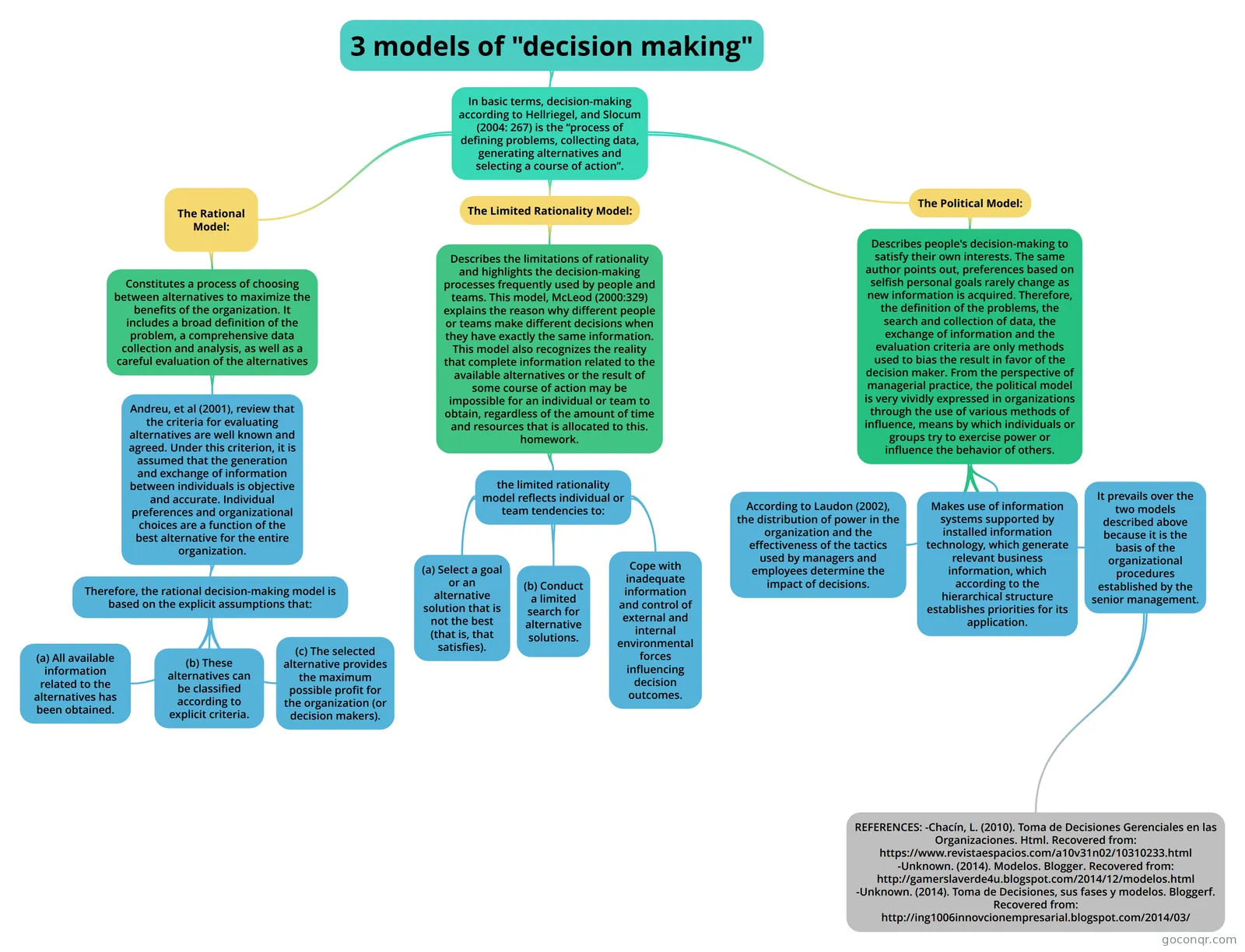
Mind map: 3 models of decision making
Inhalt der Mindmap
3 models of "decision making"
In basic terms, decision-making according to Hellriegel, and Slocum (2004: 267) is the “process of defining problems, collecting data, generating alternatives and selecting a course of action”.
- The Rational Model:
- Constitutes a process of choosing between alternatives to maximize the benefits of the organization. It includes a broad definition of the problem, a comprehensive data collection and analysis, as well as a careful evaluation of the alternatives
- Andreu, et al (2001), review that the criteria for evaluating alternatives are well known and agreed. Under this criterion, it is assumed that the generation and exchange of information between individuals is objective and accurate. Individual preferences and organizational choices are a function of the best alternative for the entire organization.
- Therefore, the rational decision-making model is based on the explicit assumptions that:
- (a) All available information related to the alternatives has been obtained.
- (b) These alternatives can be classified according to explicit criteria.
- (c) The selected alternative provides the maximum possible profit for the organization (or decision makers).
- Therefore, the rational decision-making model is based on the explicit assumptions that:
- Andreu, et al (2001), review that the criteria for evaluating alternatives are well known and agreed. Under this criterion, it is assumed that the generation and exchange of information between individuals is objective and accurate. Individual preferences and organizational choices are a function of the best alternative for the entire organization.
- Constitutes a process of choosing between alternatives to maximize the benefits of the organization. It includes a broad definition of the problem, a comprehensive data collection and analysis, as well as a careful evaluation of the alternatives
- The Limited Rationality Model:
- Describes the limitations of rationality and highlights the decision-making processes frequently used by people and teams. This model, McLeod (2000:329) explains the reason why different people or teams make different decisions when they have exactly the same information. This model also recognizes the reality that complete information related to the available alternatives or the result of some course of action may be impossible for an individual or team to obtain, regardless of the amount of time and resources that is allocated to this. homework.
- the limited rationality model reflects individual or team tendencies to:
- (a) Select a goal or an alternative solution that is not the best (that is, that satisfies).
- (b) Conduct a limited search for alternative solutions.
- Cope with inadequate information and control of external and internal environmental forces influencing decision outcomes.
- the limited rationality model reflects individual or team tendencies to:
- Describes the limitations of rationality and highlights the decision-making processes frequently used by people and teams. This model, McLeod (2000:329) explains the reason why different people or teams make different decisions when they have exactly the same information. This model also recognizes the reality that complete information related to the available alternatives or the result of some course of action may be impossible for an individual or team to obtain, regardless of the amount of time and resources that is allocated to this. homework.
- The Political Model:
- Describes people's decision-making to satisfy their own interests. The same author points out, preferences based on selfish personal goals rarely change as new information is acquired. Therefore, the definition of the problems, the search and collection of data, the exchange of information and the evaluation criteria are only methods used to bias the result in favor of the decision maker. From the perspective of managerial practice, the political model is very vividly expressed in organizations through the use of various methods of influence, means by which individuals or groups try to exercise power or influence the behavior of others.
- According to Laudon (2002), the distribution of power in the organization and the effectiveness of the tactics used by managers and employees determine the impact of decisions.
- Makes use of information systems supported by installed information technology, which generate relevant business information, which according to the hierarchical structure establishes priorities for its application.
- It prevails over the two models described above because it is the basis of the organizational procedures established by the senior management.
- REFERENCES: -Chacín, L. (2010). Toma de Decisiones Gerenciales en las Organizaciones. Html. Recovered from: https://www.revistaespacios.com/a10v31n02/10310233.html -Unknown. (2014). Modelos. Blogger. Recovered from: http://gamerslaverde4u.blogspot.com/2014/12/modelos.html -Unknown. (2014). Toma de Decisiones, sus fases y modelos. Bloggerf. Recovered from: http://ing1006innovcionempresarial.blogspot.com/2014/03/
- Describes people's decision-making to satisfy their own interests. The same author points out, preferences based on selfish personal goals rarely change as new information is acquired. Therefore, the definition of the problems, the search and collection of data, the exchange of information and the evaluation criteria are only methods used to bias the result in favor of the decision maker. From the perspective of managerial practice, the political model is very vividly expressed in organizations through the use of various methods of influence, means by which individuals or groups try to exercise power or influence the behavior of others.
- The Rational Model:
Informationen
- Beschreibung
- Mindmap am 3 models of "decision making", erstellt von Alejandra Jimenez Cauich am 13/04/2021.
- Erstellt von
- Alejandra Jimenez Cauich
- Aufrufe
- 2
- Bewertung
Mehr zu Decision-Making Models