
Mindmap
Will, would and use to
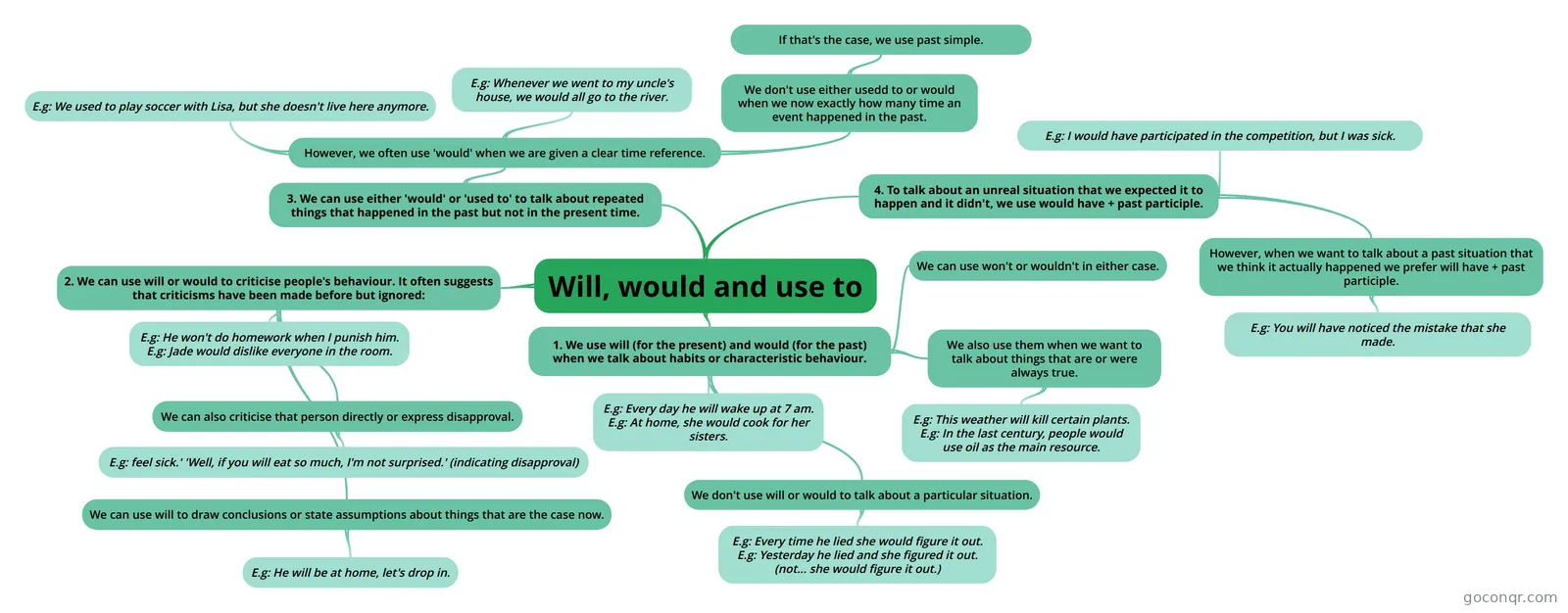
Mind map: Will, would and used to
Inhalt der Mindmap
Will, would and use to
1. We use will (for the present) and would (for the past) when we talk about habits or characteristic behaviour.
- E.g: Every day he will wake up at 7 am. E.g: At home, she would cook for her sisters.
- We also use them when we want to talk about things that are or were always true.
- E.g: This weather will kill certain plants. E.g: In the last century, people would use oil as the main resource.
- We don't use will or would to talk about a particular situation.
- E.g: Every time he lied she would figure it out. E.g: Yesterday he lied and she figured it out. (not... she would figure it out.)
- We can use won't or wouldn't in either case.
2. We can use will or would to criticise people's behaviour. It often suggests that criticisms have been made before but ignored:
- E.g: He won't do homework when I punish him. E.g: Jade would dislike everyone in the room.
- We can also criticise that person directly or express disapproval.
- E.g: feel sick.' 'Well, if you will eat so much, I'm not surprised.' (indicating disapproval)
- We can use will to draw conclusions or state assumptions about things that are the case now.
- E.g: He will be at home, let's drop in.
3. We can use either 'would' or 'used to' to talk about repeated things that happened in the past but not in the present time.
- However, we often use 'would' when we are given a clear time reference.
- E.g: We used to play soccer with Lisa, but she doesn't live here anymore.
- E.g: Whenever we went to my uncle's house, we would all go to the river.
- We don't use either usedd to or would when we now exactly how many time an event happened in the past.
- If that's the case, we use past simple.
- However, we often use 'would' when we are given a clear time reference.
4. To talk about an unreal situation that we expected it to happen and it didn't, we use would have + past participle.
- E.g: I would have participated in the competition, but I was sick.
- However, when we want to talk about a past situation that we think it actually happened we prefer will have + past participle.
- E.g: You will have noticed the mistake that she made.
Informationen
- Beschreibung
- Mindmap am Will, would and use to, erstellt von Dani Narváez am 31/07/2021.
- Erstellt von
- Dani Narváez
- Aufrufe
- 1
- Bewertung