
Mindmap
Biology 2F
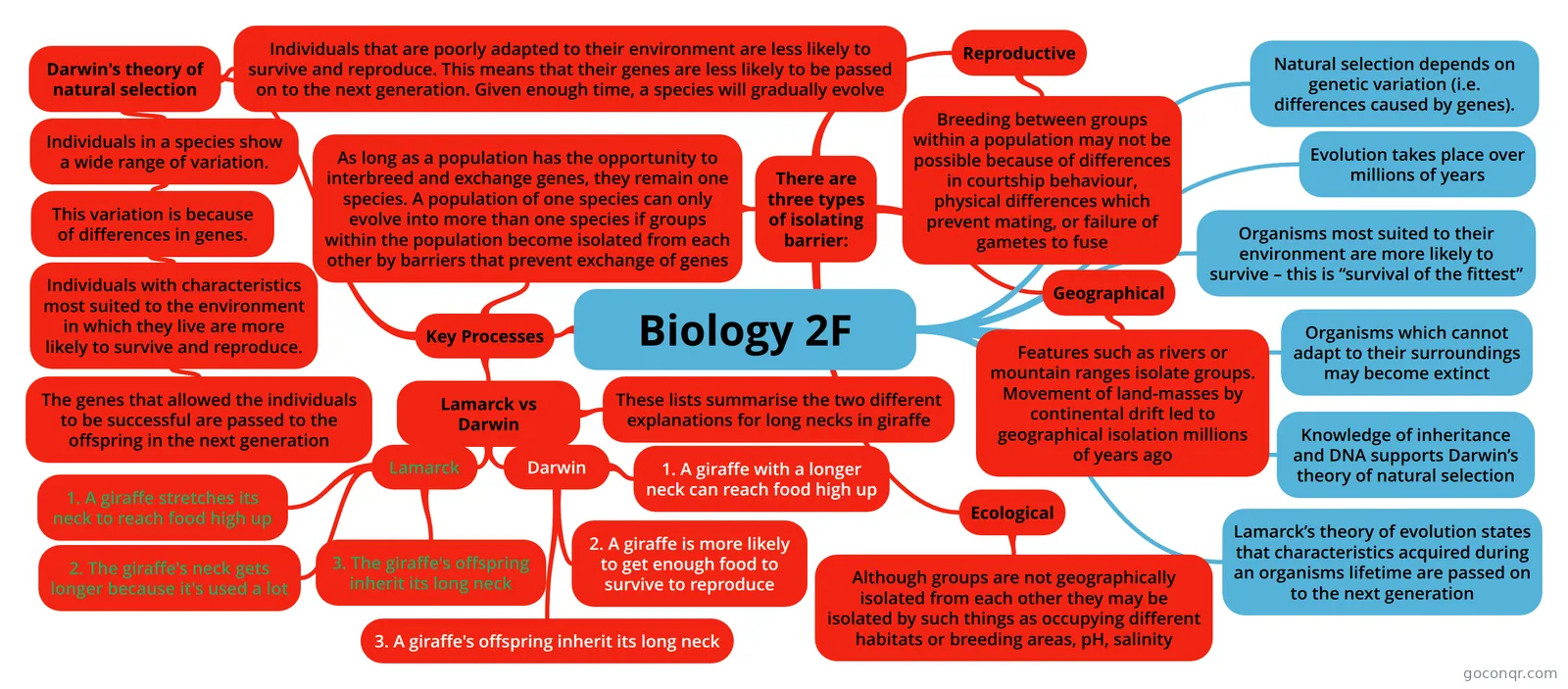
Mind map: Natural selection and evolution
Inhalt der Mindmap
Biology 2F
Key Processes
- Darwin's theory of natural selection
- Individuals in a species show a wide range of variation.
- This variation is because of differences in genes.
- Individuals with characteristics most suited to the environment in which they live are more likely to survive and reproduce.
- The genes that allowed the individuals to be successful are passed to the offspring in the next generation
- Individuals with characteristics most suited to the environment in which they live are more likely to survive and reproduce.
- This variation is because of differences in genes.
- Individuals that are poorly adapted to their environment are less likely to survive and reproduce. This means that their genes are less likely to be passed on to the next generation. Given enough time, a species will gradually evolve
- Individuals in a species show a wide range of variation.
- Lamarck vs Darwin
- These lists summarise the two different explanations for long necks in giraffe
- Lamarck
- 1. A giraffe stretches its neck to reach food high up
- 2. The giraffe's neck gets longer because it's used a lot
- 3. The giraffe's offspring inherit its long neck
- Darwin
- 1. A giraffe with a longer neck can reach food high up
- 2. A giraffe is more likely to get enough food to survive to reproduce
- 3. A giraffe's offspring inherit its long neck
- As long as a population has the opportunity to interbreed and exchange genes, they remain one species. A population of one species can only evolve into more than one species if groups within the population become isolated from each other by barriers that prevent exchange of genes
- There are three types of isolating barrier:
- Geographical
- Features such as rivers or mountain ranges isolate groups. Movement of land-masses by continental drift led to geographical isolation millions of years ago
- Ecological
- Although groups are not geographically isolated from each other they may be isolated by such things as occupying different habitats or breeding areas, pH, salinity
- Reproductive
- Breeding between groups within a population may not be possible because of differences in courtship behaviour, physical differences which prevent mating, or failure of gametes to fuse
- Geographical
- There are three types of isolating barrier:
- Darwin's theory of natural selection
Evolution takes place over millions of years
Organisms most suited to their environment are more likely to survive – this is “survival of the fittest”
Organisms which cannot adapt to their surroundings may become extinct
Natural selection depends on genetic variation (i.e. differences caused by genes).
Knowledge of inheritance and DNA supports Darwin’s theory of natural selection
Lamarck’s theory of evolution states that characteristics acquired during an organisms lifetime are passed on to the next generation
Informationen
- Beschreibung
- Mindmap am Biology 2F, erstellt von Maisie4 am 29/08/2015.
- Erstellt von
- Maisie4
- Aufrufe
- 1
- Bewertung