
340921
Beschreibung

Mindmap von jadepalmer98, aktualisiert more than 1 year ago

|
Erstellt von jadepalmer98
vor fast 13 Jahre
|
|
Solubility
- Proper definitions
- The solubility of a substance in a given solvent is the
number of grams of the solute(usually a solid) that
dissolve in 100g of the solvent(the liquid) at a
particular temperature
- Eg. at room temperature (20
degrees), about 36g of sodium
chloride (NaCl) will dissolve in
100g of water
- Eg. at room temperature (20
degrees), about 36g of sodium
chloride (NaCl) will dissolve in
100g of water
- The solubility of a (solid) solutes usually
increases with temperature
- Eg. at 60 degrees, about 37g of
sodium chloride (NaCl) will dissolve in
100g of water
- Eg. at 60 degrees, about 37g of
sodium chloride (NaCl) will dissolve in
100g of water
- A saturated solution is one that cannot
hold any more solid at that temperature -
and you have to be able to see solid on
the bottom to be certain that its saturated
- The solubility of a substance in a given solvent is the
number of grams of the solute(usually a solid) that
dissolve in 100g of the solvent(the liquid) at a
particular temperature
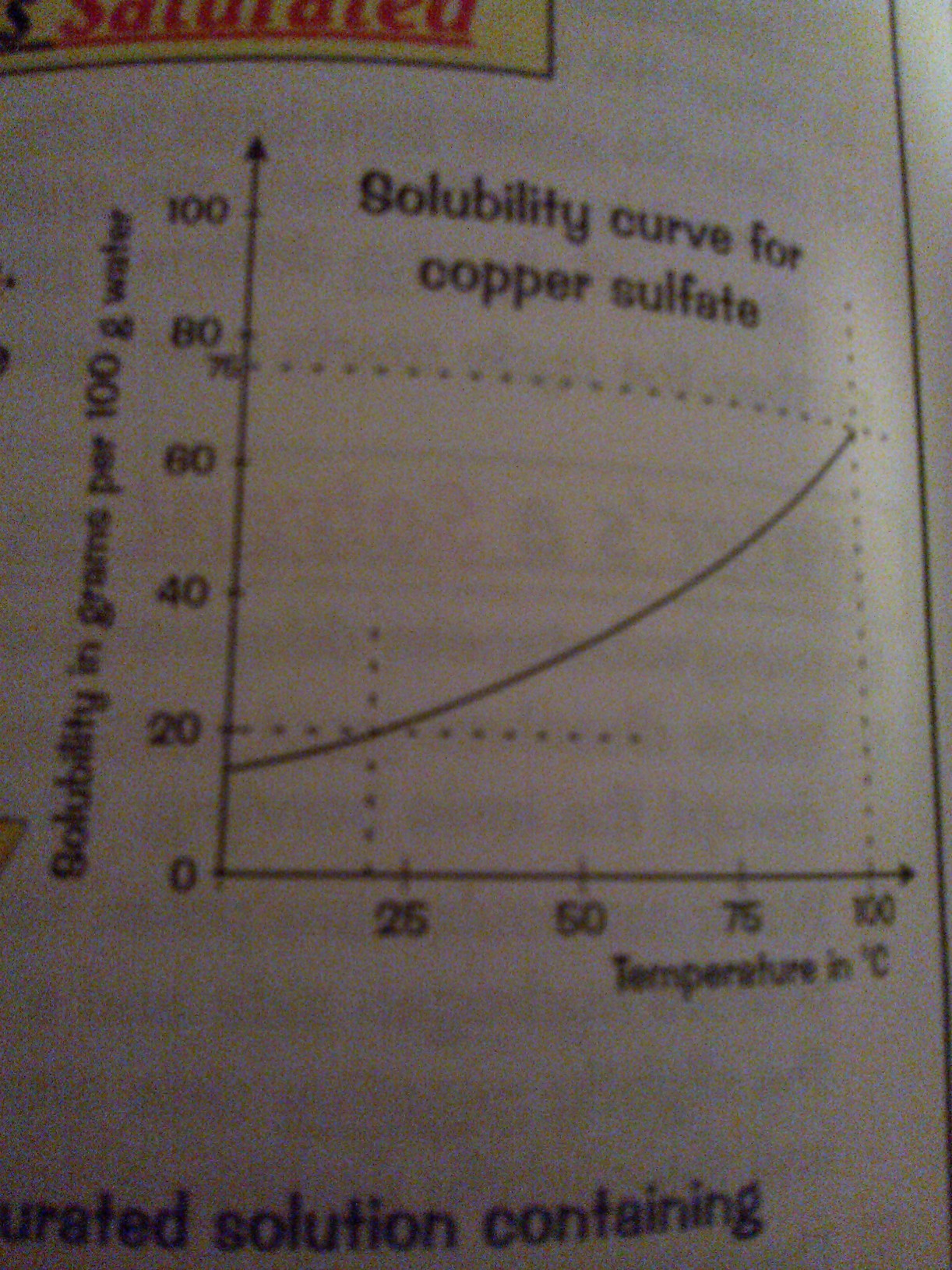
- Solubility Curves show when a
solution is saturated
- 1 - A solubility curve plots the mass of
solute dissolved in a saturated
solution at various temperatures
- 2 - The solubility of most solids
increases as the temperature
increases
- 3 - This means that cooling a saturated solution will
usually cause some solid to crystallise out - that means it
separates from the solution
- 4 - The mass of crystals formed by cooling a
solution a certain amount can be calculated from
a solubility curve...
Anmerkungen:
- Draw lines perpendicular to both axes through the temperatures in the question, then subtract the smaller mass from the larger - that difference will precipitate out on cooling.
- Ex - What mass of solid copper sulphate
will crystallise when a saturated solution
containing 100g of water is cooled from 100
degrees to 20 degrees?
- Answer - 75g - 20g = 55g
- Answer - 75g - 20g = 55g
- 1 - A solubility curve plots the mass of
solute dissolved in a saturated
solution at various temperatures
- All gases are soluble - to some extent, anyway
- Chlorine water is a solution of
chlorine gas in water
- Used as a bleach in paper and textiles industries
- Also to sterilise water supplies - kills bacteria
- Also to sterilise water supplies - kills bacteria
- Used as a bleach in paper and textiles industries
- The amount of gas that dissolves depends on the
pressure of the gas above it - the higher the
pressure, the more gas that dissolves
- Fizzy drinks initially contain a lot of CO2
dissolved in water - pressure released when
lid removed, CO2 fizzes out of solution
- Fizzy drinks initially contain a lot of CO2
dissolved in water - pressure released when
lid removed, CO2 fizzes out of solution
- But gases become less
soluble as the temperature of
the solvent increases -
opposite of solids
- Aquatic life needs dissolved oxygen, but
levels in rivers can be lowered by pollution
and a rise in temperature (caused by warm
water discharged from towns and industries)
causing problems
- Aquatic life needs dissolved oxygen, but
levels in rivers can be lowered by pollution
and a rise in temperature (caused by warm
water discharged from towns and industries)
causing problems
- Chlorine water is a solution of
chlorine gas in water
Medienanhänge
Möchten Sie kostenlos Ihre eigenen Mindmaps mit GoConqr erstellen? Mehr erfahren.