
Mindmap
Phrasal structure and verb complementation
Inhalt der Mindmap
Phrasal structure and verb complementation
Introduction to generative grammar
- Notions of generative grammar are most useful for empirical and pedagogical purposes without concerning itself with the now strongly theoretical and quite abstract aspects of this approach.
- A fundamental tenet of generative grammar is that not only do words occur in a linear order (or “string”) but they also enter into hierarchical relationships with one another within coherent units known as “constituents”.
- Generative grammar inherited the notion of constituents from the approach to grammar which preceded it called “American Structural Linguistics”
- Is concerned exclusively with the form of sentences, distinguishing between “grammatical” (or “acceptable”) and “meaningful”.
- Types of rules
- Phrase structure rules account for the form of D-structures, which are simple (as opposed to complex), active (as opposed to passive), declarative (as opposed to interrogative or imperative), and positive (as opposed to negative) sentences.
- Generative grammar inherited the notion of constituents from the approach to grammar which preceded it called “American Structural Linguistics”
- A fundamental tenet of generative grammar is that not only do words occur in a linear order (or “string”) but they also enter into hierarchical relationships with one another within coherent units known as “constituents”.
- Noam Chomsky
- Argued that immediate constituent analysis, though not wrong, was insufficient since it dealt only with the surface order.
- It could not account for the relation between an active and corresponding passive sentence.
- For example
- Sam walked the dog ~ The dog was walked by Sam
- For example
- It could not account for the relation between an active and corresponding passive sentence.
- Chomsky argued for the need to distinguish between deep (or underlying) structure (D-structure) and surface structure (S-structure)
- D-structure
- Is the abstract level in which all meaning resides, determining the structure of simple sentences, the lexical and phrasal categories to which words in the sentence belong, and the hierarchical relationships in which the words enter
- S-structure
- Is the actual linear order of words
- Different sequences on the surface – as in an active sentence and its passive counterpart
- The dog uncovered the bone and The bone was uncovered by the dog
- Similar or identical sequences on the surface
- D-structure
- Argued that immediate constituent analysis, though not wrong, was insufficient since it dealt only with the surface order.
- Notions of generative grammar are most useful for empirical and pedagogical purposes without concerning itself with the now strongly theoretical and quite abstract aspects of this approach.
Constituents
- Constituents are the proper subparts of sentences.
- A constituent can be a morpheme, word, phrase, or clause.
- Sentence analysis identifies the subject or predicate or different parts of speech, a process known as parsing the sentence into its constituents.
- For example, in the sentence: "My dog Aristotle bit the postal carrier on the ankle".
- The constituent parts are the subject, made up of a Noun Phrase ("my dog Aristotle"), and the predicate, a Verb Phrase ("bit the postal carrier on the ankle").
- For example, in the sentence: "My dog Aristotle bit the postal carrier on the ankle".
- Sentence analysis identifies the subject or predicate or different parts of speech, a process known as parsing the sentence into its constituents.
- A constituent can be a morpheme, word, phrase, or clause.
- The study of syntax is the analysis of the constituent parts of a sentence:
- Their form (the types of elements, the internal arrangement of elements, and the relation among elements within the constituent)
- Their (external) positioning in respect to other constituents
- Their function
- Constituents are the proper subparts of sentences.
A phrase structure grammar of English
- a set of rules that will “generate” any possible (simple) sentence of English.
- The grammar we write will always be subject to revision and testing: the phrase structure rules can be changed if they aren’t formulated correctly, or a particular structure might be accounted for in a different component of the grammar (by transformations rather than phrase structure rules or the reverse)
- Adjective phrase
- The adjective phrase (AP) can be expanded in several different ways
- The adjective in an adjective prhase can appear at the start, end or midle of the phrase. The adjective phrase can be placed before or after the noun or pronoun un the sentence.
- The adjective phrase (AP) can be expanded in several different ways
- Conjunction
- Prepositional phrase
- a set of rules that will “generate” any possible (simple) sentence of English.
Phrase structure rules
- The form of phrase structure rules
- A phrase structure grammar consists of a set of ordered rules known as rewrite rules, which are applied stepwise.
- A rewrite rule has a single symbol on the left and one or more symbols on the right:
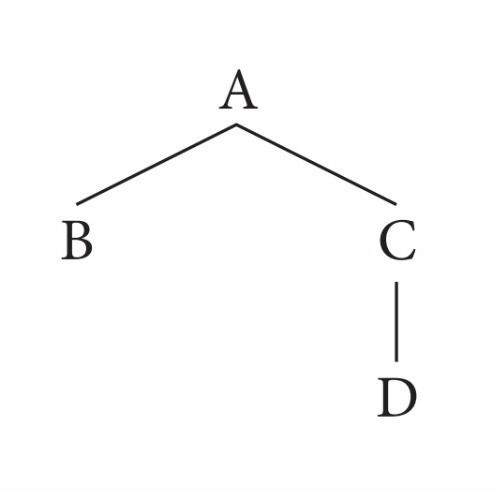
- A → B + C C → D
- More than one symbol on the right constitutes a string. The arrow is read as ‘is rewritten as’, ‘has as its constituents’, ‘consists of’, or ‘is expanded as’. The plus sign is read as ‘followed by’, but it is often omitted. The rule may also be depicted in the form of a tree diagram:
- B and C are called labeled nodes; a node is a point on the tree diagram.
- More than one symbol on the right constitutes a string. The arrow is read as ‘is rewritten as’, ‘has as its constituents’, ‘consists of’, or ‘is expanded as’. The plus sign is read as ‘followed by’, but it is often omitted. The rule may also be depicted in the form of a tree diagram:
- A → B + C C → D
- A rewrite rule has a single symbol on the left and one or more symbols on the right:
- A phrase structure grammar consists of a set of ordered rules known as rewrite rules, which are applied stepwise.
- Subject and predicate
- Every complete sentence contains two parts: a subject and a predicate
- The subject is what (or whom) the sentence is about, while the predicate tells something about the subject.
- To determine the subject of a sentence, first isolate the verb and then make a question by placing "who?" or "what?" before it -- the answer is the subject.
- A predicate has at its centre a simple predicate, which is always the verb or verbs that link up with the subject.
- The subject is what (or whom) the sentence is about, while the predicate tells something about the subject.
- Every complete sentence contains two parts: a subject and a predicate
- Noun phrase
- A noun phrase is a small group of words which contains a noun but doesn't contain a verb. A noun phrase usually contains a noun plus other words to describe it.
- That new pink bike is mine.
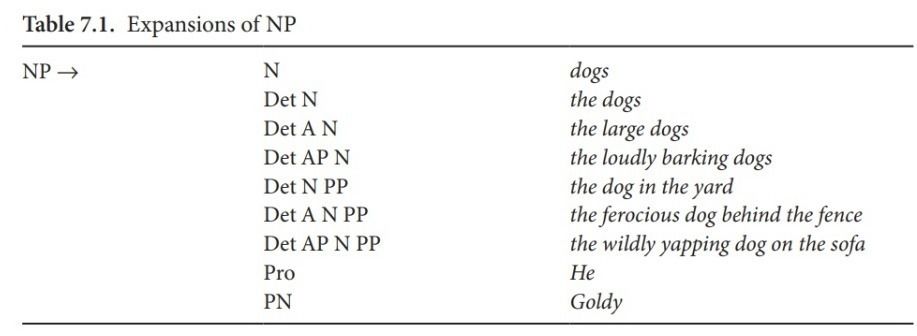
- The noun phrase (NP) can be expanded in many different ways
- A noun phrase is a small group of words which contains a noun but doesn't contain a verb. A noun phrase usually contains a noun plus other words to describe it.
- Adverb phrase
- The form of phrase structure rules
Bilder und Dateien der Mindmap
Informationen
- Beschreibung
- Mindmap am Phrasal structure and verb complementation, erstellt von Fatima Mejia am 20/11/2021.
- Erstellt von
- Fatima Mejia
- Aufrufe
- 0
- Bewertung