
Mindmap
Manner of Articulation
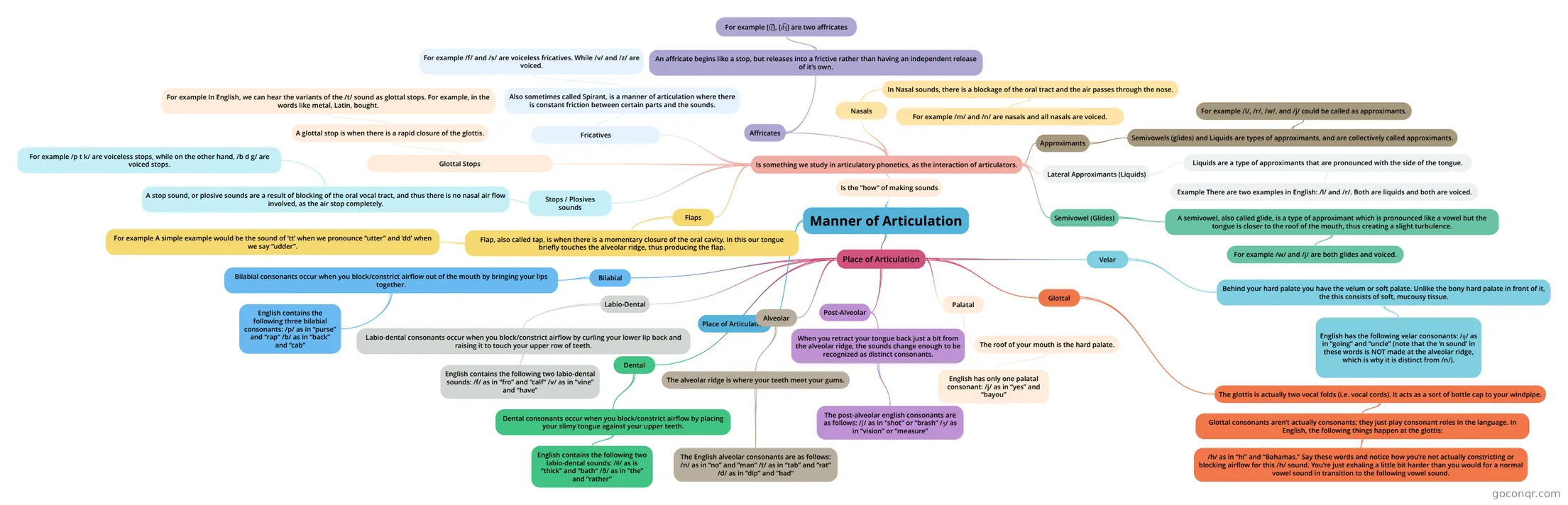
Mind map: Manner of articulation
Inhalt der Mindmap
Manner of Articulation
Place of Articulation
Place of Articulation
- Bilabial
- Bilabial consonants occur when you block/constrict airflow out of the mouth by bringing your lips together.
- English contains the following three bilabial consonants: /p/ as in “purse” and “rap“ /b/ as in “back” and “cab“
- Bilabial consonants occur when you block/constrict airflow out of the mouth by bringing your lips together.
- Labio-Dental
- Labio-dental consonants occur when you block/constrict airflow by curling your lower lip back and raising it to touch your upper row of teeth.
- English contains the following two labio-dental sounds: /f/ as in “fro” and “calf“ /v/ as in “vine” and “have”
- Labio-dental consonants occur when you block/constrict airflow by curling your lower lip back and raising it to touch your upper row of teeth.
- Dental
- Dental consonants occur when you block/constrict airflow by placing your slimy tongue against your upper teeth.
- English contains the following two labio-dental sounds: /θ/ as is “thick” and “bath“ /ð/ as in “the” and “rather”
- Dental consonants occur when you block/constrict airflow by placing your slimy tongue against your upper teeth.
- Alveolar
- The alveolar ridge is where your teeth meet your gums.
- The English alveolar consonants are as follows: /n/ as in “no” and “man“ /t/ as in “tab” and “rat“ /d/ as in “dip” and “bad“
- The alveolar ridge is where your teeth meet your gums.
- Post-Alveolar
- When you retract your tongue back just a bit from the alveolar ridge, the sounds change enough to be recognized as distinct consonants.
- The post-alveolar english consonants are as follows: /ʃ/ as in “shot” or “brash” /ʒ/ as in “vision” or “measure”
- When you retract your tongue back just a bit from the alveolar ridge, the sounds change enough to be recognized as distinct consonants.
- Palatal
- The roof of your mouth is the hard palate.
- English has only one palatal consonant: /j/ as in “yes” and “bayou”
- The roof of your mouth is the hard palate.
- Velar
- Behind your hard palate you have the velum or soft palate. Unlike the bony hard palate in front of it, the this consists of soft, mucousy tissue.
- English has the following velar consonants: /ŋ/ as in “going” and “uncle” (note that the ‘n sound’ in these words is NOT made at the alveolar ridge, which is why it is distinct from /n/).
- Behind your hard palate you have the velum or soft palate. Unlike the bony hard palate in front of it, the this consists of soft, mucousy tissue.
- Glottal
- The glottis is actually two vocal folds (i.e. vocal cords). It acts as a sort of bottle cap to your windpipe.
- Glottal consonants aren’t actually consonants; they just play consonant roles in the language. In English, the following things happen at the glottis:
- /h/ as in “hi” and “Bahamas.” Say these words and notice how you’re not actually constricting or blocking airflow for this /h/ sound. You’re just exhaling a little bit harder than you would for a normal vowel sound in transition to the following vowel sound.
- Glottal consonants aren’t actually consonants; they just play consonant roles in the language. In English, the following things happen at the glottis:
- The glottis is actually two vocal folds (i.e. vocal cords). It acts as a sort of bottle cap to your windpipe.
- Bilabial
Is the “how” of making sounds
- Is something we study in articulatory phonetics, as the interaction of articulators.
- Stops / Plosives sounds
- A stop sound, or plosive sounds are a result of blocking of the oral vocal tract, and thus there is no nasal air flow involved, as the air stop completely.
- For example /p t k/ are voiceless stops, while on the other hand, /b d g/ are voiced stops.
- A stop sound, or plosive sounds are a result of blocking of the oral vocal tract, and thus there is no nasal air flow involved, as the air stop completely.
- Glottal Stops
- A glottal stop is when there is a rapid closure of the glottis.
- For example In English, we can hear the variants of the /t/ sound as glottal stops. For example, in the words like metal, Latin, bought.
- A glottal stop is when there is a rapid closure of the glottis.
- Fricatives
- Also sometimes called Spirant, is a manner of articulation where there is constant friction between certain parts and the sounds.
- For example /f/ and /s/ are voiceless fricatives. While /v/ and /z/ are voiced.
- Also sometimes called Spirant, is a manner of articulation where there is constant friction between certain parts and the sounds.
- Affricates
- An affricate begins like a stop, but releases into a frictive rather than having an independent release of it’s own.
- For example [t͡ʃ], [d͡ʒ] are two affricates
- An affricate begins like a stop, but releases into a frictive rather than having an independent release of it’s own.
- Nasals
- In Nasal sounds, there is a blockage of the oral tract and the air passes through the nose.
- For example /m/ and /n/ are nasals and all nasals are voiced.
- In Nasal sounds, there is a blockage of the oral tract and the air passes through the nose.
- Approximants
- Semivowels (glides) and Liquids are types of approximants, and are collectively called approximants.
- For example /l/, /r/, /w/, and /j/ could be called as approximants.
- Semivowels (glides) and Liquids are types of approximants, and are collectively called approximants.
- Lateral Approximants (Liquids)
- Liquids are a type of approximants that are pronounced with the side of the tongue.
- Example There are two examples in English: /l/ and /r/. Both are liquids and both are voiced.
- Liquids are a type of approximants that are pronounced with the side of the tongue.
- Semivowel (Glides)
- A semivowel, also called glide, is a type of approximant which is pronounced like a vowel but the tongue is closer to the roof of the mouth, thus creating a slight turbulence.
- For example /w/ and /j/ are both glides and voiced.
- A semivowel, also called glide, is a type of approximant which is pronounced like a vowel but the tongue is closer to the roof of the mouth, thus creating a slight turbulence.
- Flaps
- Flap, also called tap, is when there is a momentary closure of the oral cavity. In this our tongue briefly touches the alveolar ridge, thus producing the flap.
- For example A simple example would be the sound of ‘tt’ when we pronounce “utter” and ‘dd’ when we say “udder”.
- Flap, also called tap, is when there is a momentary closure of the oral cavity. In this our tongue briefly touches the alveolar ridge, thus producing the flap.
- Stops / Plosives sounds
- Is something we study in articulatory phonetics, as the interaction of articulators.
Informationen
- Beschreibung
- Mindmap am Manner of Articulation, erstellt von Ericka Hernandez am 04/01/2022.
- Erstellt von
- Ericka Hernandez
- Aufrufe
- 3
- Bewertung
Mehr zu Place and Manner of Articulation