
Mindmap
Green Electronics
Inhalt der Mindmap
Green Electronics
Energy Storage
- Energy Harvesting
- Light Energy Source For Harvesting
- Small Scale Photovoltaics
- Motion
- Piezo-electric
- Generation
- Pressure causes deformation of ferro-electric material. Deformation creates spontaneous electrical polarization. Electrical Polarization creates potential. Used as inverse effect for precision motors such as actuators
- Generation
- Capacitative
- Parallel Plate Capacitor with equations
- Series Resistance
- Leakage Current
- Electrolytic Capacitor
- Roughened Metal Electrode
- Ultra Capacitors
- Super Capacitors
- Parallel Plate Capacitor with equations
- Magnetic Induction
- Magnetic Induction Energy Transfer
- Efficient Heat Transfer
- Described Using Mutual Induction Equations
- Flux Linkage
- No Risk Of Electrical Shorts
- Ceramic Coating, with no heat makes easy to clean.
- Magnetic Induction through repetitive motion
- Harvests energy by moving coils within a magnets
- Wind Eenrgy
- Vibration Energy
- Magnetic Induction Energy Transfer
- Springs
- Piezo-electric
- Radio
- RF
- Rectifying Antenna
- Inductive Charging
- Passive RFID
- Internal Antenna is used for communications, whilst integrated circuit is used for processing data. https://www.engineersgarage.com/passive-rfid-tags/
- No Power Source
- Energy Transfer can be inductive or via directed radio waves
- Internal Antenna For generation and communication
- Integrated Circuit For processing and storing Information
- Passive RFID
- Active RFID
- Internal Battery
- Expensive
- Large
- Internal Battery
- Temperature
- Thermoelectric
- Basic Principle
- Carnot Cycle
- Theoretical Max Efficiency of conversion from thermal energy to work
- Seebeck Effect
- Thermo-Couples
- Carnot Cycle
- Applications
- Long Life Energy
- Radio-Isotope Thermoelectric Generator
- Waste Heat Recovery
- Wireless Sensing Network
- Peltier Coolers
- Long Life Energy
- Device Layout
- N type And P-Type material
- Full Module
- Lateral Design
- Vertical Design
- Full Module
- N type And P-Type material
- Figure Of Merit
- Thermoelectric Power
- Max PowerPoint Tracking
- Thermoelectric Efficiency
- Thermal conductivity
- Thermoelectric Power
- Materials Enhancement
- Little Impact On Energy saving Or climate
- High Impact On Wireless Sensing Networks
- Material Abundance
- Tellurium rare Either use selenium or sulphur
- Lowering Lattice Thermal Conductivity
- Nanostructuring
- Orientations
- Super Lattices
- Quantum Confinement
- Nanocomposites
- Phonon Scattering
- Basic Principle
- Thermoelectric
- Considerations In Energy Harvesting Applicability
- Need To Be Wireless?
- Industrial Environment
- If so then can be charged
- Automotive or Aeronautical Environment
- Uses engine of some kind, energy harvesting only needs to be supplementary.
- Industrial Environment
- Battery Free?
- Minimise Footprint
- Printed Circuit
- Extend Battery Life?
- Need To Be Wireless?
- Light Energy Source For Harvesting
- Irreversible Chemical Storage
- Fuel Cells
- Hydrogen Based. Defined as the electrochemical energy generation system. Typically uses hydrogen as anode and oxygen as cathode with potassium hydroxide as an electrode and water as a solvent.http://butane.chem.uiuc.edu/pshapley/Environmental/L11/2.html 90% efficiency operation typically. Converts chemical energy to electrical Energy to motion. This is an irreversible process.
- Hydrogen Sources
- Geological Processes
- Electrolysis Of Water
- Combustion Engine
- Carbon Based Petrol or Gasoline Converts chemical energy to heat and then motion. Inefficient as limited by Carnot Cycle For gas plant efficiency is limited to 60%. In cars this reduces to 30%.
- Fuel Cells
- Reversible Chemical Storage
- Batteries
- Converts chemical energy to electrical energy to motion at 90% efficiency. Reversible process. Works by reduction and oxidation at both surfaces. Ions are formed by these processes and move throughout the electrolyte, whist electrons are forced through the external circuit via a separator or membrane. https://www.pveducation.org/pvcdrom/battery-basics/basic-battery-operation
- Lead Acid
- Cheap
- Low Energy Density Amongst Batteries
- Charging
- Formation Of Pb at cathode
- Cathode being where reduction takes place and is the negative electrode.
- Formation Of PBO2 at the anode
- Oxidation takes place, negative electrode
- Sulphuric acid forms in the electrolyte
- Formation Of Pb at cathode
- Discharging
- Removal Of Sulphuric Acid from electrolyte
- Formation Of Lead Sulphate at both electrodes
- Ni-metal hydride
- Good Energy Density
- Memory Effect
- Displays best performance when fully charged or discharged for a long life
- Li-ion
- Excellent Energy Density
- Good Power Density
- Expensive
- Optimal Performance when not fully charged or discharged
- Electrolyte highly flammable
- Limitations Of Batteries
- Low Energy density
- Low Energy Density
- Requires lithium or Cobalt
- Limits scalability as requires mining. Severe impact on the environment.
- Long Charge times
- Harsh Infrastructure Requirements
- Batteries
- Electronic Charge Storage
- Capacitance Storage
- Dielectric Capactitors
- Electrolytic Capacitors
- Electrochemical Capacitors
- Super Capacitors and ultra capacitors
- Capacitance Storage
- Gravitational Potential Storage
- Pumped Hydroelectricity
- E=mgh Limited in usefulness as up conversion loss and down conversion loss is dependant on the environment. Can't be built everywhere but viable where suitable.
- Pumped Hydroelectricity
- Kinetic Energy Storage
- Flywheels
- E = (I*w^2)/2 I is inertia and is calculated using I = kmR^2 k being a geometric factor where k=1 means a perfect circle whilst k=1/2 for a wheel or disk
- Regenerative Braking
- KERS- Kinetic Energy Recovery System
- Flywheels
- Thermal Energy Storage
- Phase Change Materials
- Energy given to be E = M(C*deltaT+deltaH). Energy Stored primar
- Water
- E = M(C*deltaT+deltaH) Stores energy by storing hot water below the boiling point for heating.
- Molten Salts
- E = M(C*deltaT+deltaH) Storage in temp increase above melting point, uses a heat exchanger to convert to electricity
- Phase Change Materials
- Energy Storage Considerations
- Energy u[J, Wh] or Energy Density u[Wh/kg]
- Energy density needs to be maximised for batteries. Power density less of an requirement as electric motors have high torque. Capacitors comparatively have less energy than batteries
- Power P[J/s, W] or Power Density p[W/kg]
- Capacitors have high power density
- Conversion Efficiency
- Active time [h]
- Stand By time [h]
- Cost
- Environmental Considerations
- Cyclability
- Energy u[J, Wh] or Energy Density u[Wh/kg]
- Figures Of Merit
- Ragone Plot
- Energy Density Vs Power Density https://www.sciencedirect.com/science/article/pii/B9780128111673000079
- Time to discharge
- Energy vs Power
- Ragone Plot
- Energy Harvesting
Photovoltaic Systems
- Arrays
Anthropogenic Global Warming
- Green house Effect
- The outgoing radiation from a black body needs to equal the incoming radiation from the sun. Due to gases such as water vapour and CO2 the absorption of incoming radiation increases, thus the temperature of Earth increases in response to increase radiation output. CO2 is significantly more of a problem than water vapour, however, as it adds new absorption to the spectrum whilst water vapour is already close to maximum spectrum absorption.
- Temperature Of Planets
- Role Of Atmosphere
- N2
- Reflects Radiation, breathing
- O2
- Breathe, reflects radiation
- Co2
- Absorption Of Infrared Radiation
- N2
- Evidence Of Anthropogenic Global Warming
- Temperature Increase
- CO2 is major source of temp increase
- Additional Sources Of Temp Increase
- CH4
- N2O
- Uncertainty in calculation: radiative forcing
- Uncertainty in temp measurements such as local variants
- Changes in Solar System
- CO2 Emssion
- Roughly 50% is absorbed by the ocean
- Feedback
- g=1 No Feedback
- g<1 Earth Self Regulates, unknown if humanity will survive this
- g>1 Positive Feedback Increased Concentration of water leads to further effects
- Temperature Increase
- Radiative Forcing
- Position Of Vibrational Levels
- Amount Of Greenhouse gases
- Amount Of Other Greenhouse Gases At Same Wavelength
- Details Of Vibrational Modes
- Different Formula For Each Green House Gas
- Black Body Radiation
- Radiation given by a body solely determined by its surface temperature
- Planck's Law
- This is used to describe how energy is distributed over the wavelength spectrum
- Stefan-Boltzmann-Law
- Integral Of Planck's Law describes total energy over the wavelength spectrum.
- Wein's Law
- The wavelength with max energy is found using the derivative of Planck's Law When the derivative is 0. This is Wein's Law.
- Black Body Equilibrium Temperature
- Incoming Energy UV Rays
- Outgoing Energy Infrared
- Albedo
- Absorption by Atmospheric Gases
- This occurs as all molecules contain vibrational modes, if these modes can change the dipole moment of the molecule than infrared radiation can be absorbed. Whether this can occur is dependent on the molecular structure.
- Linear Diatomic
- Linear Tri-Atomic
- Non-linear tri-atomic
- Effects Of AGW
- Higher Temperatures
- Change In Weather Patterns
- Rising Sea Levels
- Local Climate Change
- Mitigation
- Geoengineering
- Carbon Capture
- Carbon From Power plants captured and stored inside mines and the like.
- Reduction Of CO2 to C
- Solar Radiation Management
- Releasing of stratospheric sulfate aerosols in an attempt to reduce the effects of global warming. Drastic measure with likely sever side effects
- Iron fertilisation of sea to stimulate growth of phytoplankton
- Carbon Capture
- Energy Generation
- Heat Generation (local)
- Solar Heating: Thermal Panels
- Direct Conversion Of Solar Power To Heat
- Uses Heat Exchange System With Hot Water Tank
- Dependent on Orientation Of House
- High Installation Costs
- Requires additional boiler as insufficient in winter
- Heat Pumps
- Heat Is Pumped From Cold To Hot
- Has potential efficiency of over 500%
- Best performance with minimal temp difference
- Energy dissipation needs to be minimised at low temperatures requiring well insulated buildings
- ASHP lacking performance in freezing temps
- GSHP solves flaws of ASHP needs to be implemented in newbuilds
- Solar Heating: Thermal Panels
- Electricity Generation (global)
- Photovoltaics
- Wind Energy
- Tidal Energy
- Hydro Power
- Biomass
- Energy Derived from plants
- Technically renewable
- Releases as much CO2 as burning coal
- Takes up arable land for food
- Geothermal Energy
- Derived from thermal energy of the planet
- Low efficiency
- Limited to tectonic regions
- Nuclear Energy
- Fusion
- Proven
- Not yet controllable energy generation
- Fission
- 75% of electricity produced in France
- Sustainable
- No Co2 emission
- Nuclear proliferation
- Fusion
- Heat Generation (local)
- Geoengineering
- Green house Effect
Semiconductor Physics
- Semiconductor Devices
- Photovoltaics
- Payback time - 1-25 years Si wafer based accounts for 95%
- Illumination Of PN junction
- When a photon is incident onto a pn junction it excites an electron into the conduction band. This leads to the generation of an electron on the n side of the junction and the hole on the p side of the junction. The carriers approach the depletion region and experience the field of the region. The hole remains where it is whilst the electron drifts across. The separation of charges generates a voltage known as the photovoltage. An energy barrier to diffusion across the pn junction forms preventing the motion of the electron.
- Short Circuit Conditions
- Connects n region and p regions by resistance free path. Photovoltaic effect drives current flow
- Voltage is negligible.
- Short Circuit Current is equivalent to the light generated current
- Open Circuit Conditions
- Increase in voltage causes more light generated carriers to be separated by the junction. Electric field is generated to counteract built in field. Barrier height decreases. The diffusion current thus increases to match the light generated current. Means no overall current as no current flows in the device.
- No current
- Open circuit voltage is same across all terminals
- IV Characteristics OF A Solar Cell
- Solar Cells and the Ideal Diode Equation
- Quantum Efficiency
- Advanced Photovoltaics
- Important Design Features Of Solar Cell
- Feataures Of BSF
- Potential Barrier Due TO BSF
- Power Loss Due To Emitter
- Features Of Crystalline Silicon Technologies
- Feataures Of BSF
- Important Design Features Of Solar Cell
- Multicrystalline Solar Cells
- Formed Of Polysilicon
- Thermoelectric Materials
- Light-Emitting Diodes
- Photovoltaics
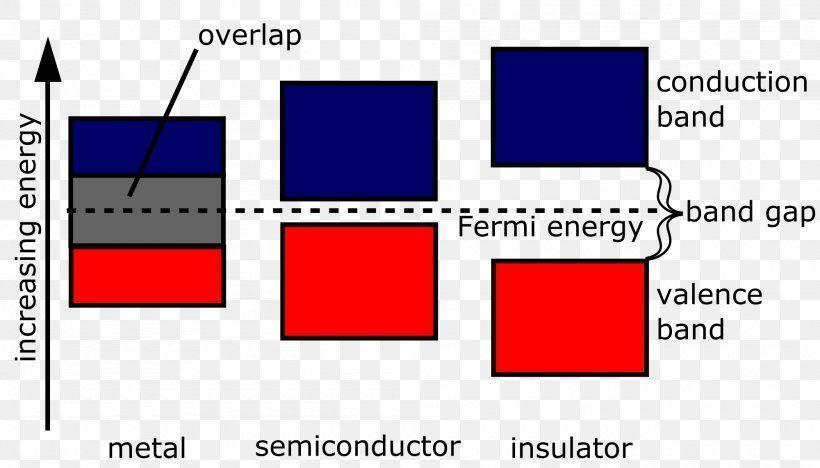
- Energy Band Diagrams
- Metals
- Electrons can easily move between full and empty bands
- Lithium
- Electrons are isolated in the 1s and 2s orbitals. When a certain amount of atoms are brought together to form a crystal, the 2s orbitals overlap and the wavefunctions combine to from a series of finely separated energy levels. As the number of atoms is large this combines an energy band. Only half of the states are occupied due to electron spin. This process happens with other empty orbitals.
- Semiconductors
- Bandgap is <2EV Electrons require additional energy to move into higher energy states
- Direct Bandgap Materials
- Indirect Bandgap Materials
- Intrinsic Semiconductor
- Extrinsic Semiconductor
- Insulator
- Bandgap is greater than 2eV
- Effective Mass
- Method to express the effect of all internal forces on an electron due to interaction of an electron with areas in a crystal.
- Density Of States
- Semiconductor Devices
Bilder und Dateien der Mindmap
Informationen
- Beschreibung
- Mindmap am Green Electronics, erstellt von Daniel Adeyemi am 31/01/2022.
- Erstellt von
- Daniel Adeyemi
- Aufrufe
- 4
- Bewertung