
Mindmap
1. Modal Verbs I
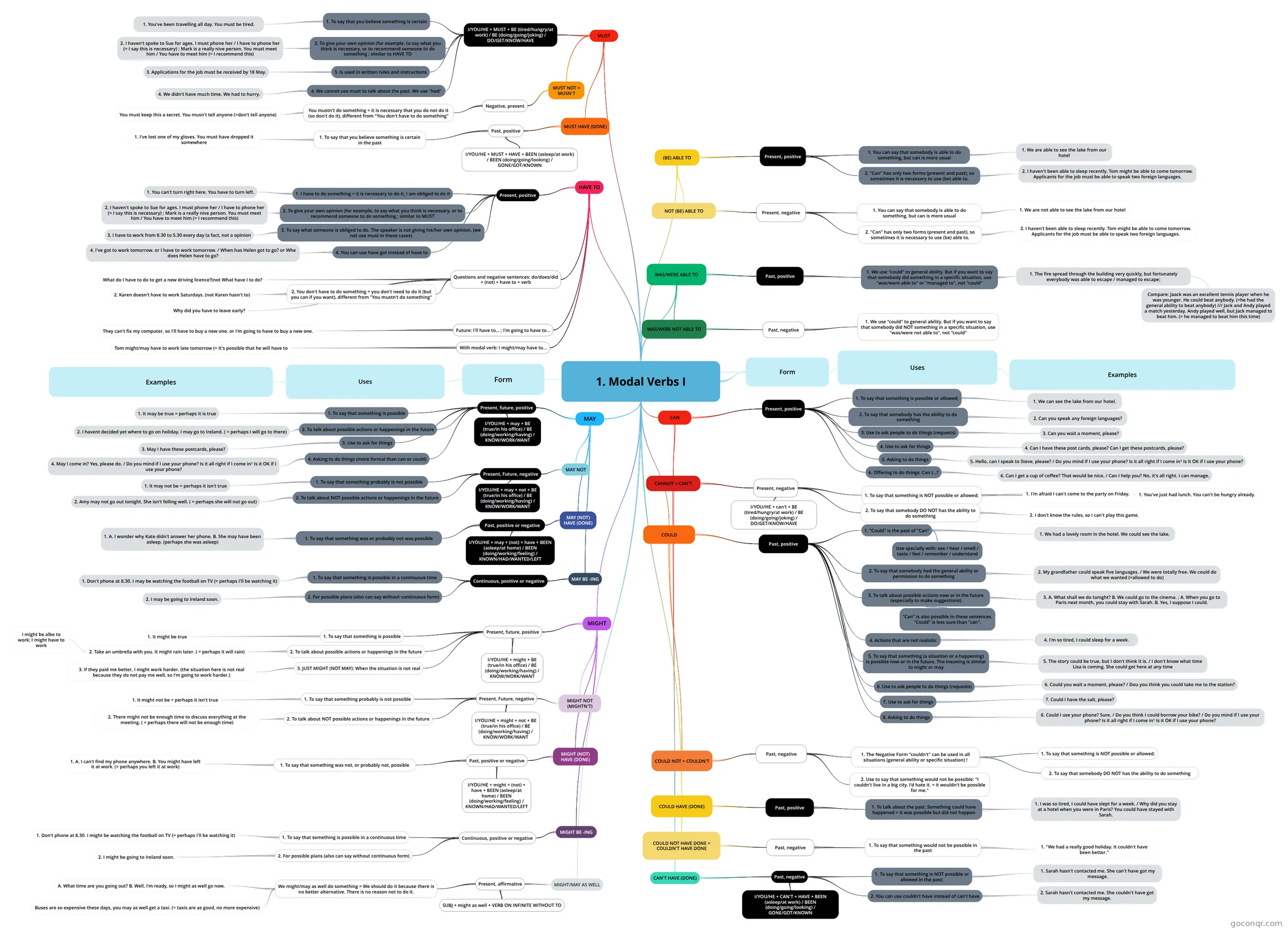
Mind map: Modal verbs I
Inhalt der Mindmap
1. Modal Verbs I
Form
- Uses
- Examples
- Form
- Uses
- Examples
- Uses
- Uses
CAN
- Present, positive
- 1. To say that something is possible or allowed;
- 1. We can see the lake from our hotel.
- 2. To say that somebody has the ability to do something
- 2. Can you speak any foreign languages?
- 3. Use to ask people to do things (requests)
- 3. Can you wait a moment, please?
- 4. Use to ask for things
- 4. Can I have these post cards, please? Can I get these postcards, please?
- 5. Asking to do things
- 5. Hello, can I speak to Steve, please? / Do you mind if I use your phone? Is it all right if I come in¹ Is it OK if I use your phone?
- 6. Offering to do things: Can I...?
- 6. Can I get a cup of coffee? That would be nice. / Can I help you? No, it's all right. I can manage.
- 1. To say that something is possible or allowed;
- CANNOT = CAN'T
- Present, negative
- 1. To say that something is NOT possible or allowed;
- 1. I'm afraid I can't come to the party on Friday.
- 1. You've just had lunch. You can't be hungry already.
- 2. To say that somebody DO NOT has the ability to do something
- 2. I don't know the rules, so I can't play this game.
- I/YOU/HE + can't + BE (tired/hungry/at work) / BE (doing/going/joking) / DO/GET/KNOW/HAVE
- 1. To say that something is NOT possible or allowed;
- CAN'T HAVE (DONE)
- Past, negative
- 1. To say that something is NOT possible or allowed in the past;
- 1. Sarah hasn't contacted me. She can't have got my message.
- I/YOU/HE + CAN'T + HAVE + BEEN (asleep/at work) / BEEN (doing/going/looking) / GONE/GOT/KNOWN
- 2. You can use couldn't have instead of can't have
- 2. Sarah hasn't contacted me. She couldn't have got my message.
- 1. To say that something is NOT possible or allowed in the past;
- Past, negative
- Present, negative
- Present, positive
(BE) ABLE TO
- Present, positive
- 1. You can say that somebody is able to do something, but can is more usual
- 1. We are able to see the lake from our hotel
- 2. "Can" has only two forms (present and past), so sometimes it is necessary to use (be) able to.
- 2. I haven't been able to sleep recently. Tom might be able to come tomorrow. Applicants for the job must be able to speak two foreign languages.
- 1. You can say that somebody is able to do something, but can is more usual
- NOT (BE) ABLE TO
- Present, negative
- 1. You can say that somebody is able to do something, but can is more usual
- 1. We are not able to see the lake from our hotel
- 2. "Can" has only two forms (present and past), so sometimes it is necessary to use (be) able to.
- 2. I haven't been able to sleep recently. Tom might be able to come tomorrow. Applicants for the job must be able to speak two foreign languages.
- 1. You can say that somebody is able to do something, but can is more usual
- Present, negative
- Present, positive
COULD
- Past, positive
- 1. "Could" is the past of "Can"
- 1. We had a lovely room in the hotel. We could see the lake.
- Use specially with: see / hear / smell / taste / feel / remember / understand
- 2. To say that somebody had the general ability or permission to do something
- 2. My grandfather could speak five languages. / We were totally free. We could do what we wanted (=allowed to do)
- 3. To talk about possible actions now or in the future (especially to make suggestions)
- "Can" is also possible in these sentences. "Could" is less sure than "can".
- 3. A. What shall we do tonight? B. We could go to the cinema. ; A. When you go to Paris next month, you could stay with Sarah. B. Yes, I suppose I could.
- 4. Actions that are not realistic
- 4. I'm so tired, I could sleep for a week.
- 5. To say that something (a situation or a happening) is possible now or in the future. The meaning is similar to might or may
- 5. The story could be true, but I don't think it is. / I don't know what time Lisa is coming. She could get here at any time
- 6. Use to ask people to do things (requests)
- 6. Could you wait a moment, please? / Dou you think you could take me to the station?
- 7. Use to ask for things
- 7. Could I have the salt, please?
- 8. Asking to do things
- 8. Could I use your phone? Sure. / Do you think I could borrow your bike? / Do you mind if I use your phone? Is it all right if I come in¹ Is it OK if I use your phone?
- 1. "Could" is the past of "Can"
- COULD NOT = COULDN'T
- Past, negative
- 1. The Negative Form "couldn't" can be used in all situations (general ability or specific situation) !
- 1. To say that something is NOT possible or allowed;
- 2. To say that somebody DO NOT has the ability to do something
- 2. Use to say that something would not be possible: "I couldn't live in a big city. I'd hate it. = it wouldn't be possible for me."
- 1. The Negative Form "couldn't" can be used in all situations (general ability or specific situation) !
- Past, negative
- Past, positive
WAS/WERE ABLE TO
- WAS/WERE NOT ABLE TO
- Past, negative
- 1. We use "could" to general ability. But if you want to say that somebody did NOT something in a specific situation, use "was/were not able to", not "could"
- Past, negative
- Past, positive
- 1. We use "could" to general ability. But if you want to say that somebody did something in a specific situation, use "was/were able to" or "managed to", not "could"
- 1. The fire spread through the building very quickly, but fortunately everybody was able to escape / managed to escape;
- Compare: Jaack was an excellent tennis player when he was younger. He could beat anybody. (=he had the general ability to beat anybody) /// Jack and Andy played a match yesterday. Andy played well, but Jack managed to beat him. (= he managed to beat him this time)
- 1. The fire spread through the building very quickly, but fortunately everybody was able to escape / managed to escape;
- 1. We use "could" to general ability. But if you want to say that somebody did something in a specific situation, use "was/were able to" or "managed to", not "could"
- WAS/WERE NOT ABLE TO
COULD HAVE (DONE)
- Past, positive
- 1. To talk about the past. Something could have happened = it was possible but did not happen
- 1. I was so tired, I could have slept for a week. / Why did you stay at a hotel when you were in Paris? You could have stayed with Sarah.
- 1. To talk about the past. Something could have happened = it was possible but did not happen
- COULD NOT HAVE DONE = COULDN'T HAVE DONE
- Past, negative
- 1. To say that something would not be possible in the past
- 1. "We had a really good holiday. It couldn't have been better."
- 1. To say that something would not be possible in the past
- Past, negative
- Past, positive
MUST
- I/YOU/HE + MUST + BE (tired/hungry/at work) / BE (doing/going/joking) / DO/GET/KNOW/HAVE
- 1. To say that you believe something is certain
- 1. You've been travelling all day. You must be tired.
- 2. To give your own opinion (for example, to say what you think is necessary, or to recommend someone to do something ; similar to HAVE TO
- 2. I haven't spoke to Sue for ages. I must phone her / I have to phone her (= I say this is necessary) ; Mark is a really nive person. You must meet him / You have to meet him (= I recommend this)
- 3. Is used in written rules and instructions
- 3. Applications for the job must be received by 18 May.
- 4. We cannot use must to talk about the past. We use "had"
- 4. We didn't have much time. We had to hurry.
- 1. To say that you believe something is certain
- MUST HAVE (DONE)
- Past, positive
- 1. To say that you believe something is certain in the past
- 1. I've lost one of my gloves. You must have dropped it somewhere
- I/YOU/HE + MUST + HAVE + BEEN (asleep/at work) / BEEN (doing/going/looking) / GONE/GOT/KNOWN
- 1. To say that you believe something is certain in the past
- Past, positive
- MUST NOT = MUSN'T
- Negative, present
- You mustn't do something = it is necessary that you do not do it (so don't do it), different from "You don't have to do something"
- You must keep this a secret. You musn't tell anyone (=don't tell anyone)
- You mustn't do something = it is necessary that you do not do it (so don't do it), different from "You don't have to do something"
- Negative, present
- I/YOU/HE + MUST + BE (tired/hungry/at work) / BE (doing/going/joking) / DO/GET/KNOW/HAVE
MAY
- Present, future, positive
- 1. To say that something is possible
- 1. It may be true = perhaps it is true
- I/YOU/HE + may + BE (true/in his office) / BE (doing/working/having) / KNOW/WORK/WANT
- 2. To talk about possible actions or happenings in the future
- 2. I havent decided yet where to go on holiday. I may go to Ireland. ( = perhaps I will go to there)
- 3. Use to ask for things
- 3. May I have these postcards, please?
- 4. Asking to do things (more formal than can or could)
- 4. May I come in? Yes, please do. / Do you mind if I use your phone? Is it all right if I come in¹ Is it OK if I use your phone?
- 1. To say that something is possible
- MAY NOT
- Present, Future, negative
- 1. To say that something probably is not possible
- 1. It may not be = perhaps it isn't true
- I/YOU/HE + may + not + BE (true/in his office) / BE (doing/working/having) / KNOW/WORK/WANT
- 2. To talk about NOT possible actions or happenings in the future
- 2. Amy may not go out tonight. She isn't felling well. ( = perhaps she will not go out)
- 1. To say that something probably is not possible
- Present, Future, negative
- MAY (NOT) HAVE (DONE)
- Past, positive or negative
- 1. To say that something was or probably not was possible
- 1. A. I wonder why Kate didn't answer her phone. B. She may have been asleep. (perhaps she was asleep)
- I/YOU/HE + may + (not) + have + BEEN (asleep/at home) / BEEN (doing/working/feeling) / KNOWN/HAD/WANTED/LEFT
- 1. To say that something was or probably not was possible
- Past, positive or negative
- MAY BE -ING
- Continuous, positive or negative
- 1. To say that something is possible in a continuous time
- 1. Don't phone at 8.30. I may be watching the football on TV (= perhaps I'll be watching it)
- 2. For possible plans (also can say without continuous form)
- 2. I may be going to Ireland soon.
- 1. To say that something is possible in a continuous time
- Continuous, positive or negative
- Present, future, positive
MIGHT
- Present, future, positive
- 1. To say that something is possible
- 1. It might be true
- I/YOU/HE + might + BE (true/in his office) / BE (doing/working/having) / KNOW/WORK/WANT
- 2. To talk about possible actions or happenings in the future
- 2. Take an umbrella with you. It might rain later. ( = perhaps it will rain)
- I might be albe to work; I might have to work
- 2. Take an umbrella with you. It might rain later. ( = perhaps it will rain)
- 3. JUST MIGHT (NOT MAY): When the situation is not real
- 3. If they paid me better, I might work harder. (the situation here is not real because they do not pay me well, so I'm going to work harder.)
- 1. To say that something is possible
- MIGHT NOT (MIGHTN'T)
- Present, Future, negative
- 1. To say that something probably is not possible
- 1. It might not be = perhaps it isn't true
- I/YOU/HE + might + not + BE (true/in his office) / BE (doing/working/having) / KNOW/WORK/WANT
- 2. To talk about NOT possible actions or happenings in the future
- 2. There might not be enough time to discuss everything at the meeting. ( = perhaps there will not be enough time)
- 1. To say that something probably is not possible
- Present, Future, negative
- MIGHT (NOT) HAVE (DONE)
- Past, positive or negative
- 1. To say that something was not, or probably not, possible
- 1. A. I can't find my phone anywhere. B. You might have left it at work. (= perhaps you left it at work)
- I/YOU/HE + might + (not) + have + BEEN (asleep/at home) / BEEN (doing/working/feeling) / KNOWN/HAD/WANTED/LEFT
- 1. To say that something was not, or probably not, possible
- Past, positive or negative
- MIGHT BE -ING
- Continuous, positive or negative
- 1. To say that something is possible in a continuous time
- 1. Don't phone at 8.30. I might be watching the football on TV (= perhaps I'll be watching it)
- 2. For possible plans (also can say without continuous form)
- 2. I might be going to Ireland soon.
- 1. To say that something is possible in a continuous time
- Continuous, positive or negative
- Present, future, positive
MIGHT/MAY AS WELL
- Present, affirmative
- We might/may as well do something = We should do it because there is no better alternative. There is no reason not to do it.
- A. What time are you going out? B. Well, I'm ready, so I might as well go now.
- Buses are so expensive these days, you may as well get a taxi. (= taxis are as good, no more expensive)
- SUBJ + might as well + VERB ON INFINITE WITHOUT TO
- We might/may as well do something = We should do it because there is no better alternative. There is no reason not to do it.
- Present, affirmative
HAVE TO
- Present, positive
- 1. I have to do something = it is necessary to do it, I am obliged to do it
- 1. You can't turn right here. You have to turn left.
- 2. To give your own opinion (for example, to say what you think is necessary, or to recommend someone to do something ; similar to MUST
- 2. I haven't spoke to Sue for ages. I must phone her / I have to phone her (= I say this is necessary) ; Mark is a really nive person. You must meet him / You have to meet him (= I recommend this)
- 3. To say what someone is obliged to do. The speaker is not giving his/her own opinion. (we not use must in these cases)
- 3. I have to work from 8.30 to 5.30 every day (a fact, not a opinion
- 4. You can use have got instead of have to
- 4. I've got to work tomorrow. or I have to work tomorrow. / When has Helen got to go? or Whe does Helen have to go?
- 1. I have to do something = it is necessary to do it, I am obliged to do it
- Questions and negative sentences: do/does/did + (not) + have to + verb
- 2. You don't have to do something = you don't need to do it (but you can if you want), different from "You mustn't do something"
- 2. Karen doesn't have to work Saturdays. (not Karen hasn't to)
- What do I have to do to get a new driving licence?(not What have I to do?
- Why did you have to leave early?
- 2. You don't have to do something = you don't need to do it (but you can if you want), different from "You mustn't do something"
- Future: I'll have to... ; I'm going to have to...
- They can't fix my computer, so I'll have to buy a new one. or I'm going to have to buy a new one.
- With modal verb: I might/may have to...
- Tom might/may have to work late tomorrow (= It's possible that he will have to
- Present, positive
Informationen
- Beschreibung
- Intermediate English Grammar (2. Modal Verbs & Conditionals and Wish (If I, I wish)) Mindmap am 1. Modal Verbs I, erstellt von Carolina Damásio am 14/03/2022.
- Erstellt von
- Carolina Damásio
- Aufrufe
- 1
- Bewertung