
Mindmap
The first conditional
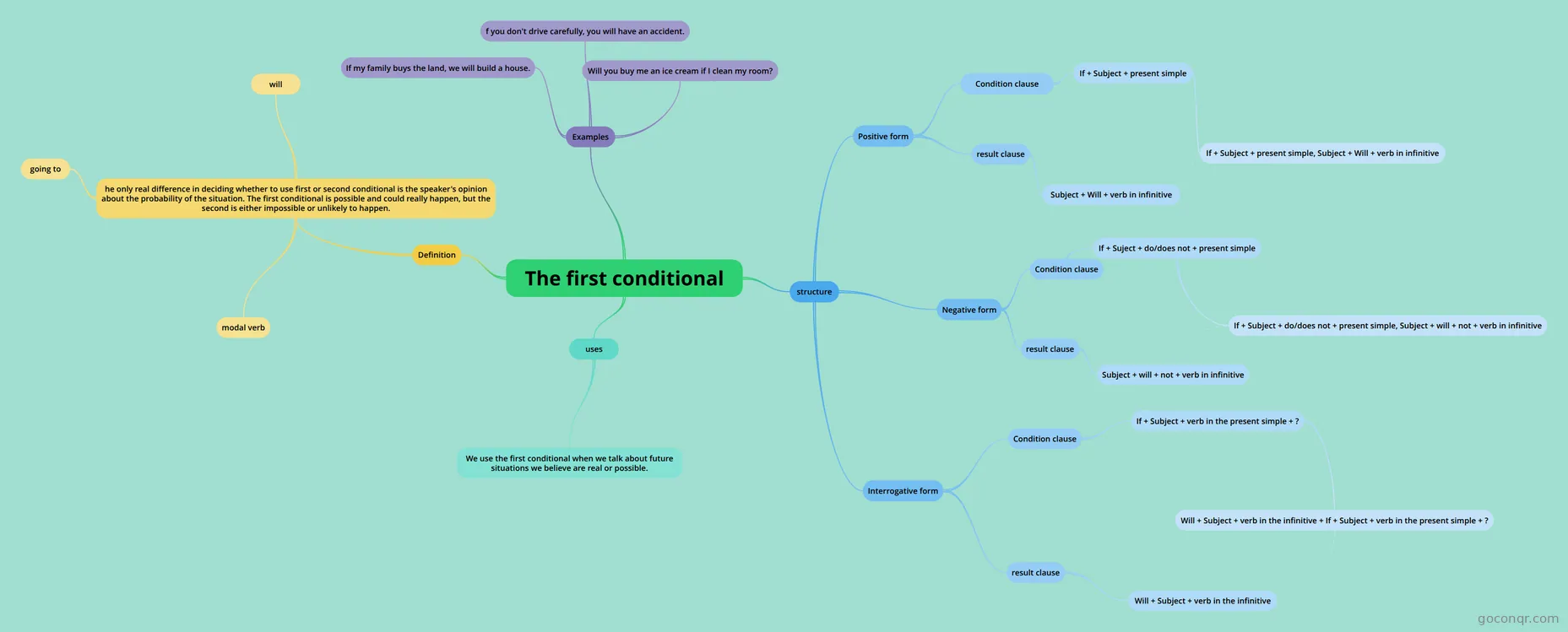
Mind map: The first conditional
Inhalt der Mindmap
The first conditional
uses
- We use the first conditional when we talk about future situations we believe are real or possible.
structure
- Positive form
- Condition clause
- If + Subject + present simple
- If + Subject + present simple, Subject + Will + verb in infinitive
- If + Subject + present simple
- result clause
- Subject + Will + verb in infinitive
- Condition clause
- Negative form
- Condition clause
- If + Suject + do/does not + present simple
- If + Subject + do/does not + present simple, Subject + will + not + verb in infinitive
- If + Suject + do/does not + present simple
- result clause
- Subject + will + not + verb in infinitive
- Condition clause
- Interrogative form
- Condition clause
- If + Subject + verb in the present simple + ?
- Will + Subject + verb in the infinitive + If + Subject + verb in the present simple + ?
- If + Subject + verb in the present simple + ?
- result clause
- Will + Subject + verb in the infinitive
- Condition clause
- Positive form
Definition
- he only real difference in deciding whether to use first or second conditional is the speaker's opinion about the probability of the situation. The first conditional is possible and could really happen, but the second is either impossible or unlikely to happen.
- modal verb
- going to
- will
- he only real difference in deciding whether to use first or second conditional is the speaker's opinion about the probability of the situation. The first conditional is possible and could really happen, but the second is either impossible or unlikely to happen.
Examples
- If my family buys the land, we will build a house.
- f you don't drive carefully, you will have an accident.
- Will you buy me an ice cream if I clean my room?