
Mindmap
Instrumentos de investigación
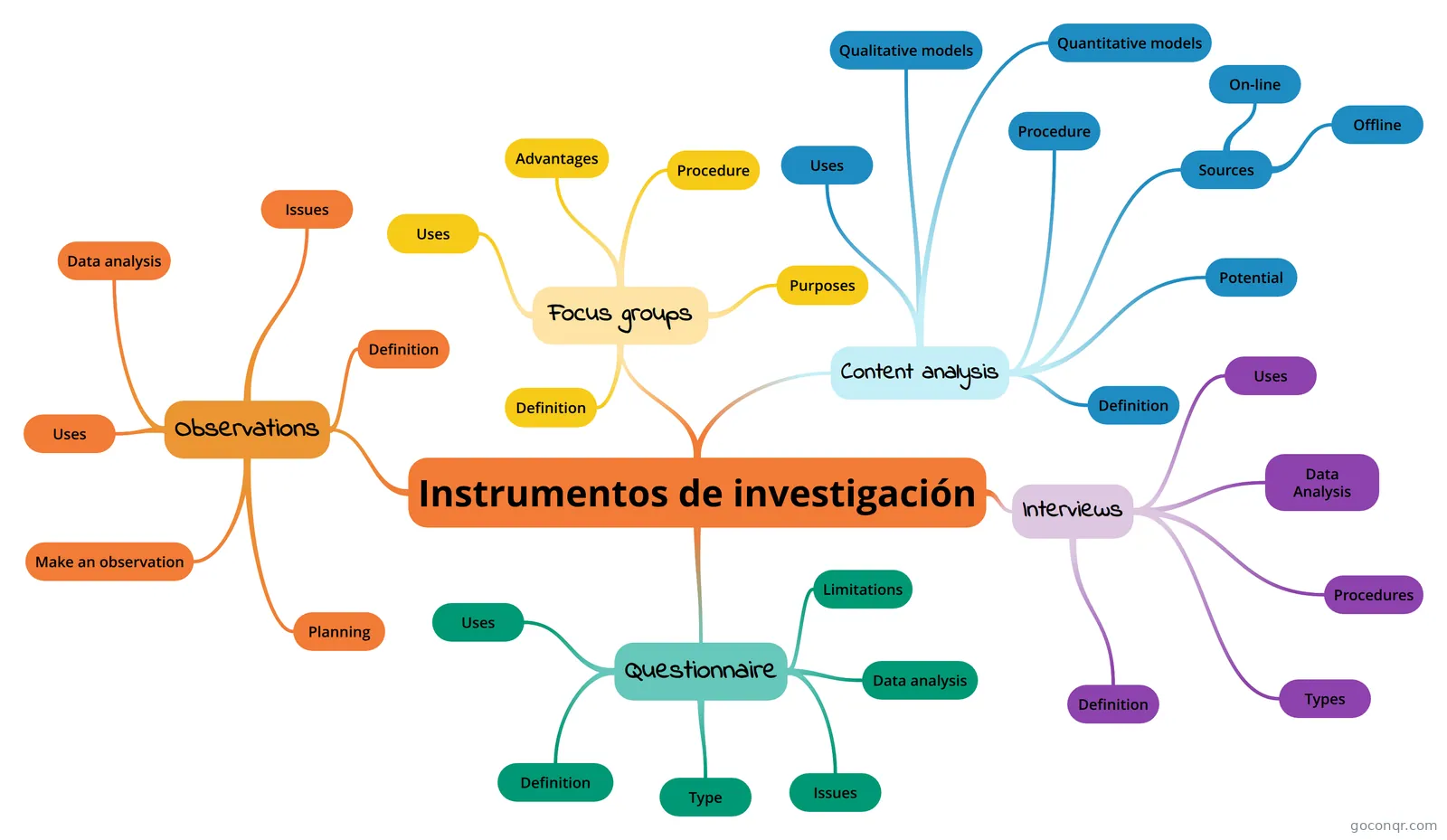
Mind map: Instrumentos de investigación
Inhalt der Mindmap
Instrumentos de investigación
Questionnaire
- Definition
- A questionnaire is a quantifiable data collection technique that takes the form of a series of questions asked in a specific order.
- Type
- On-line questionnaires Written questionnaires (on paper) Telephone questionnaires Face-to-face questionnaires Questionnaire for cross-sectional surveys Questionnaire for longitudinal surveys
- Issues
- Helps to collect quantitative data. In this case, the questionnaire is designed in such a way that it collects a very specific type of information. It can be used to initiate formal research to prove or disprove a hypothesis. An unstructured questionnaire collects qualitative data. The Questionnaire in this case has a basic structure and some branching questions, but nothing that limits a respondent's answers. These questions help to collect in-depth data from a respondent, as there is a large scope for answering in detail, using their own words.
- Data analysis
- Data analysis is a process that will allow you to understand and interpret information in order to identify points of value.
- Uses
- To collect in an organized manner the information that will make it possible to account for the variables of interest in a certain study, research, survey or poll.
- Limitations
- Must have an identifier number, but should not contain personal identifiers of the contain personal identification of the subject, i.e., it must be should be anonymous. Questionnaires provide "soft" information soft" information as opposed to the "hard" information of observation. In addition, they provide affirmations, not measurements. The answers do not necessarily reflect reality, but rather the respondent's perception of it. of reality, but rather the respondent's perception of it. The interviewer is fundamental. The interviewer is essential; he or she "makes himself" and needs great technique and preparation for this purpose. preparation for this purpose. He/she must behave neutrally and not express agreement or surprise.
- Definition
Interviews
- Definition
- An interview is an exchange of ideas or opinions through a conversation between two or more people. All the people present in an interview are engaged in a dialogue about a given issue.
- Types
- Structured interview Unstructured and free-form interview In-depth interview Focused interview Focused interview
- Procedures
- The interview is the big last step in the process of obtaining a green card through marriage, and it can be the most intimidating and stressful element. You can reduce that stress by knowing what to expect and preparing a complete and organized packet to take with you to the interview. Marriage-based green card interviews within the United States are handled by the U.S. Citizenship and Immigration Services (USCIS), while interviews abroad are handled by the U.S. State Department.
- Data Analysis
- Qualitative analysis has no magic formula, no universal rules or one right way to do it. This is both the value and the risk of qualitative research. The truth is that it is a time-consuming and concentrated task that in some cases can become almost chaotic, but with a huge hidden potential to uncover latent needs, differentiate yourself from the competition and have a much deeper understanding of your customers. Qualitative analysis involves a somewhat more intuitive than tangible approach, which cannot always be understood with a dogmatic quantitative mindset. It is a science and an art that not only involves numbers and facts, but also involves desires, expectations, expressions and memory in human experiences.
- Uses
- The interview is one of the instruments whose purpose is to collect data, but due to its flexibility it allows for obtaining more in-depth, detailed information, which even the interviewee and interviewer did not have identified, since it adapts to the context and the characteristics of the interviewee.
- Definition
Content analysis
- Procedure
- To conduct a content analysis it is necessary to study the data, pose the questions and objectives, develop a coding system, define the categories and proceed to coding. In this sense, it is not as simple a process as one might think.
- Sources
- Content analysis forms the bridge between quantitative and qualitative research methods, where some of the organizational issues that are very difficult to study, such as organizational behavior, human resources and customer problems, can be considered. By analyzing the presence of certain words and texts within a given qualitative data, the relationship between words and images, researchers can make inferences about many vital aspects such as audience, behavior, culture and level of satisfaction in social interactions.
- Offline
- Offline content analysis is based on books, journals, essays, interviews, research notes, open-ended questions, and directories. The sample of offline sources will represent the entire universe. However, in many cases, the offline data may be out of date.
- On-line
- With the rapid growth of the Internet, online data sources have gained importance. Online conversations, social media comments, product reviews and customer opinions are collected from the most recent and up-to-date references, making the data source more relevant.
- Potential
- The potential of content analysis is, therefore, broad, and allows its use from both a quantitative and qualitative point of view, taking advantage of the benefits of both approaches when combined in a systematic and reproducible way, which gives it, when applied rigorously, the characteristics of a good scientific methodology. Currently, content analysis is defined as "a research technique consisting of the analysis of social reality through the observation and analysis of documents created or produced within one or more societies".
- Definition
- Content analysis is a qualitative research method often used to analyze the characteristics and features of content. It is an approach used to quantify qualitative information by classifying data and comparing different pieces of information to summarize it into useful information.
- Quantitative models
- Quantitative Content Analysis (QCA) is a research method in which the characteristics of textual, visual or auditory material are systematically classified and recorded for analysis. Widely used in the field of communication, it is also useful in other fields. Fundamental to content analysis is the process of coding, which consists of following a set of instructions on the features to look for in a text and then making the designated annotation when that feature appears. To conduct a successful content analysis, close attention must be paid to unitization (segmenting texts for analysis), sampling (selecting an appropriate collection of units for analysis), reliability (having different researchers perform the codes consistently), and validity (using a coding scheme that adequately represents the specified phenomena).
- Uses
- Content analysis aims to systematically analyze content to extract meaningful insights and patterns from the data. The main objectives of content analysis in qualitative research include: Understanding and interpreting the underlying meanings and nuances in the data.
- Qualitative models
- Qualitative content analysis is a strategy or methodology applied to the social sciences, which has been evolving over the years, with a perspective focused on numerical values in which the meaning and grouping of thematic categories is prioritized. With the MAXQDA tool, both processes can be carried out to achieve a more integrative understanding of content analysis.
- Procedure
Focus groups
- Uses
- To narrate opinions, experiences, beliefs or perceptions of norms. To get feedback in the client's own words about the strengths and weaknesses of the program.
- Advantages
- Topics are specific and controlled Helps to reveal attributes Helps to understand the target audience's perception of the company The moderator can analyze non-verbal responses. Results are easier to analyze Reduces effort compared to individual interviews
- Procedure
- Define the objective of the focus group. Select a moderator. Determine the group of participants. Create the list of questions. Schedules the session date and time. Create an appropriate atmosphere. Provide all necessary information.
- Purposes
- To get feedback in the client's own words about the strengths and weaknesses of the program. To gain a deeper understanding of certain types of issues.
- Definition
- Focus groups involve a series of guided discussions about specific topics with a small select group and are a way of obtaining small group and are a way to obtain information about the needs in your community. about needs in your community.
- Uses
Observations
- Issues
- That observation is the usual way that we human beings use to approach reality, an innate mechanism that allows us to contemplate the world in order to know it, interpret it and learn how to the world in order to know it, interpret it and learn how to manage in it. in it. Observation is, therefore, a privileged instance for learning, even if we are often not sufficiently aware of it. often we are not sufficiently aware of it. Methodical observation is used in the social sciences, which involves an intentional procedure of observation, i.e., one that has an observation, i.e., it has a predetermined purpose and a methodology that allows for the the desired information about the phenomenon of interest. This observation, called methodical or systematic, is one of the bases of scientific knowledge. scientific knowledge. It is very different to observe scientifically in the natural sciences than in the social sciences. social sciences, therefore, in the latter the method has certain characteristics that are different from a natural observation. natural observation.
- Data analysis
- For the analysis and interpretation of the data, they propose the treatment of the data through a comprehensive analysis, articulated on the understanding and tracking of the data, through the search for categories. and tracing of the data, through the search for fundamental categories in the facts that have been described. the facts that have been described throughout the different instruments used in qualitative research. used in qualitative research. Understanding the categories as "ideas, themes, concepts, concepts, interpretations, propositions, propositions, propositions, propositions, propositions, propositions, propositions, concepts, interpretations, propositions, topologies (arising from the observed data or from the evaluator's criteria)"(1). the evaluator's criteria We worked by discriminating and attending to the analyses according to the categories and subcategories registered in the different subcategories recorded in the different instruments: questionnaires; interviews; participant observation: field notes, diary of the observation: field notes, researcher's diary and videos, and finally, reports issued.
- Uses
- Observation is a fundamental element of any research process; the researcher relies on it to obtain as much data as possible. Much of the body of knowledge that constitutes science has been achieved through observation.
- Definition
- It is a technique that consists of attentively observing the phenomenon, fact or case, taking information and recording it for later analysis. Observation is a fundamental element of any research process; the researcher relies on it to obtain as much data as possible.
- Make an observation
- This is the mechanism used by the researcher to collect and record information: Forms, psychological tests, opinion scales, and attitudes. opinion scales, and attitudes.
- Planning
- Describe and explain. Adequate and reliable data. Well-identified behaviors.
- Issues
Informationen
- Beschreibung
- Mindmap am Instrumentos de investigación, erstellt von ROSAURA GÓMEZ am 12/11/2023.
- Erstellt von
- ROSAURA GÓMEZ
- Aufrufe
- 6
- Bewertung