
Mindmap
Introduction to issues in language assessment
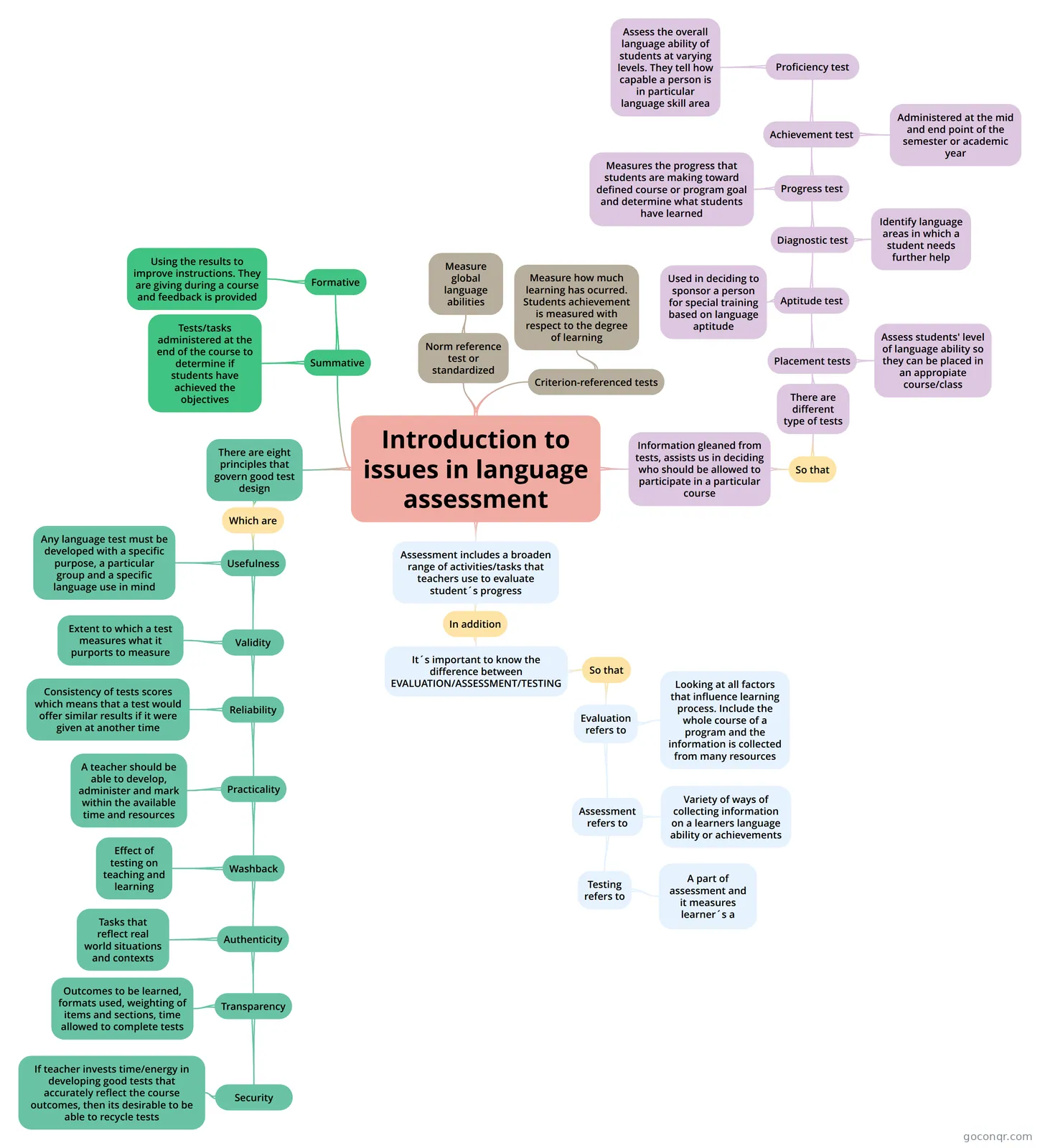
Mind map: Introduction to issues in language assessment
Inhalt der Mindmap
Introduction to issues in language assessment
Assessment includes a broaden range of activities/tasks that teachers use to evaluate student´s progress
- In addition
- It´s important to know the difference between EVALUATION/ASSESSMENT/TESTING
- So that
- Evaluation refers to
- Looking at all factors that influence learning process. Include the whole course of a program and the information is collected from many resources
- Assessment refers to
- Variety of ways of collecting information on a learners language ability or achievements
- Testing refers to
- A part of assessment and it measures learner´s a
- Evaluation refers to
- So that
- It´s important to know the difference between EVALUATION/ASSESSMENT/TESTING
- In addition
Information gleaned from tests, assists us in deciding who should be allowed to participate in a particular course
- So that
- There are different type of tests
- Placement tests
- Assess students' level of language ability so they can be placed in an appropiate course/class
- Aptitude test
- Used in deciding to sponsor a person for special training based on language aptitude
- Diagnostic test
- Identify language areas in which a student needs further help
- Progress test
- Measures the progress that students are making toward defined course or program goal and determine what students have learned
- Achievement test
- Administered at the mid and end point of the semester or academic year
- Proficiency test
- Assess the overall language ability of students at varying levels. They tell how capable a person is in particular language skill area
- Placement tests
- There are different type of tests
- So that
There are eight principles that govern good test design
- Which are
- Usefulness
- Any language test must be developed with a specific purpose, a particular group and a specific language use in mind
- Validity
- Extent to which a test measures what it purports to measure
- Reliability
- Consistency of tests scores which means that a test would offer similar results if it were given at another time
- Practicality
- A teacher should be able to develop, administer and mark within the available time and resources
- Washback
- Effect of testing on teaching and learning
- Authenticity
- Tasks that reflect real world situations and contexts
- Transparency
- Outcomes to be learned, formats used, weighting of items and sections, time allowed to complete tests
- Security
- If teacher invests time/energy in developing good tests that accurately reflect the course outcomes, then its desirable to be able to recycle tests
- Usefulness
- Which are
Criterion-referenced tests
- Measure how much learning has ocurred. Students achievement is measured with respect to the degree of learning
Norm reference test or standardized
- Measure global language abilities
Summative
- Tests/tasks administered at the end of the course to determine if students have achieved the objectives
- Formative
- Using the results to improve instructions. They are giving during a course and feedback is provided
Informationen
- Beschreibung
- Mindmap am Introduction to issues in language assessment, erstellt von LAURA VALENTINA CHAPARRO SOTO am 16/02/2024.
- Erstellt von
- LAURA VALENTINA CHAPARRO SOTO
- Aufrufe
- 1
- Bewertung
Mehr zu Types and Approaches to Language Testing