
Mindmap
AP Calculus Concept Map
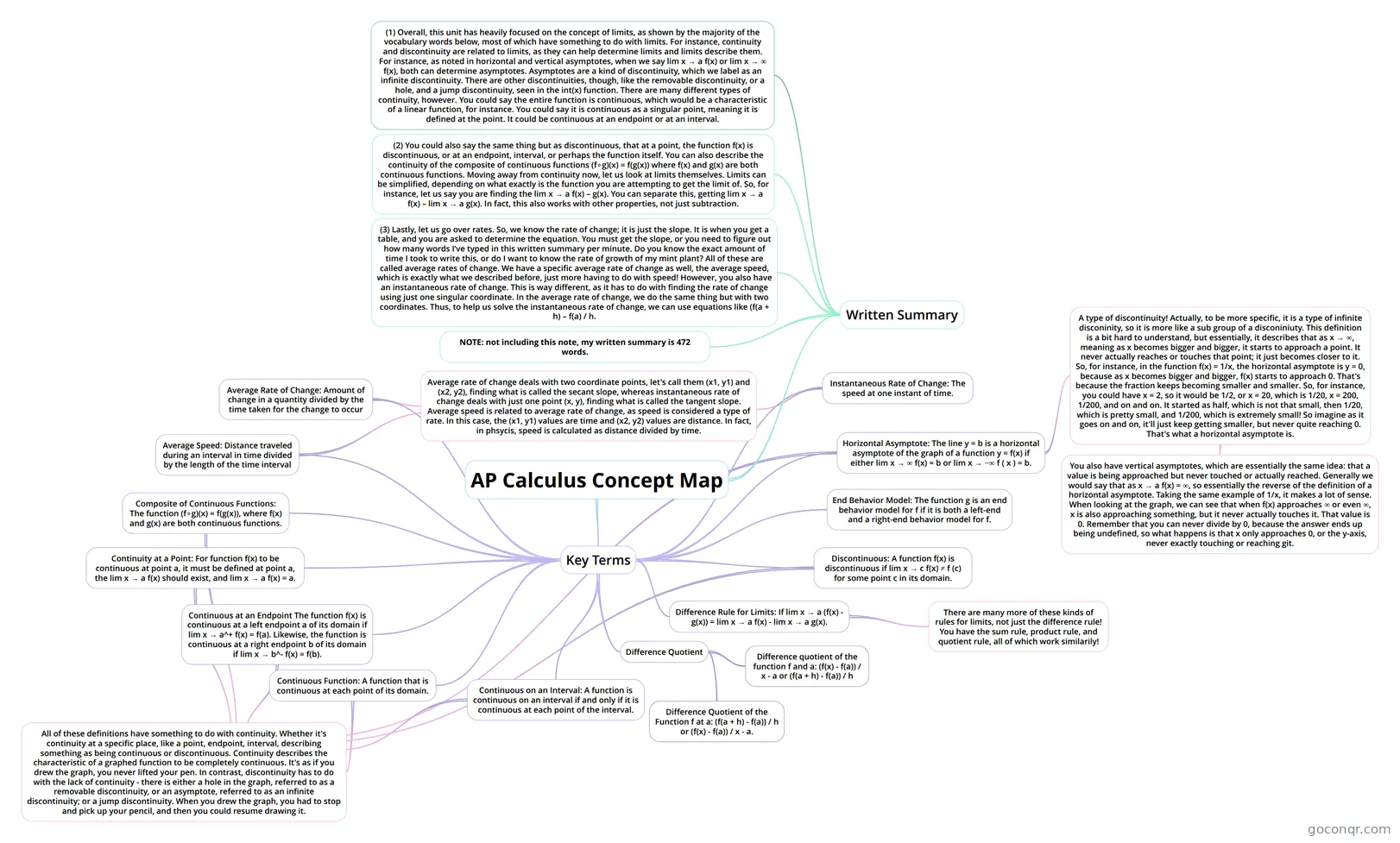
Mind map: AP Calculus limits and continuity
Inhalt der Mindmap
AP Calculus Concept Map
Key Terms
- Average Rate of Change: Amount of change in a quantity divided by the time taken for the change to occur
- Average rate of change deals with two coordinate points, let's call them (x1, y1) and (x2, y2), finding what is called the secant slope, whereas instantaneous rate of change deals with just one point (x, y), finding what is called the tangent slope. Average speed is related to average rate of change, as speed is considered a type of rate. In this case, the (x1, y1) values are time and (x2, y2) values are distance. In fact, in phsycis, speed is calculated as distance divided by time.
- Average Speed: Distance traveled during an interval in time divided by the length of the time interval
- Composite of Continuous Functions: The function (f∘g)(x) = f(g(x)), where f(x) and g(x) are both continuous functions.
- Continuity at a Point: For function f(x) to be continuous at point a, it must be defined at point a, the lim x → a f(x) should exist, and lim x → a f(x) = a.
- Continuous at an Endpoint The function f(x) is continuous at a left endpoint a of its domain if lim x → a^+ f(x) = f(a). Likewise, the function is continuous at a right endpoint b of its domain if lim x → b^- f(x) = f(b).
- Continuous Function: A function that is continuous at each point of its domain.
- All of these definitions have something to do with continuity. Whether it's continuity at a specific place, like a point, endpoint, interval, describing something as being continuous or discontinuous. Continuity describes the characteristic of a graphed function to be completely continuous. It's as if you drew the graph, you never lifted your pen. In contrast, discontinuity has to do with the lack of continuity - there is either a hole in the graph, referred to as a removable discontinuity, or an asymptote, referred to as an infinite discontinuity; or a jump discontinuity. When you drew the graph, you had to stop and pick up your pencil, and then you could resume drawing it.
- Continuous on an Interval: A function is continuous on an interval if and only if it is continuous at each point of the interval.
- Difference Quotient
- Difference Quotient of the Function f at a: (f(a + h) - f(a)) / h or (f(x) - f(a)) / x - a.
- Difference quotient of the function f and a: (f(x) - f(a)) / x - a or (f(a + h) - f(a)) / h
- Difference Rule for Limits: If lim x → a (f(x) - g(x)) = lim x → a f(x) - lim x → a g(x).
- There are many more of these kinds of rules for limits, not just the difference rule! You have the sum rule, product rule, and quotient rule, all of which work similarily!
- Discontinuous: A function f(x) is discontinuous if lim x → c f(x) ≠ f (c) for some point c in its domain.
- End Behavior Model: The function g is an end behavior model for f if it is both a left-end and a right-end behavior model for f.
- Horizontal Asymptote: The line y = b is a horizontal asymptote of the graph of a function y = f(x) if either lim x → ∞ f(x) = b or lim x → −∞ f ( x ) = b.
- A type of discontinuity! Actually, to be more specific, it is a type of infinite disconinity, so it is more like a sub group of a disconiniuty. This definition is a bit hard to understand, but essentially, it describes that as x → ∞, meaning as x becomes bigger and bigger, it starts to approach a point. It never actually reaches or touches that point; it just becomes closer to it. So, for instance, in the function f(x) = 1/x, the horizontal asymptote is y = 0, because as x becomes bigger and bigger, f(x) starts to approach 0. That's because the fraction keeps becoming smaller and smaller. So, for instance, you could have x = 2, so it would be 1/2, or x = 20, which is 1/20, x = 200, 1/200, and on and on. It started as half, which is not that small, then 1/20, which is pretty small, and 1/200, which is extremely small! So imagine as it goes on and on, it'll just keep getting smaller, but never quite reaching 0. That's what a horizontal asymptote is.
- You also have vertical asymptotes, which are essentially the same idea: that a value is being approached but never touched or actually reached. Generally we would say that as x → a f(x) = ∞, so essentially the reverse of the definition of a horizontal asymptote. Taking the same example of 1/x, it makes a lot of sense. When looking at the graph, we can see that when f(x) approaches ∞ or even ∞, x is also approaching something, but it never actually touches it. That value is 0. Remember that you can never divide by 0, because the answer ends up being undefined, so what happens is that x only approaches 0, or the y-axis, never exactly touching or reaching git.
- A type of discontinuity! Actually, to be more specific, it is a type of infinite disconinity, so it is more like a sub group of a disconiniuty. This definition is a bit hard to understand, but essentially, it describes that as x → ∞, meaning as x becomes bigger and bigger, it starts to approach a point. It never actually reaches or touches that point; it just becomes closer to it. So, for instance, in the function f(x) = 1/x, the horizontal asymptote is y = 0, because as x becomes bigger and bigger, f(x) starts to approach 0. That's because the fraction keeps becoming smaller and smaller. So, for instance, you could have x = 2, so it would be 1/2, or x = 20, which is 1/20, x = 200, 1/200, and on and on. It started as half, which is not that small, then 1/20, which is pretty small, and 1/200, which is extremely small! So imagine as it goes on and on, it'll just keep getting smaller, but never quite reaching 0. That's what a horizontal asymptote is.
- Instantaneous Rate of Change: The speed at one instant of time.
- Average Rate of Change: Amount of change in a quantity divided by the time taken for the change to occur
Written Summary
- (1) Overall, this unit has heavily focused on the concept of limits, as shown by the majority of the vocabulary words below, most of which have something to do with limits. For instance, continuity and discontinuity are related to limits, as they can help determine limits and limits describe them. For instance, as noted in horizontal and vertical asymptotes, when we say lim x → a f(x) or lim x → ∞ f(x), both can determine asymptotes. Asymptotes are a kind of discontinuity, which we label as an infinite discontinuity. There are other discontinuities, though, like the removable discontinuity, or a hole, and a jump discontinuity, seen in the int(x) function. There are many different types of continuity, however. You could say the entire function is continuous, which would be a characteristic of a linear function, for instance. You could say it is continuous as a singular point, meaning it is defined at the point. It could be continuous at an endpoint or at an interval.
- (2) You could also say the same thing but as discontinuous, that at a point, the function f(x) is discontinuous, or at an endpoint, interval, or perhaps the function itself. You can also describe the continuity of the composite of continuous functions (f∘g)(x) = f(g(x)) where f(x) and g(x) are both continuous functions. Moving away from continuity now, let us look at limits themselves. Limits can be simplified, depending on what exactly is the function you are attempting to get the limit of. So, for instance, let us say you are finding the lim x → a f(x) – g(x). You can separate this, getting lim x → a f(x) – lim x → a g(x). In fact, this also works with other properties, not just subtraction.
- (3) Lastly, let us go over rates. So, we know the rate of change; it is just the slope. It is when you get a table, and you are asked to determine the equation. You must get the slope, or you need to figure out how many words I’ve typed in this written summary per minute. Do you know the exact amount of time I took to write this, or do I want to know the rate of growth of my mint plant? All of these are called average rates of change. We have a specific average rate of change as well, the average speed, which is exactly what we described before, just more having to do with speed! However, you also have an instantaneous rate of change. This is way different, as it has to do with finding the rate of change using just one singular coordinate. In the average rate of change, we do the same thing but with two coordinates. Thus, to help us solve the instantaneous rate of change, we can use equations like (f(a + h) – f(a) / h.
- NOTE: not including this note, my written summary is 472 words.
Informationen
- Beschreibung
- Mindmap am AP Calculus Concept Map, erstellt von Maya Faour am 16/09/2024.
- Erstellt von
- Maya Faour
- Aufrufe
- 0
- Bewertung