
4040536
Beschreibung

Mindmap von Nur Fadzliyana, aktualisiert more than 1 year ago

|
Erstellt von Nur Fadzliyana
vor etwa 10 Jahre
|
|
The Protists Mind Map
- Algae
- Unicellular, colonial, filamentous or larger forms such as seaweeds
- Photosynthetic; freshwater and marine water habitats; main component of plankton
- Basis of the food web in most aquatic habitats-some produce neurotoxin
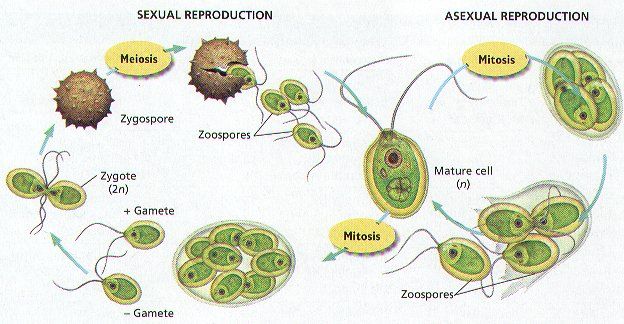
- asexual and sexual reproduction
- example; chlorophyta, rhodophyta,phaeophyta,chrysophyta,phrrophyta
- Unicellular, colonial, filamentous or larger forms such as seaweeds
- Protozoa
- unicellular,lack cell wall,no chlorophyll,some are pathogen
- aerobic,anaerobic chemoheterotrophic organism
- asexual by binary fission and mitosis, sexual by conjugation/produce gametes
- major
groups
- Archaezoa
-flagellated,trypanosoma
gambiense,African sleeping
sickness
- Rhizopoda
-Amoeba,phagocytosis,cause
amoebic dysentery
- Ciliophora
-Paramecium,possess
cilia,Balantidium coli
- Apicomplexa
-not motile in
mature
forms,obligate
parasites,cause
Malaria and
toxoplasmosis
- Archaezoa
-flagellated,trypanosoma
gambiense,African sleeping
sickness
- important in food webs and decomposing organic matter
- unicellular,lack cell wall,no chlorophyll,some are pathogen
- Slime molds
- moist terrestrial habitats
- engulf bacterial
- as decomposer and consumer
- three divisions
- 1. Myxomycota
(plasmodial slime molds)
- 2. Acrasiomycota
(cellular slime molds
and individual
amoeboid cells)
- 3.
Peronosporomycetes
(water molds
- 1. Myxomycota
(plasmodial slime molds)
- moist terrestrial habitats
Medienanhänge
Möchten Sie kostenlos Ihre eigenen Mindmaps mit GoConqr erstellen? Mehr erfahren.