
Mindmap
PPROMT Lancet Nov 2015
Inhalt der Mindmap
PPROMT Lancet Nov 2015
STUDY DESIGN
- 65 centres in 11 countries
- 2004-2013
- All able to care for >= 34/40 babies
- 34-36+6 weeks
- Exclusions: labour, chorio, meconium. NOT GBS colonisation
- 1:1 randomisation
- Immediate delivery: scheduled asap & within 24 hours
- Expectant: after spont labour, term IOL or for usual indications
- Antibiotics as per usual protocols
- Primary outcome: definitive or probably neonatal sepsis
- Definite: culture + from blood/CSF, treated >5 days & clinical signs of infection.
- Probable: clinical signs for which baby received ABx for >5d, plus abnormal pathology
- Secondary outcomes
- Composite neonatal morbidity/mortality indicator: sepsis, ventilation >24h, SB/NND
- RDS, perinatal mortality, any ventilation, NICU stay, hospital stay, birth weight, SGA, Apgar <7@5m, antibiotics, LP, art line use, inotropes, breastfeeding on discharge
- Maternal: APH, IPH, VTE, cord prolapse, antibiotics postpartum, intrapartum fever, PPH, mode of delivery, labour onset, & hospital stay
- Sample size needed
- 906 per group to detect reduction of 5% in expectant group vs 2.5% in immediate group @5% sig/80% power
- All analyses intention to treat
- 65 centres in 11 countries
RESULTS
- 924 immediate delivery (ID) 915 expectant management (EM)
- 13 in immediate group & 1 in expectant group did not receive intervention
- 1 lost to follow up & 2 withdrew in IM and 1 lost to follow up in EM
- Primary outcome assessed for 1835: 923 ID & 912 EM
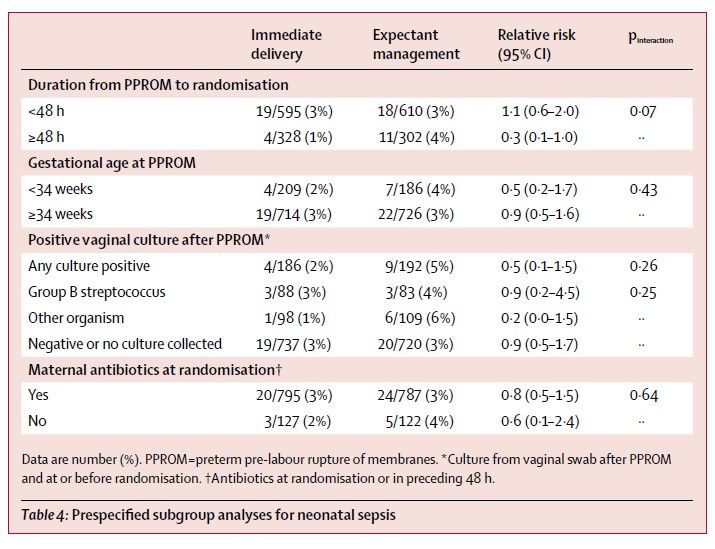
- Probable/definite neonatal sepsis: NSD (2% vs 3%)
- Compared to EM, ID had no effect on neonatal sepsis regardless of GA at PPROM, duration or antibiotic use & no difference if GBS + at randomisation
- Probable/definite neonatal sepsis: NSD (2% vs 3%)
- Baseline maternal & pregnancy characteristics similar (including GBS status)
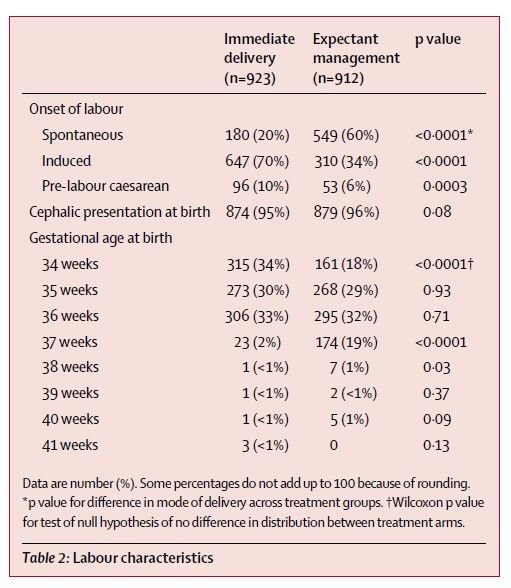
- At randomisation: 79/78% had swabs collected & 26/27% were abnormal. Overall 12% GBS rate in both groups
- Steroids: 40% in each group
- Antibiotics in previous 48h: 86% each group
- 'Any antibiotics' 92% vs 93%
- EM: 75% managed as inpatient
- Secondary outcomes
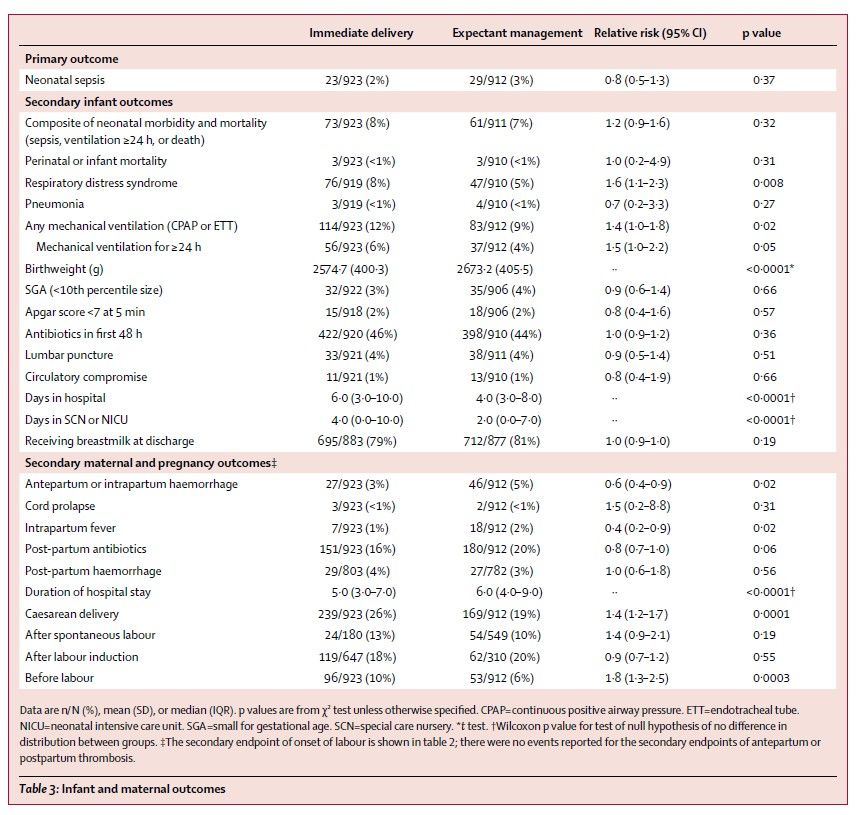
- Composite neonatal outcome: NSD (8% vs 7%)
- Birthweight: SD - 2574g vs 2673g
- RDS: SD - 8% vs 5%
- Mechanical ventilation: SD - 12% vs 9%
- Days in SCN/NICU: SD - 4 vs 2 days
- 3 deaths in each group: = SIDS x1 (ID/EM), congen abn x1 (ID/EM), sepsis x1 (ID), uknown x1 (EM)
- Maternal outcomes
- Maternal outcomes favouring immediate delivery
- APH: SD - 3% vs 5%
- Fever: SD - 1% vs 2%
- Maternal outcomes favouring exepctant management
- LSCS: SD - 26% vs 19%
- 6% of EM delivered due to chorio
- Maternal outcomes favouring immediate delivery
- 924 immediate delivery (ID) 915 expectant management (EM)
BACKGROUND
- PROM 20% of all births & 40% of preterm births
- Term: IOL preferable
- Preterm: not clear for >34/40
- Risks of delay: abruption, infection, fetal distress, cord prolapse
- Risk of IOL:even mild prematurity linked with health burden
- PROM 20% of all births & 40% of preterm births
Mind map by Danny Tucker
Jonathan M Morris, Christine L Roberts, Jennifer R Bowen, Jillian A Patterson, Diana M Bond, Charles S Algert, Jim G Thornton, Caroline A Crowther, on behalf of the PPROMT Collaboration
Bilder und Dateien der Mindmap










Informationen
- Beschreibung
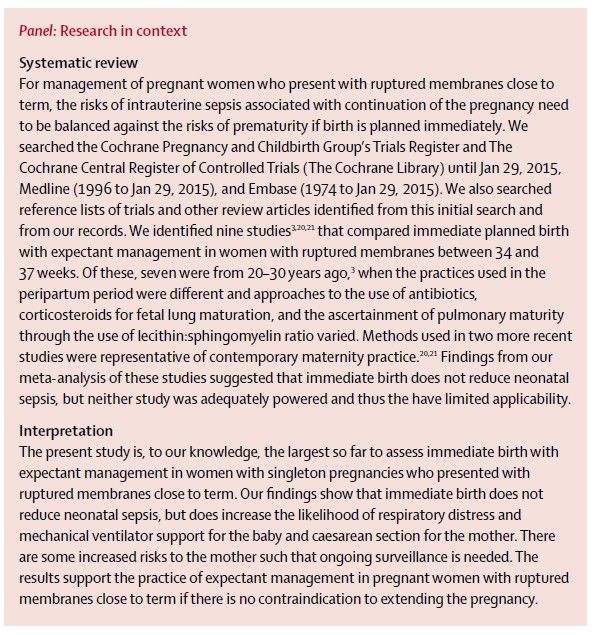
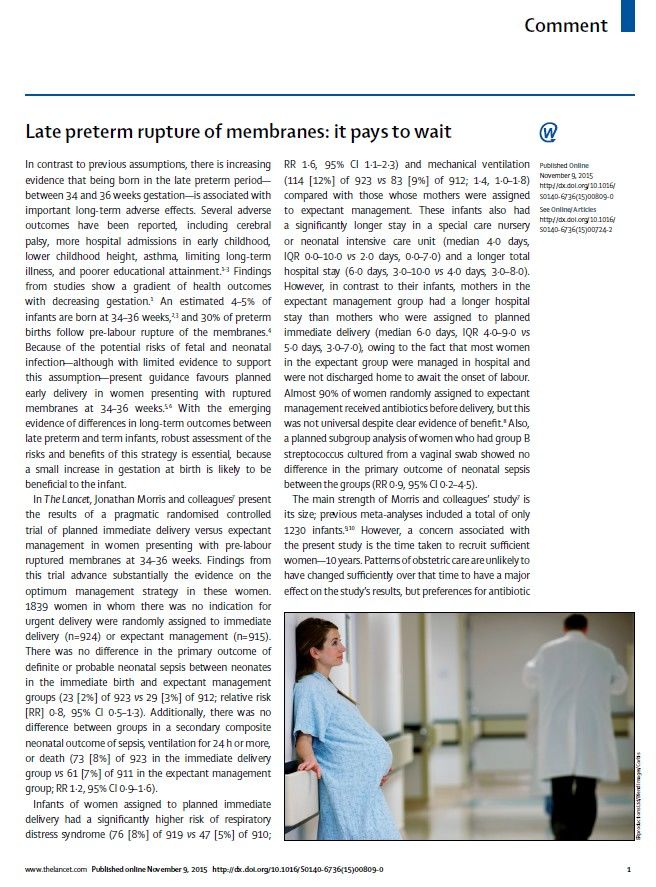
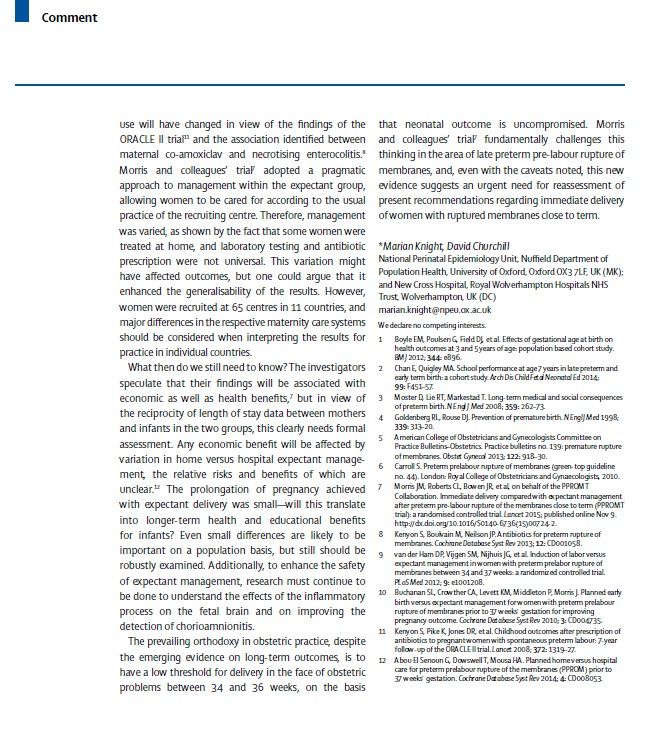
- Preterm pre-labour ruptured membranes close to term is associated with increased risk of neonatal infection, but immediate delivery is associated with risks of prematurity. The balance of risks is unclear. This study aimed to establish whether immediate birth in singleton pregnancies with ruptured membranes close to term reduces neonatal infection without increasing other morbidity (http://www.thelancet.com/journals/lancet/article/PIIS0140-6736%2815%2900724-2/abstract)
- Erstellt von
- Danny Tucker
- Aufrufe
- 328
- Tags
- Bewertung