
Quiz
Anatomy of Surgical Incisions in Obstetrics & Gynaecology
This quiz has question types that open in the usual player.
Questions in this quiz (32)
1The common vertical incision used in O&G to access the abdomen is known as a [blank_start]laparotomy[blank_end]
- Alaparotomy
2The incision for a caesarian section is typically conducted [blank_start]horizontally[blank_end] [blank_start]2cm[blank_end] above the [blank_start]pubic symphysis[blank_end]
- Apubic symphysis
- Biliac crests
- C2cm
- D4cm
- Ehorizontally
- Fvertically
3In order to reduce scarring, surgical incisions in O&G are made in an attempt to follow the tension lines of the skin known as [blank_start]Langer[blank_end] lines
- ALanger
4What are the three layers of abdominal fascia called?
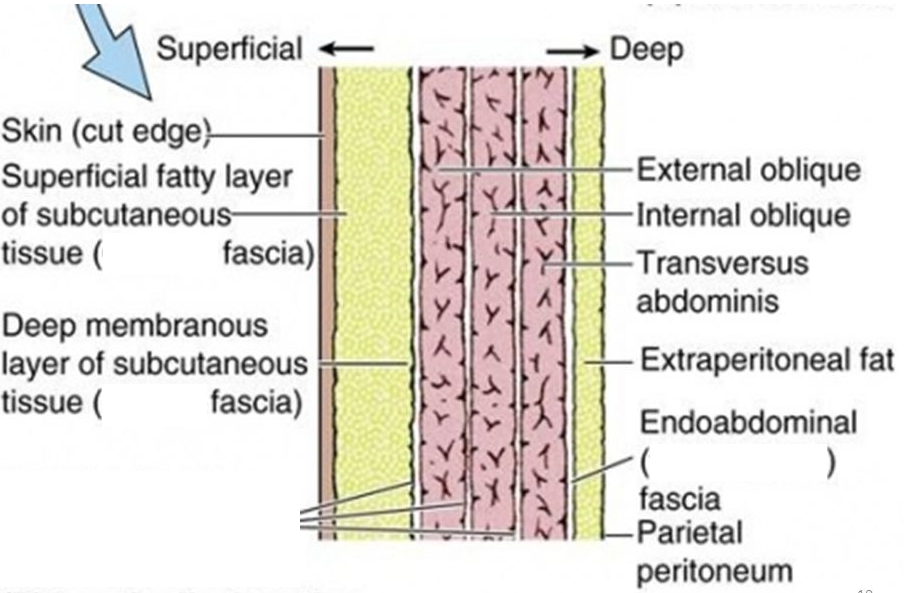
- ACamper's Fascia
- BScarpa's Fascia
- CTransversalis Fascia
5Which of the three layers of abdominal fascia are found beneath the oblique musculature?
[blank_start]Transversalis[blank_end] fascia- ATransversalis
6Arrange the 4 groups of abdominal muscles from superficial to deep:
[blank_start]External oblique muscles[blank_end]
[blank_start]Internal oblique muscles[blank_end]
[blank_start]Rectus abdominis muscles[blank_end]
[blank_start]Transversus abdominis muscles[blank_end]- AExternal oblique muscles
- BInternal oblique muscles
- CRectus abdominis muscles
- DTransversus abdominis muscles
7Which direction do the external oblique muscles run in?
- APostero-anteriorly
- BAntero-Posteriorly
8Superiorly, the external oblique muscles attach to ribs [blank_start]5-11[blank_end]
- A5-11
- B5-12
- C6-11
- D6-10
9The external intercostals are joined by a fibrous sheath called an aponeurosis. Name the midline section where the two aponeuroses meet and blend together.
The [blank_start]Linea Alba[blank_end]- ALinea Alba
10As well as the linea alba, which two other structures do the external obliques attach to inferiorly?
- APubic tubercle
- BIliac crest
- CASIS
- DIschial spine
11The internal obliques run in the [blank_start]antero-posterior[blank_end] direction
- Aantero-posterior
- Bpostero-anterior
12An aponeurosis is a flattened [blank_start]tendon[blank_end]
- Atendon
- Bligament
- Cfibrous capsule
- Dmuscle
13Which abdominal muscles attach to the thoracolumbar fascia found on the back of the body?
- AExternal obliques
- BInternal obliques
- CTransversus Abdominis
14Which bony feature of the pelvis do all abdominal muscles apart from the rectus abdominis attach to?
- APubic Tubercle
- BIliac Crest
- CASIS
- DIschial Spine
15The aponeurosis that exists lateral to the rectus abdominis muscles is known as the linea [blank_start]semilunaris[blank_end]
- Asemilunaris
16What is the name of the strong, fibrous layer that surrounds the rectus abdominis muscles and is made up of the combined aponeuroses of transversus abdominis, external oblique and internal oblique muscles?
[blank_start]Rectus sheath[blank_end]- ARectus sheath
17Which line, lying halfway between the pubic crest and umbilicus, demarcates the lower part of the rectus sheath?
The [blank_start]Arcuate[blank_end] line- AArcuate
18Which lateral abdominal muscle is always superficial to the rectus abdominis in the rectus sheath?
- AExternal Oblique
- BInternal Oblique
- CTransversus Abdominis
19Which muscle splits into anterior and posterior 'leaflets' in the rectus sheath above the acuate line?
- AExternal oblique
- BInternal oblique
- CTransversus Abdominis
20The only notable difference above and below the arcuate line is that above the arcuate line the internal oblique is split into two leaflets, one of which is superficial and the other deep to the rectus abdominis, whereas below the arcuate line the whole internal oblique lies superficial to the rectus abdominis.
- ATrue
- BFalse
21What is the vertebral level os the subcostal nerve?
[blank_start]T12[blank_end]- AT12
22Blood supply to the anterolateral abdominal wall:
Anterior Abdominal Wall:
Superior & Inferior [blank_start]epigastric[blank_end] arteries
Lateral Abdominal Wall:
[blank_start]Intercostal[blank_end] and [blank_start]subcostal[blank_end] arteries (alphabetical order)- Aepigastric
- Bsubcostal
- CIntercostal
23Blood supply to the anterior abdominal wall:
The Superior Epigastric Arteries are a continuation of the [blank_start]internal thoracic[blank_end] artery
The Inferior Epigastric Arteries are branches of the [blank_start]External Iliac[blank_end] Artery- AExternal Iliac
- Binternal thoracic
24What are the internal thoracic arteries and veins also known as in women?
The [blank_start]mammary[blank_end] arteries and veins- Amammary
25What is the vertebral level of the ilioinguinal and iliohypogastric nerves that supply the anterolateral abdominal wall?
[blank_start]L1[blank_end]- AL1
26Between which two muscles do the abdominal nerves travel?
- AExternal Oblique
- BInternal Oblique
- CTransversus Abdominis
27In a Caesarean section, the rectus abdominis muscles are cut in order to reach the uterus.
- ATrue
- BFalse
28Which structure is found halfway between ASIS and pubic tubercle, and is the emerging point for the inferior epigastric artery into the abdomen?
[blank_start]Deep inguinal ring[blank_end]- ADeep inguinal ring
29What triangle is formed from the lateral border of rectus sheath medially, the inguinal ligament inferiorly and the inferior epigastric artery laterally?
The [blank_start]Inguinal[blank_end] Triangle- AInguinal
30Direct vs Indirect Hernias:
First, reduce the hernia and put pressure on the deep inguinal ring (halfway between ASIS and pubic tubercle). Following this ask the patient to cough.
If it pops out upon coughing, it's [blank_start]a direct[blank_end] inguinal hernia (through rectus muscle)
If it doesn't pop out upon coughing, it's [blank_start]an indirect[blank_end] inguinal hernia (it passes through the deep inguinal ring, which you're blocking)- Aa direct
- Ban indirect
- Can indirect
- Da direct
31Direct inguinal hernias occur [blank_start]medially[blank_end] to the inferior epigastric artery.
Indirect inguinal hernias occur [blank_start]laterally[blank_end] to the inferior epigastric artery.- Alaterally
- Bmedially
- Cmedially
- Dlaterally
32The incision used to conduct a hysterectomy is the same that is used to conduct a caesarean section
- ATrue
- BFalse
Information
- Description
- Anatomy lecture given by luke reid on the monday of week 4. It would be best to go through this lecture using the pictures in the lecture as it makes things much easier given there's a lot of talk of insertions and attachments.
- Author
- Matthew Coulson
- Language
- English
- Views
- 137
- History
- Created on 1 Dec 2018 · updated on 1 Dec 2018
- Tags
- Rating
- No ratings yet Rate this quiz