
Mindmap
WORDS AND WORD CLASSES MIND MAP COPIA
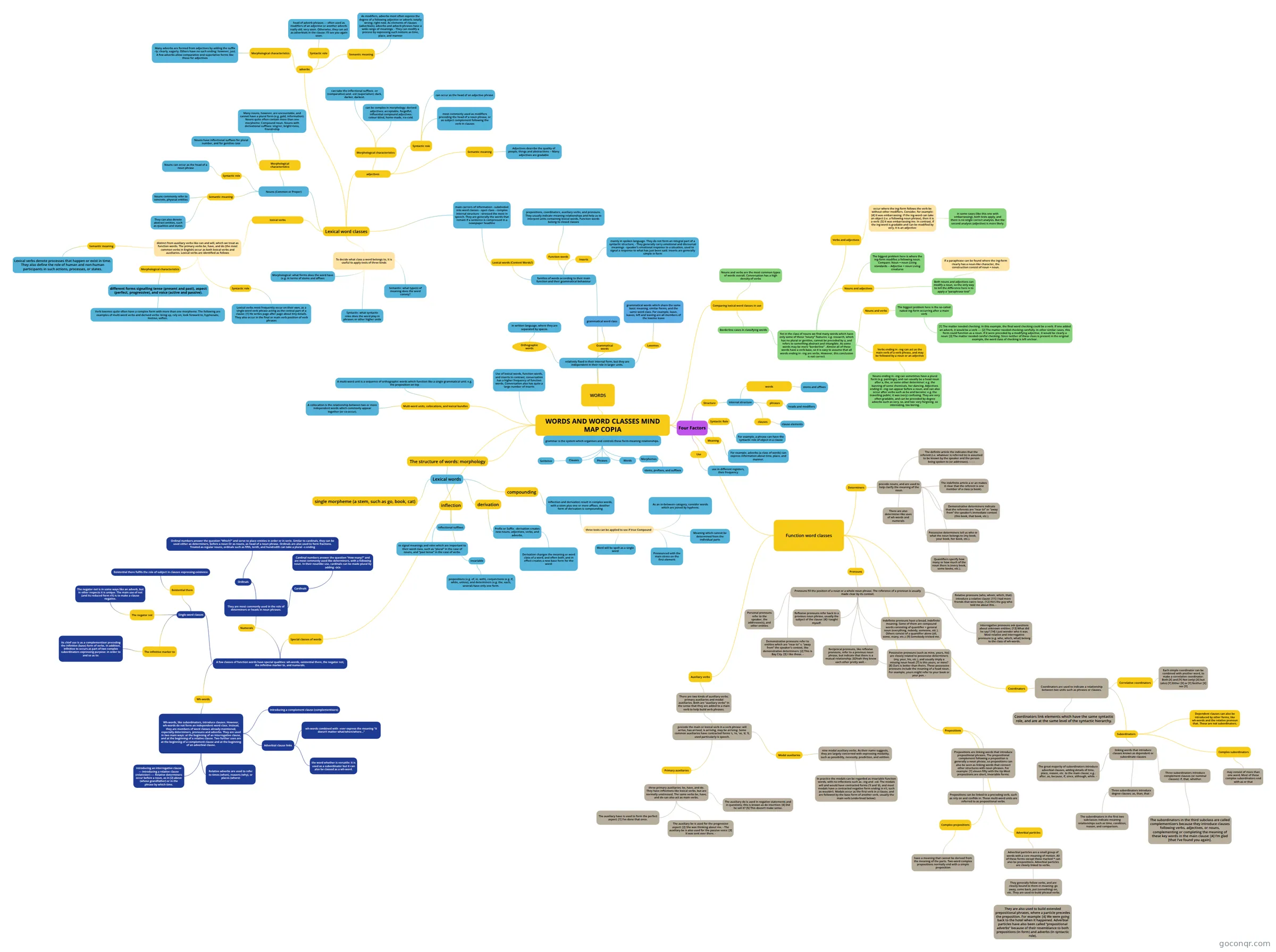
Mind map: words and word classes
Inhalt der Mindmap
WORDS AND WORD CLASSES MIND MAP COPIA
grammar is the system which organises and controls these form-meaning relationships.
- Phrases
- Clauses
- Words
- Morphemes
- stems, prefixes, and suffixes
- Sentence
Four Factors
- Structure
- internal structure
- words
- stems and affixes
- phrases
- heads and modifiers
- clauses
- clause elements
- words
- internal structure
- Syntactic Role
- For example, a phrase can have the syntactic role of object in a clause
- Meaning
- For example, adverbs (a class of words) can express information about time, place, and manner.
- Use
- use in different registers, their frequency
- Structure
WORDS
- relatively fixed in their internal form, but they are independent in their role in larger units.
- Orthographic words
- in written language, where they are separated by spaces.
- Grammatical words
- grammatical word class
- Lexemes
- grammatical words which share the same basic meaning, similar forms, and the same word class. For example, leave, leaves, left and leaving are all members of the lexeme leave
- Orthographic words
- families of words according to their main function and their grammatical behaviour
- Function words
- prepositions, coordinators, auxiliary verbs, and pronouns. They usually indicate meaning relationships and help us to interpret units containing lexical words, Function words belong to closed classes
- Lexical words (Content Words?)
- main carriers of information - subdivided into word classes - open class - complex internal structure - stressed the most in speech. They are generally the words that remain if a sentence is compressed in a newspaper headline
- Lexical word classes
- Nouns (Common or Proper)
- Morphological characteristics
- Nouns have inflectional suffixes for plural number, and for genitive case
- Many nouns, however, are uncountable, and cannot have a plural form (e.g. gold, information). Nouns quite often contain more than one morpheme: Compound noun. Nouns with derivational suffixes: sing+er, bright+ness, friend+ship
- Syntactic role
- Nouns can occur as the head of a noun phrase
- Semantic meaning
- Nouns commonly refer to concrete, physical entities
- They can also denote abstract entities, such as qualities and states
- Morphological characteristics
- lexical verbs
- distinct from auxiliary verbs like can and will, which we treat as function words. The primary verbs be, have, and do (the most common verbs in English) occur as both lexical verbs and auxiliaries. Lexical verbs are identified as follows
- Morphological characteristics
- different forms signalling tense (present and past), aspect (perfect, progressive), and voice (active and passive).
- Verb lexemes quite often have a complex form with more than one morpheme. The following are examples of multi-word verbs and derived verbs: bring up, rely on, look forward to, hyphenate, itemise, soften.
- different forms signalling tense (present and past), aspect (perfect, progressive), and voice (active and passive).
- Syntactic role
- Lexical verbs most frequently occur on their own, as a single-word verb phrase acting as the central part of a clause: [1] He writes page after page about tiny details. They also occur in the final or main verb position of verb phrases
- Semantic meaning
- Lexical verbs denote processes that happen or exist in time. They also define the role of human and non-human participants in such actions, processes, or states.
- Morphological characteristics
- distinct from auxiliary verbs like can and will, which we treat as function words. The primary verbs be, have, and do (the most common verbs in English) occur as both lexical verbs and auxiliaries. Lexical verbs are identified as follows
- adjectives
- Morphological characteristics
- can take the inflectional suffixes –er (comparative) and –est (superlative): dark, darker, darkest.
- can be complex in morphology: derived adjectives: acceptable, forgetful, influential compound adjectives: colour-blind, home-made, ice-cold.
- Syntactic role
- can occur as the head of an adjective phrase
- most commonly used as modifiers preceding the head of a noun phrase, or as subject complement following the verb in clauses
- Semantic meaning
- Adjectives describe the quality of people, things and abstractions -- Many adjectives are gradable
- Adjectives describe the quality of people, things and abstractions -- Many adjectives are gradable
- Adjectives describe the quality of people, things and abstractions -- Many adjectives are gradable
- Morphological characteristics
- adverbs
- Morphological characteristics
- Many adverbs are formed from adjectives by adding the suffix –ly: clearly, eagerly. Others have no such ending: however, just. A few adverbs allow comparative and superlative forms like those for adjectives
- Syntactic role
- head of adverb phrases --- often used as modifiers of an adjective or another adverb: really old, very soon. Otherwise, they can act as adverbials in the clause: I’ll see you again soon.
- Semantic meaning
- As modifiers, adverbs most often express the degree of a following adjective or adverb: totally wrong; right now. As elements of clauses (adverbials), adverbs and adverb phrases have a wide range of meanings: - They can modify a process by expressing such notions as time, place, and manner
- As modifiers, adverbs most often express the degree of a following adjective or adverb: totally wrong; right now. As elements of clauses (adverbials), adverbs and adverb phrases have a wide range of meanings: - They can modify a process by expressing such notions as time, place, and manner
- Morphological characteristics
- To decide what class a word belongs to, it is useful to apply tests of three kinds
- Morphological: what forms does the word have (e.g. in terms of stems and affixes
- Syntactic: what syntactic roles does the word play in phrases or other higher units
- Semantic: what type(s) of meaning does the word convey?
- Nouns (Common or Proper)
- Lexical word classes
- main carriers of information - subdivided into word classes - open class - complex internal structure - stressed the most in speech. They are generally the words that remain if a sentence is compressed in a newspaper headline
- Inserts
- mainly in spoken language. They do not form an integral part of a syntactic structure, - They generally carry emotional and discoursal meanings - speaker’s emotional response to a situation, used to signal a response to what has just been said. Inserts are generally simple in form
- Function words
- relatively fixed in their internal form, but they are independent in their role in larger units.
The structure of words: morphology
- Lexical words
- single morpheme (a stem, such as go, book, cat)
- inflection
- inflectional suffixes
- to signal meanings and roles which are important to their word class, such as “plural” in the case of nouns, and “past tense” in the case of verbs.
- invariable
- prepositions (e.g. of, in, with), conjunctions (e.g. if, while, unless), and determiners (e.g. the, each, several) have only one form.
- inflectional suffixes
- derivation
- Prefix or Suffix - derivation creates new nouns, adjectives, verbs, and adverbs.
- Derivation changes the meaning or word class of a word, and often both, and in effect creates a new base form for the word:
- Prefix or Suffix - derivation creates new nouns, adjectives, verbs, and adverbs.
- compounding
- Inflection and derivation result in complex words, with a stem plus one or more affixes. Another form of derivation is compounding
- three tests can be applied to see if true Compound
- Word will be spelt as a single word
- The word will be spelt as a single word, without spaces between the two forms: goldfish, not gold fish
- Pronounced with the main stress on the first element
- Meaning which cannot be determined from the individual parts
- As an in-between category, consider words which are joined by hyphens:
- Word will be spelt as a single word
- three tests can be applied to see if true Compound
- Inflection and derivation result in complex words, with a stem plus one or more affixes. Another form of derivation is compounding
- Lexical words
Multi-word units, collocations, and lexical bundles
- A multi-word unit is a sequence of orthographic words which function like a single grammatical unit: e.g. the preposition on top
- A collocation is the relationship between two or more independent words which commonly appear together (or co-occur).
Use of lexical words, function words, and inserts In contrast, conversation has a higher frequency of function words. Conversation also has quite a large number of inserts
Comparing lexical word classes in use
- Nouns and verbs are the most common types of words overall. Conversation has a high density of verbs
- Borderline cases in classifying words
- “furniture”, for example, includes clear cases, like tables and chairs, but also less clear or borderline cases, such as television sets, cookers, and electric heaters. The same is true for word classes of grammar. For example, nouns can be more or less “nouny
- Yet in the class of nouns we find many words which have only some of these “nouny” features: e.g. research, which has no plural or genitive, cannot be preceded by a, and refers to something abstract and intangible. As some words may be more “borderline” . Almost all of these words have a verb base, so it is easy to assume that all words ending in –ing are verbs. However, this conclusion is not correct.
- Yet in the class of nouns we find many words which have only some of these “nouny” features: e.g. research, which has no plural or genitive, cannot be preceded by a, and refers to something abstract and intangible. As some words may be more “borderline” . Almost all of these words have a verb base, so it is easy to assume that all words ending in –ing are verbs. However, this conclusion is not correct.
- Verbs ending in –ing can act as the main verb of a verb phrase, and may be followed by a noun or an adjective
- Nouns ending in –ing can sometimes have a plural form (e.g. paintings), and can usually be a head noun after a, the, or some other determiner: e.g. the banning of some chemicals, her dancing. Adjectives ending in –ing can appear before a noun, and can also occur after verbs such as be and become: e.g. the travelling public; it was (very) confusing. They are very often gradable, and can be preceded by degree adverbs such as very, so, and too: very forgiving, so interesting, too boring.
- Nouns ending in –ing can sometimes have a plural form (e.g. paintings), and can usually be a head noun after a, the, or some other determiner: e.g. the banning of some chemicals, her dancing. Adjectives ending in –ing can appear before a noun, and can also occur after verbs such as be and become: e.g. the travelling public; it was (very) confusing. They are very often gradable, and can be preceded by degree adverbs such as very, so, and too: very forgiving, so interesting, too boring.
- Nouns and verbs
- The biggest problem here is the so-called naked ing-form occurring after a main verb
- [1] The matter needed checking. In this example, the final word checking could be a verb. If one added an adverb, it would be a verb ---- [2] The matter needed checking carefully. In other similar cases, this form could function as a noun. If it were preceded by a modifying adjective, it would be clearly a noun: [3] The matter needed careful checking. Since neither of these clues is present in the original example, the word class of checking is left unclear.
- The biggest problem here is the so-called naked ing-form occurring after a main verb
- Nouns and adjectives
- The biggest problem here is where the ing-form modifies a following noun. Compare: Noun + noun Living standards -- Adjective + noun Living creatures
- Both nouns and adjectives can modify a noun, so the only way to tell the difference here is to apply a “paraphrase test”
- If a paraphrase can be found where the ing-form clearly has a noun-like character, the construction consist of noun + noun.
- Verbs and adjectives
- occur where the ing-form follows the verb be without other modifiers. Consider, for example: [4] It was embarrassing. If the ing-word can take an object (i.e. a following noun phrase), then it is a verb: [5] It was embarrassing me. In contrast, if the ing-word is gradable and can be modified by very, it is an adjective:
- In some cases (like this one with embarrassing), both tests apply, and there is no single correct analysis. But the second analysis (adjective) is more likely.
- occur where the ing-form follows the verb be without other modifiers. Consider, for example: [4] It was embarrassing. If the ing-word can take an object (i.e. a following noun phrase), then it is a verb: [5] It was embarrassing me. In contrast, if the ing-word is gradable and can be modified by very, it is an adjective:
Function word classes
- Determiners
- precede nouns, and are used to help clarify the meaning of the noun.
- The definite article the indicates that the referent (i.e. whatever is referred to) is assumed to be known by the speaker and the person being spoken to (or addressee). - - - -
- The indefinite article a or an makes it clear that the referent is one member of a class (a book).
- Demonstrative determiners indicate that the referents are “near to” or “away from” the speaker’s immediate context (this book, that book, etc.).
- Possessive determiners tell us who or what the noun belongs to (my book, your book, her book, etc.).
- Quantifiers specify how many or how much of the noun there is (every book, some books, etc.).
- There are also determiner-like uses of wh-words and numerals
- precede nouns, and are used to help clarify the meaning of the noun.
- Pronouns
- Pronouns fill the position of a noun or a whole noun phrase. The reference of a pronoun is usually made clear by its context.
- Personal pronouns refer to the speaker, the addressee(s), and other entities
- Demonstrative pronouns refer to entities which are “near to” v. “away from” the speaker’s context, like demonstrative determiners: [2] This is Bay City. [3] I like those. -
- Reflexive pronouns refer back to a previous noun phrase, usually the subject of the clause: [4] I taught myself.
- Reciprocal pronouns, like reflexive pronouns, refer to a previous noun phrase, but indicate that there is a mutual relationship: [6]Yeah they know each other pretty well. -
- Possessive pronouns (such as mine, yours, his) are closely related to possessive determiners (my, your, his, etc.), and usually imply a missing noun head: [7] Is this yours, or mine? [8] Ours is better than theirs. These possessive pronouns include the meaning of a head noun. For example, yours might refer to your book or your pen. -
- Indefinite pronouns have a broad, indefinite meaning. Some of them are compound words consisting of quantifier + general noun (everything, nobody, someone, etc.). Others consist of a quantifier alone (all, some, many, etc.): [9] Somebody tricked me.
- Interrogative pronouns ask questions about unknown entities: [13] What did he say? [14] I just wonder who it was. Most relative and interrogative pronouns (e.g. who, which, what) belong to the class of wh-words.
- Relative pronouns (who, whom, which, that) introduce a relative clause: [11] I had more friends that were boys. [12] He’s the guy who told me about this. -
- Pronouns fill the position of a noun or a whole noun phrase. The reference of a pronoun is usually made clear by its context.
- Auxiliary verbs
- There are two kinds of auxiliary verbs: primary auxiliaries and modal auxiliaries. Both are “auxiliary verbs” in the sense that they are added to a main verb to help build verb phrases.
- precede the main or lexical verb in a verb phrase: will arrive, has arrived, is arriving, may be arriving. Some common auxiliaries have contracted forms ‘s, ‘re, ‘ve, ‘d, ‘ll, used particularly is speech.
- Primary auxiliaries
- three primary auxiliaries: be, have, and do. They have inflections like lexical verbs, but are normally unstressed. The same verbs be, have, and do can also act as main verbs.
- The auxiliary have is used to form the perfect aspect: [1] I’ve done that once.
- The auxiliary be is used for the progressive aspect: [2] She was thinking about me. - The auxiliary be is also used for the passive voice: [3] It was sent over there. -
- The auxiliary do is used in negative statements and in questions; this is known as do insertion: [4] Did he sell it? [5] This doesn’t make sense.
- three primary auxiliaries: be, have, and do. They have inflections like lexical verbs, but are normally unstressed. The same verbs be, have, and do can also act as main verbs.
- Modal auxiliaries
- nine modal auxiliary verbs. As their name suggests, they are largely concerned with expressing modality, such as possibility, necessity, prediction, and volition.
- will, can, shall, may, must, would, could, should, might Each modal in the lower row is historically the past tense of the modal directly above it.
- In practice the modals can be regarded as invariable function words, with no inflections such as –ing and –ed. The modals will and would have contracted forms (‘ll and ‘d), and most modals have a contracted negative form ending in n’t, such as wouldn’t. Modals occur as the first verb in a clause, and are followed by the base form of another verb, usually the main verb (underlined below):
- nine modal auxiliary verbs. As their name suggests, they are largely concerned with expressing modality, such as possibility, necessity, prediction, and volition.
- Primary auxiliaries
- precede the main or lexical verb in a verb phrase: will arrive, has arrived, is arriving, may be arriving. Some common auxiliaries have contracted forms ‘s, ‘re, ‘ve, ‘d, ‘ll, used particularly is speech.
- There are two kinds of auxiliary verbs: primary auxiliaries and modal auxiliaries. Both are “auxiliary verbs” in the sense that they are added to a main verb to help build verb phrases.
- Prepositions
- Prepositions are linking words that introduce prepositional phrases. The prepositional complement following a preposition is generally a noun phrase, so prepositions can also be seen as linking words that connect other structures with noun phrases. For example: [1] eleven fifty with the tip Most prepositions are short, invariable forms:
- Prepositions can be linked to a preceding verb, such as rely on and confide in. These multi-word units are referred to as prepositional verbs.
- Complex prepositions
- have a meaning that cannot be derived from the meaning of the parts. Two-word complex prepositions normally end with a simple preposition
- Complex prepositions
- Prepositions can be linked to a preceding verb, such as rely on and confide in. These multi-word units are referred to as prepositional verbs.
- Adverbial particles
- Adverbial particles are a small group of words with a core meaning of motion. All of these forms except those marked * can also be prepositions. Adverbial particles are closely linked to verbs.
- They generally follow verbs, and are closely bound to them in meaning: go away, come back, put (something) on, etc. They are used to build phrasal verbs
- They are also used to build extended prepositional phrases, where a particle precedes the preposition. For example: [4] We were going back to the hotel when it happened. Adverbial particles have also been called “prepositional adverbs” because of their resemblance to both prepositions (in form) and adverbs (in syntactic role).
- They generally follow verbs, and are closely bound to them in meaning: go away, come back, put (something) on, etc. They are used to build phrasal verbs
- Adverbial particles are a small group of words with a core meaning of motion. All of these forms except those marked * can also be prepositions. Adverbial particles are closely linked to verbs.
- Prepositions are linking words that introduce prepositional phrases. The prepositional complement following a preposition is generally a noun phrase, so prepositions can also be seen as linking words that connect other structures with noun phrases. For example: [1] eleven fifty with the tip Most prepositions are short, invariable forms:
- Coordinators
- Coordinators are used to indicate a relationship between two units such as phrases or clauses.
- Correlative coordinators
- Each simple coordinator can be combined with another word, to make a correlative coordinator: Both [X] and [Y] Not (only) [X] but (also) [Y] Either [X] or [Y] Neither [X] nor [Y]
- Subordinators
- linking words that introduce clauses known as dependent or subordinate clauses
- The subordinator shows the connection of meaning between the main clause and the subordinate clause
- The great majority of subordinators introduce adverbial clauses, adding details of time, place, reason, etc. to the main clause; e.g.: after, as, because, if, since, although, while. -
- Three subordinators introduce degree clauses: as, than, that -
- The subordinators in the first two subclasses indicate meaning relationships such as time, condition, reason, and comparison.
- Three subordinators introduce complement clauses (or nominal clauses): if, that, whether.
- The subordinators in the third subclass are called complementizers because they introduce clauses following verbs, adjectives, or nouns, complementing or completing the meaning of these key words in the main clause: [4] I’m glad [that I’ve found you again].
- Dependent clauses can also be introduced by other forms, like wh-words and the relative pronoun that. These are not subordinators.
- Complex subordinators
- may consist of more than one word. Most of these complex subordinators end with as or that
- as long as as soon as Given that Except that
- may consist of more than one word. Most of these complex subordinators end with as or that
- linking words that introduce clauses known as dependent or subordinate clauses
- Coordinators link elements which have the same syntactic role, and are at the same level of the syntactic hierarchy.
- Correlative coordinators
- Coordinators are used to indicate a relationship between two units such as phrases or clauses.
- Determiners
Special classes of words
- A few classes of function words have special qualities: wh-words, existential there, the negator not, the infinitive marker to, and numerals.
- Wh-words
- Wh-words, like subordinators, introduce clauses. However, wh-words do not form an independent word class. Instead, they are members of word classes already mentioned, especially determiners, pronouns and adverbs. They are used in two main ways: at the beginning of an interrogative clause, and at the beginning of a relative clause. Two further uses are at the beginning of a complement clause and at the beginning of an adverbial clause.
- Wh-words, like subordinators, introduce clauses. However, wh-words do not form an independent word class. Instead, they are members of word classes already mentioned, especially determiners, pronouns and adverbs. As their name suggests, wh-words begin with wh, with the single exception of how. They are used in two main ways: at the beginning of an interrogative clause, and at the beginning of a relative clause. Two further uses are at the beginning of a complement clause and at the beginning of an adverbial clause.
- Introducing an interrogative clause --- Introducing a relative clause (relativizer) ---- Relative determiners occur before a noun, as in [2] above (whose grandfather) or in the phrase by which time.
- Introducing a complement clause (complementisers)
- Adverbial clause links
- wh-words combined with –ever express the meaning “it doesn’t matter what/when/where…”
- the word whether is versatile: it is used as a subordinator but it can also be classed as a wh-word.
- Relative adverbs are used to refer to times (when), reasons (why), or places (where)
- Wh-words, like subordinators, introduce clauses. However, wh-words do not form an independent word class. Instead, they are members of word classes already mentioned, especially determiners, pronouns and adverbs. They are used in two main ways: at the beginning of an interrogative clause, and at the beginning of a relative clause. Two further uses are at the beginning of a complement clause and at the beginning of an adverbial clause.
- Single-word classes
- Existential there
- Existential there fulfils the role of subject in clauses expressing existence
- The negator not
- The negator not is in some ways like an adverb, but in other respects it is unique. The main use of not (and its reduced form n’t) is to make a clause negative.
- The infinitive marker to
- Its chief use is as a complementiser preceding the infinitive (base) form of verbs. In addition, infinitive to occurs as part of two complex subordinators expressing purpose: in order to and so as to:
- The infinitive marker to is another unique word (not to be confused with the common preposition to). Its chief use is as a complementiser preceding the infinitive (base) form of verbs. [5] What do you want to drink? [6] I’m just happy to be here right now. In addition, infinitive to occurs as part of two complex subordinators expressing purpose: in order to and so as to:
- Its chief use is as a complementiser preceding the infinitive (base) form of verbs. In addition, infinitive to occurs as part of two complex subordinators expressing purpose: in order to and so as to:
- Existential there
- Numerals
- They are most commonly used in the role of determiners or heads in noun phrases.
- Ordinals
- Ordinal numbers answer the question “Which?” and serve to place entities in order or in serie. Similar to cardinals, they can be used either as determiners, before a noun Or as nouns, as head of a noun phrase. Ordinals are also used to form fractions. Treated as regular nouns, ordinals such as fifth, tenth, and hundredth can take a plural –s ending
- Cardinals
- Cardinal numbers answer the question “How many?” and are most commonly used like determiners, with a following noun. In their nounlike use, cardinals can be made plural by adding –(e)s
- Cardinal numbers answer the question “How many?” and are most commonly used like determiners, with a following noun: [1] Four people were arrested. However, cardinals also occur as head of noun phrases: [2] Four of the ten yen traders have pleaded guilty. In their nounlike use, cardinals can be made plural by adding –(e)s: [3] Cops in twos and threes huddle and smile at me with benevolence. [4] Damage is estimated at hundreds of millions of pounds.
- Cardinal numbers answer the question “How many?” and are most commonly used like determiners, with a following noun. In their nounlike use, cardinals can be made plural by adding –(e)s
- Ordinals
- They are most commonly used in the role of determiners or heads in noun phrases.
- Wh-words
- A few classes of function words have special qualities: wh-words, existential there, the negator not, the infinitive marker to, and numerals.
Informationen
- Beschreibung
- Universitario Gramatica 2 Mindmap am WORDS AND WORD CLASSES MIND MAP COPIA, erstellt von Leon Gutierrez am 30/01/2026.
- Erstellt von
- Leon Gutierrez
- Aufrufe
- 0
- Bewertung