
Mindmap
Meta Ethics
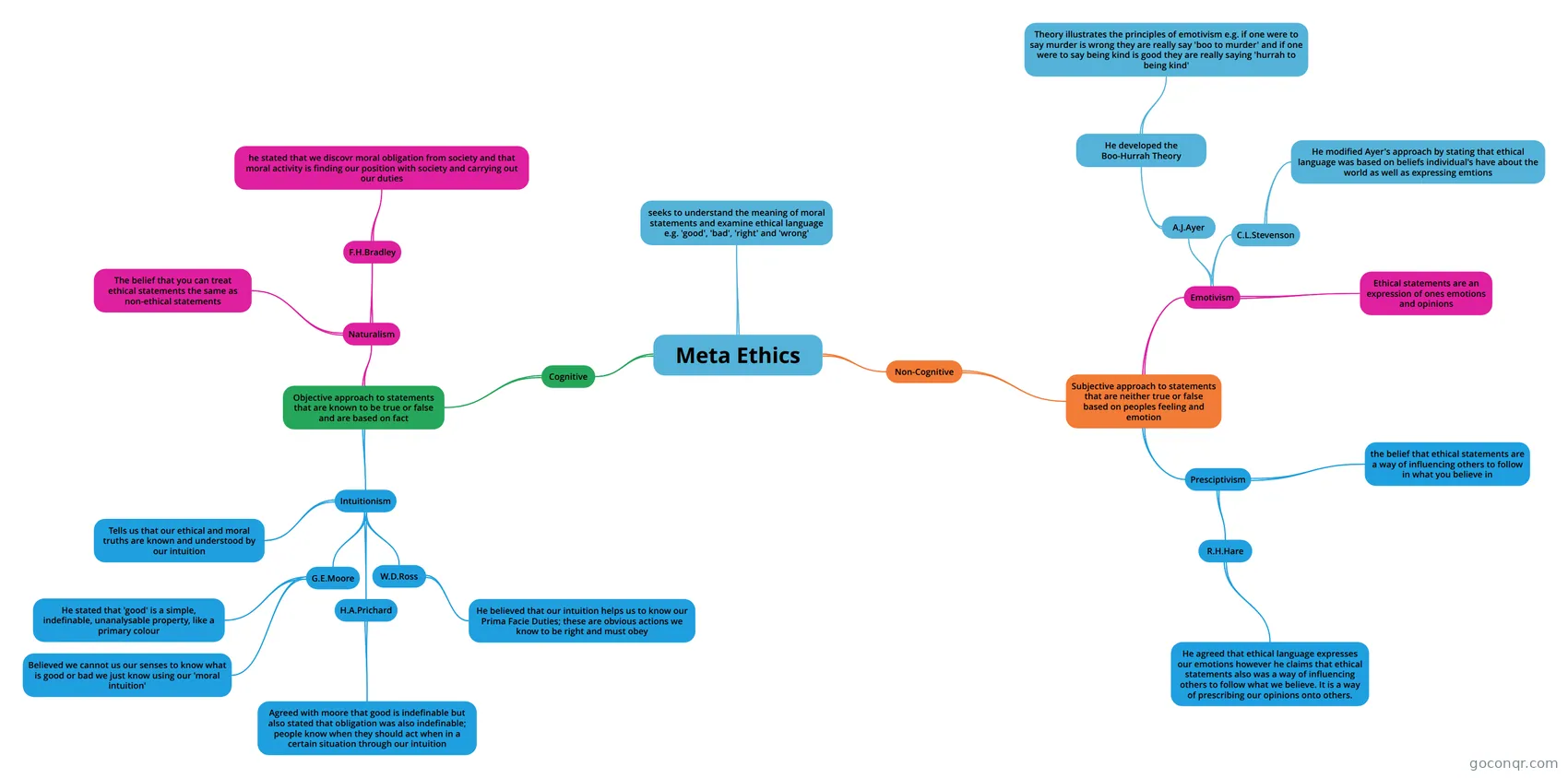
Mind map: Meta ethics
Inhalt der Mindmap
Meta Ethics
seeks to understand the meaning of moral statements and examine ethical language e.g. 'good', 'bad', 'right' and 'wrong'
Cognitive
- Objective approach to statements that are known to be true or false and are based on fact
- Naturalism
- The belief that you can treat ethical statements the same as non-ethical statements
- F.H.Bradley
- he stated that we discovr moral obligation from society and that moral activity is finding our position with society and carrying out our duties
- Intuitionism
- Tells us that our ethical and moral truths are known and understood by our intuition
- G.E.Moore
- He stated that 'good' is a simple, indefinable, unanalysable property, like a primary colour
- Believed we cannot us our senses to know what is good or bad we just know using our 'moral intuition'
- H.A.Prichard
- Agreed with moore that good is indefinable but also stated that obligation was also indefinable; people know when they should act when in a certain situation through our intuition
- W.D.Ross
- He believed that our intuition helps us to know our Prima Facie Duties; these are obvious actions we know to be right and must obey
- Naturalism
- Objective approach to statements that are known to be true or false and are based on fact
Non-Cognitive
- Subjective approach to statements that are neither true or false based on peoples feeling and emotion
- Emotivism
- Ethical statements are an expression of ones emotions and opinions
- A.J.Ayer
- He developed the Boo-Hurrah Theory
- Theory illustrates the principles of emotivism e.g. if one were to say murder is wrong they are really say 'boo to murder' and if one were to say being kind is good they are really saying 'hurrah to being kind'
- He developed the Boo-Hurrah Theory
- C.L.Stevenson
- He modified Ayer's approach by stating that ethical language was based on beliefs individual's have about the world as well as expressing emtions
- Presciptivism
- the belief that ethical statements are a way of influencing others to follow in what you believe in
- R.H.Hare
- He agreed that ethical language expresses our emotions however he claims that ethical statements also was a way of influencing others to follow what we believe. It is a way of prescribing our opinions onto others.
- Emotivism
- Subjective approach to statements that are neither true or false based on peoples feeling and emotion
Informationen
- Beschreibung
- A-Level Religious Studies (Meta-Ethics) Mindmap am Meta Ethics, erstellt von Isabella Langton am 11/12/2015.
- Erstellt von
- Isabella Langton
- Aufrufe
- 23
- Bewertung