
Mindmap
P1 Revision (again...)
Inhalt der Mindmap
P1 Revision (again...)
Cooking and communicating using waves
- Infra red (heat) radiation
- All warm/hot objects emit infra red radiation
- Dull, black objects give out more radiation than shiny, bright objects at the same temperature because dull, black objects are very good absorbers of radiation whereas shiny, bright objects are very poor absorbers
- Microwaves
- Microwaves in a microwave oven are absorbed by water or fat molecules in food
- The hotter the object the more radiation they emit
- Infra red and microwave cookery
- Infra red does not penetrate very far into food, it only heats the surface
- Energy is absorbed by particles on the surface, this increases the KINETIC ENERGY of the particles
- Microwaves penetrate 1cm into the outer layer of the food
- The water or fat molecules in the outer layers vibrate more and their kinetic energy increases. The energy is transferred to the centre of the food by conduction or convection (depending on the food)
- Microwaves pass through plastic and glass but, like infra red radiation, are reflected from shiny metal surfaces
- The door of a microwave oven is made from special glass that can reflect microwave radiation
- Infra red does not penetrate very far into food, it only heats the surface
- Electromagnetic spectrum
- Energy is transferred by waves
- The shorter the wavelength/ higher the frequency, the more energy is associated with the radiation. The longer the wavelength/ lower the frequency, the less energy is associated with the radiation
- Microwave communication (signals and properties)
- Long distance- transmitter and receiver have to be in line of sight. Line of sight is lost due to the curvature of the Earth. Microwave aerials for sending telephone signals are placed on top of tall buildings/towers
- Weather conditions and large areas of water can affect microwave reception by scattering the signals
- Shortest wavelength- 1mm and the longest is 30cm
- Microwaves used for communications are longer than those used for cooking. Less energy is associated with mobile phones than with microwaves
- Microwaves are reflected by large flat surfaces such as water
- Diffraction
- Microwaves do not exhibit very much diffraction around large obstacles, such as hills. This leads to signal loss- reason why mobile signal can go from strong to very weak
- Interference
- Two different signals overlap and interfere with each other
- Infra red (heat) radiation
Data transmission
- Invisible infra red waves
- Uses- remote controls, wireless computer mouse, security alarms and thermal imaging cameras
- Sends a coded digital signal to the device
- Uses- remote controls, wireless computer mouse, security alarms and thermal imaging cameras
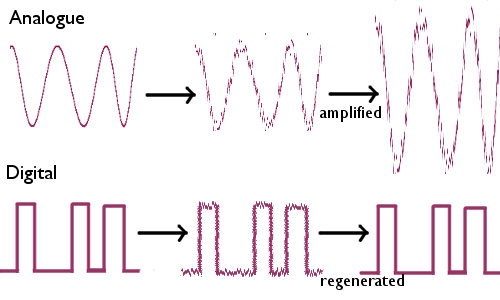
- Digital signals have two values- on (1 or high) or off (0 or low)
- Any small difference in the signal value will not be noticed and can easily be removed because it only has two values
- Analogue signal- height of a wave indicates loudness and distance between waves indicates pitch (the higher the pitch the closer the waves are together) Can have any value, continuously variable
- Typical frequency for human speech- 200Hz. A typical frequency for a radio carrier wave is 200,000Hz
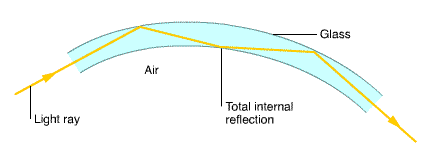
- Optical fibres (look on other mind map)
- Multiplexer
- Allows many different signals to be transmitted simultaneously. Each is divided into segments of very short duration. Combines the individual signals to be sent and transmits them as a combined signal
- Demultiplexer
- Separates the signals at the receiving end of the transmission
- Invisible infra red waves
Bilder und Dateien der Mindmap
Informationen
- Beschreibung
- Mindmap am P1 Revision (again...), erstellt von olivia.jermy am 16/12/2013.
- Erstellt von
- olivia.jermy
- Aufrufe
- 19
- Bewertung