
Electromagnetic Spectrum
368 resources created by 321 users
This Electromagnetic Spectrum page on GoConqr gathers community-made mind maps, quizzes, flashcards and notes, from radio waves and microwaves to X-rays and gamma rays. It's built for school students revising a topic and teachers after ready-made material. There are over 350 resources here, including more than 30 quizzes, over 210 mind maps and 90 flashcards, with most pitched at secondary level and exam names such as GCSE Physics and National 5 Physics appearing. Pick a wave type, try a quiz, then make your own maps.
Select topic
- Properties of electromagnetic waves11
- Radio waves and wireless communication23
- Infrared and microwave radiation30
- Visible light9
- Ultraviolet radiation6
- X-rays and gamma rays39
- Uses of electromagnetic waves36
- Hazards of electromagnetic radiation20
- Electromagnetic radiation and the atmosphere9
- Spectroscopy and spectra9
Top Electromagnetic Spectrum resources
-
17 questionsP2 Quiz Choose the sources of light.
-
83 questionsColor and Light Test The color of an object we see is determined by the
-
Mind map Nat 5 Physics Waves and Radiation
-
Mind map National 5 - Physics Unit 2 waves & Radiation National 5- Unit 2 Waves and Radiation- Mind Map
-
Mind map The Electromagnetic Spectrum
-
Mind map X-Rays
-
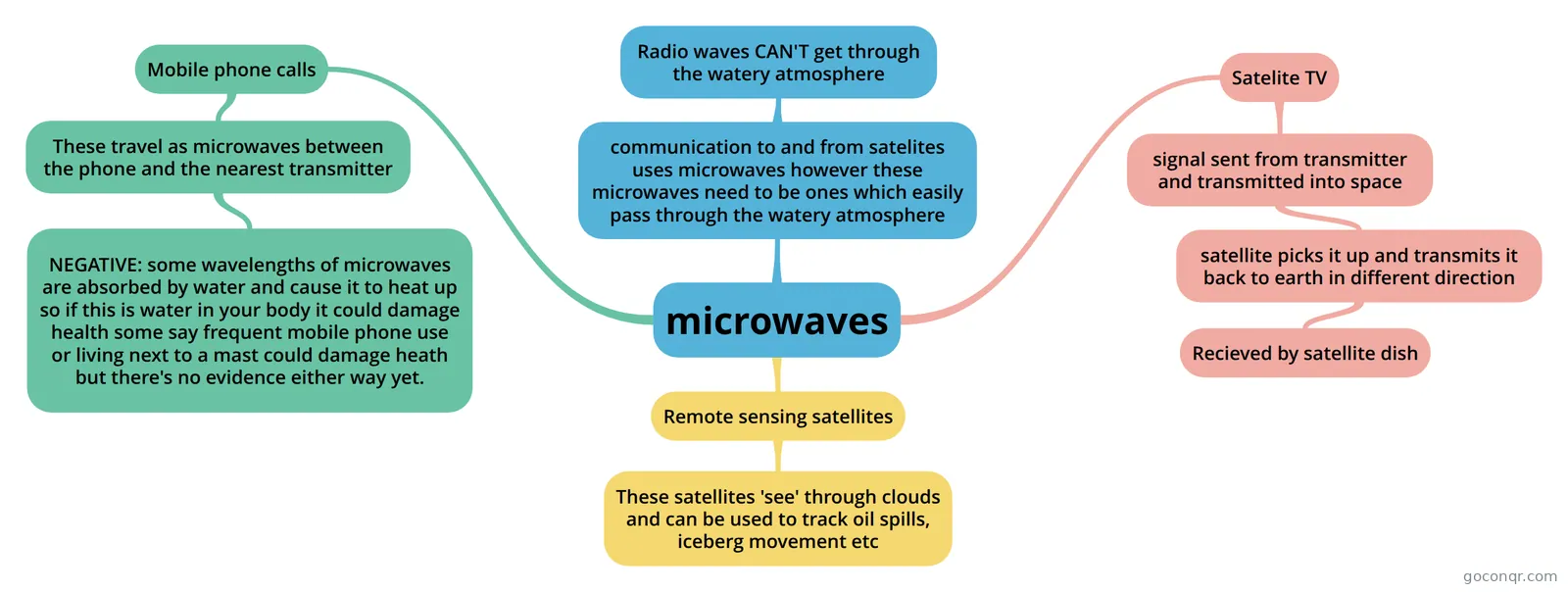 Mind map microwaves
-
10 questionsWaves and Radiation Quiz What is Frequency measured in?
Quizzes
See all 37 quizzes-
17 questionsP2 Quiz Choose the sources of light.
-
83 questionsColor and Light Test The color of an object we see is determined by the
-
10 questionsWaves and Radiation Quiz What is Frequency measured in?
-
4 questionsPHSI3011 M4 (W5) Vibrational Spectroscopy The two types of Vibrational Spectroscopy differ in the mechanisms they rely on: Dipole moment – Vibrations...
-
64 questionsTEST TEMA 1 ESPECTRO A molecule has three energy levels (A, B and C). Level A is the fundamental one and levels B and C correspo...
-
29 questionsPhysical Fundamentals Which of the following would NOT normally be considered as a form of remote sensing?
-
25 questionsP1.6 - P1.10 Which of these is an electromagnetic wave?
-
22 questionsCh 26 Most of the waves in the electromagnetic spectrum are
Mind maps
See all 217 mind mapsFlashcards
See all 91 flashcards-
29 cardsWeek 6 Lns Can you recall the following? (Ch11)
-
24 cardsT324 A radio wave has a period of 250 µs. Calculate the frequency in MHz. Express your answer to one significant...
-
24 cardsPhysics P2 P2.1 ELECTROMAGNETIC RADIATION . Light is a type of EM radiation . Radiation is just a transfer of energy ....
-
42 cardsp2 What is the speed of light? (in a vacuum)
-
26 cardsP2: Physics Flash Cards P2: Physics A photon of which type of electromagnetic radiation will transfer the most energy? Explain why.
-
26 cardsP1.6 - P1.10 Light is an electromagnetic wave. All electromagnetic waves are transverse.
-
26 cardsP2 P2 Electromagnetic waves don't transfer any matter. What do they transfer?
-
17 cardsPhysics revision cards Cards about physics
Flowcharts
Notes
See all 16 notes-
P2 Electromagnetic Radiation Light is type of EM radiation Radiation if transfer of energy Visible light just the radiation our eyes can detect 7 Types of radiation: Radio waves, Microwaves, Infrared, Visible light, Ultr...
-
3. Using the Electromagnetic Spectrum 3. Recent technological developments have allowed greater use of the electromagnetic spectrum3.1 - Electromagnetic waves do not require a mediumDescribe electromagnetic waves in terms of their speed in space and their...
-
4. The Applications of the Reflection and Refraction of Electromagnetic Waves 4. Many communication technologies use applications of reflection and refraction of electromagnetic waves4.1 - The law and effect of reflectionDescribe and apply the law of reflection and explain the effect of reflect...
-
wireless communication - radio waves. Long wavelengths travel well through Earth’s atmosphere.Radio waves and microwaves are good at transmitting information over long distances.This is because they don’t get absorbed by the Earth’s atmosphere as much as ...
-
Electromagnetic Spectrum Vocab Electromagnetic Spectrum: The full range of frequencies, from radio waves to gamma rays, that characterizes light. Radiation: Energy emitted in the form of waves (light) or particles (photons). Vi...
-
P1- 1.1 P1- 1.1- INFRARED RADIATION- We can use special cameras to 'see' animals and people in the dark- The cameras detect INFRARED RADIATION- Every object emits infrared radiation- THE HOTTER AN OBJECT IS THE MORE INFRARED ...
-
Infra-red Infrared:Anything that is 'hot' will emit electromagnetic radiation. Radiation which is coming in may be reflected but some will be absorbed.The materials electrons can also emit radiation, not much if cool, but lots ...
-
P1 Topic 2 Physics P1 Topic 22.1 - HerschelWilliam Herschel, Put coloured filters on telescope, some heated telescope more than others, Used prism to break up visible light, found thermometer reading went higher from violet to r...
Slides
Topics in Electromagnetic Spectrum
More Physics topics
About Electromagnetic Spectrum
GoConqr OriginalWhat this unit covers
The resources follow the spectrum from one end to the other. There are separate mind maps for Radiowaves, Microwaves, Infrared, Visible light, Ultraviolet Rays, Gamma rays and several on X-rays. Other maps look at the nature of waves, uses, benefits and risks, and satellite communication.
Where to start
Begin with the mind map called The Electromagnetic Spectrum. It covers the discovery of waves, including Isaac Newton and the visible spectrum, and defines the visible spectrum as the range of light waves the human eye can see. Next, open Nat 5 Physics Waves and Radiation, which links the spectrum to wave types, light and nuclear radiation. It notes that all waves transfer energy and that longitudinal waves vibrate in the same direction as the wave travels.
Going into detail
Once you have the overview, pick one wave type at a time.
- The RADIO WAVES map explains that long radio waves diffract, bend round hills and houses, and curve around the Earth.
- The microwaves map looks at satellite communication and why signals must pass easily through the watery atmosphere.
- The X-Rays map notes their high frequency, very short wavelength and effect on photographic film.
Using quizzes and maps together
Read a map, close it, then test yourself. The Waves and Radiation Quiz asks about frequency, diffraction and background radiation. The Color and Light Test asks what the source of electromagnetic waves is and how a vibrating electron makes a wave. The P2 Quiz covers sources of light and the speed of light through a vacuum. Any question you miss tells you which map to reread. Flashcard decks such as Electromagnetic Spectrum and EM Spectrum and Properties are good for quick recall of order and uses.
Where it sits
This unit belongs to the strand Waves, Sound and Light in Physics. Teachers can use the maps as ready-made starters, and students can pick a quiz to check what they know, then build their own versions.
Frequently asked questions
Which resource should I open first?
Start with the mind map The Electromagnetic Spectrum. It gives an overview, including how the visible spectrum was discovered and what the human eye can see. After that, try the Waves and Radiation Quiz to check what stuck, then move on to the maps for individual wave types.
What do the mind maps cover?
There are maps for radio waves, microwaves, infrared, visible light, ultraviolet, X-rays and gamma rays. Others cover the nature of EM waves, absorbing radiation, benefits and risks, and satellite communication. Some are written for National 5 Physics, so the wording may follow that course.
Which exams do these resources suit?
Most resources are pitched at secondary level. The listed material mentions GCSE Physics, iGCSE Physics, IB Physics, National 5 Physics and OCR Physics A. Check each resource against your own course, as community authors may follow different specifications.
Are the resources free to use?
Yes. Every resource listed here is free to open, study and take, with no account needed. They were made by GoConqr users, not by GoConqr itself. A free account also saves your quiz scores and lets you make your own quizzes, mind maps, flashcards and notes.
Are there flashcards as well as quizzes?
Yes. There are around 90 flashcard decks, with titles such as Electromagnetic Spectrum, X-Rays, Greenhouse Effect and Electromagnetic Radiation Uses. They suit short revision sessions, while the quizzes are better for checking understanding after you have read a map.
What if I can't find the topic I need?
Try a nearby title, since many resources are named after exam topics such as Radiation, Waves and Radiation or P2. If nothing fits, you can make your own mind map, quiz or flashcards and shape them around your course.