
Mindmap
Energy insecurity and geopolitical tensions
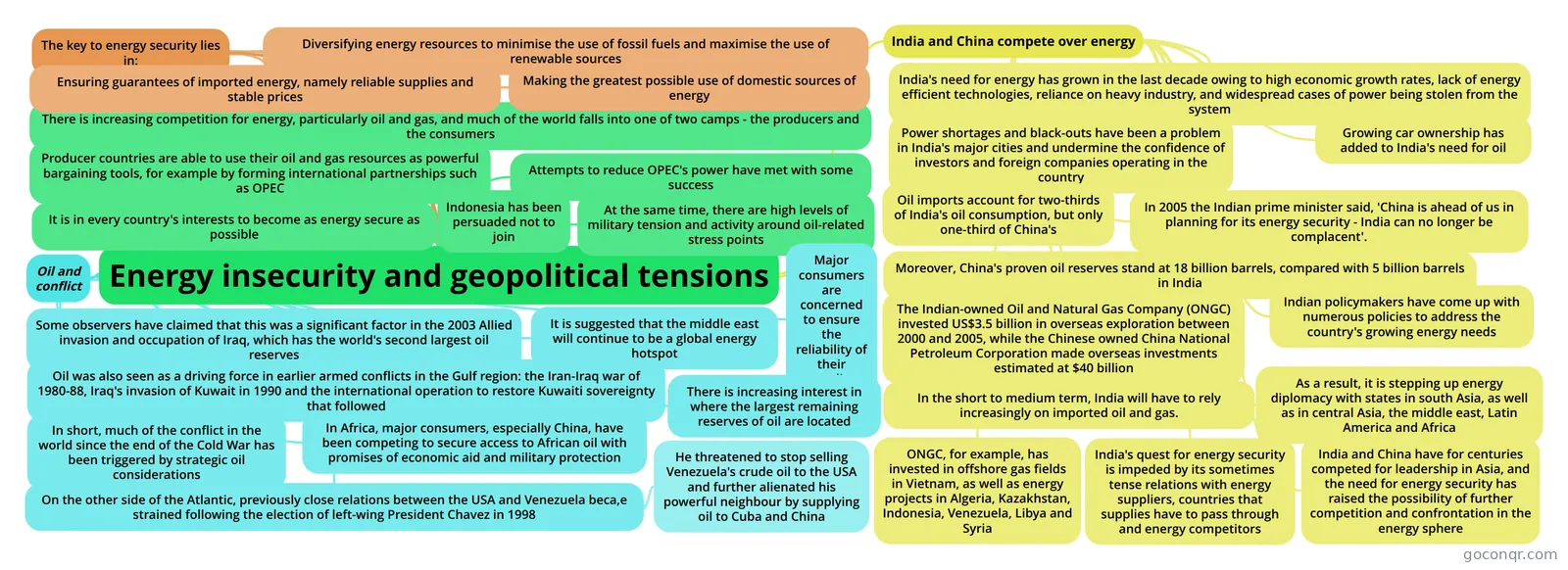
Mind map: Energy insecurity and geopolitical tensions
Inhalt der Mindmap
Energy insecurity and geopolitical tensions
It is in every country's interests to become as energy secure as possible
The key to energy security lies in:
- Making the greatest possible use of domestic sources of energy
- Diversifying energy resources to minimise the use of fossil fuels and maximise the use of renewable sources
- Ensuring guarantees of imported energy, namely reliable supplies and stable prices
Oil and conflict
- It is suggested that the middle east will continue to be a global energy hotspot
- Major consumers are concerned to ensure the reliability of their supplies
- Some observers have claimed that this was a significant factor in the 2003 Allied invasion and occupation of Iraq, which has the world's second largest oil reserves
- Oil was also seen as a driving force in earlier armed conflicts in the Gulf region: the Iran-Iraq war of 1980-88, Iraq's invasion of Kuwait in 1990 and the international operation to restore Kuwaiti sovereignty that followed
- In Africa, major consumers, especially China, have been competing to secure access to African oil with promises of economic aid and military protection
- On the other side of the Atlantic, previously close relations between the USA and Venezuela beca,e strained following the election of left-wing President Chavez in 1998
- He threatened to stop selling Venezuela's crude oil to the USA and further alienated his powerful neighbour by supplying oil to Cuba and China
- In short, much of the conflict in the world since the end of the Cold War has been triggered by strategic oil considerations
- There is increasing interest in where the largest remaining reserves of oil are located
There is increasing competition for energy, particularly oil and gas, and much of the world falls into one of two camps - the producers and the consumers
Producer countries are able to use their oil and gas resources as powerful bargaining tools, for example by forming international partnerships such as OPEC
Attempts to reduce OPEC's power have met with some success
Indonesia has been persuaded not to join
At the same time, there are high levels of military tension and activity around oil-related stress points
India and China compete over energy
- India's need for energy has grown in the last decade owing to high economic growth rates, lack of energy efficient technologies, reliance on heavy industry, and widespread cases of power being stolen from the system
- Power shortages and black-outs have been a problem in India's major cities and undermine the confidence of investors and foreign companies operating in the country
- Growing car ownership has added to India's need for oil
- In 2005 the Indian prime minister said, 'China is ahead of us in planning for its energy security - India can no longer be complacent'.
- Oil imports account for two-thirds of India's oil consumption, but only one-third of China's
- Moreover, China's proven oil reserves stand at 18 billion barrels, compared with 5 billion barrels in India
- The Indian-owned Oil and Natural Gas Company (ONGC) invested US$3.5 billion in overseas exploration between 2000 and 2005, while the Chinese owned China National Petroleum Corporation made overseas investments estimated at $40 billion
- Indian policymakers have come up with numerous policies to address the country's growing energy needs
- In the short to medium term, India will have to rely increasingly on imported oil and gas.
- As a result, it is stepping up energy diplomacy with states in south Asia, as well as in central Asia, the middle east, Latin America and Africa
- ONGC, for example, has invested in offshore gas fields in Vietnam, as well as energy projects in Algeria, Kazakhstan, Indonesia, Venezuela, Libya and Syria
- India's quest for energy security is impeded by its sometimes tense relations with energy suppliers, countries that supplies have to pass through and energy competitors
- India and China have for centuries competed for leadership in Asia, and the need for energy security has raised the possibility of further competition and confrontation in the energy sphere
Informationen
- Beschreibung
- A-Levels Geography (Energy Security) Mindmap am Energy insecurity and geopolitical tensions, erstellt von Jodie Goodacre am 24/12/2013.
- Erstellt von
- Jodie Goodacre
- Aufrufe
- 145
- Tags
- Bewertung