
460517


Positive and Negative
Externalities in
Consumption and
Production
- EXTERNALITIES= costs or benefits that spill over
to third parties external to a market transaction
- Occur outside of the market,
affecting individuals not
directly involved in the
production and/or consumption
of a particular good or service
- Occur outside of the market,
affecting individuals not
directly involved in the
production and/or consumption
of a particular good or service
- MARGINAL PRIVATE COST= the cost to an
individual or firm of an economic transaction
- MARGINAL EXTERNAL COST= the spillover
cost to third parties of an economic transaction
- MARGINAL SOCIAL COST= the full cost
to society of an economic transaction,
including private and external costs
- MARGINAL PRIVATE BENEFIT= the benefit to
an individual or firm of an economic transaction
- MARGINAL EXTERNAL BENEFIT= the spillover
benefit to third parties of an economic transaction
- MARGINAL SOCIAL BENEFIT= the full
benefit to society of an economic transaction,
including private and external benefits
- NEGATIVE EXTERNALITIES= costs
imposed on a third party not involved with
the consumption or production of the good
- POSITIVE EXTERNALITY= a positive spillover
effect to third parties of a market transaction
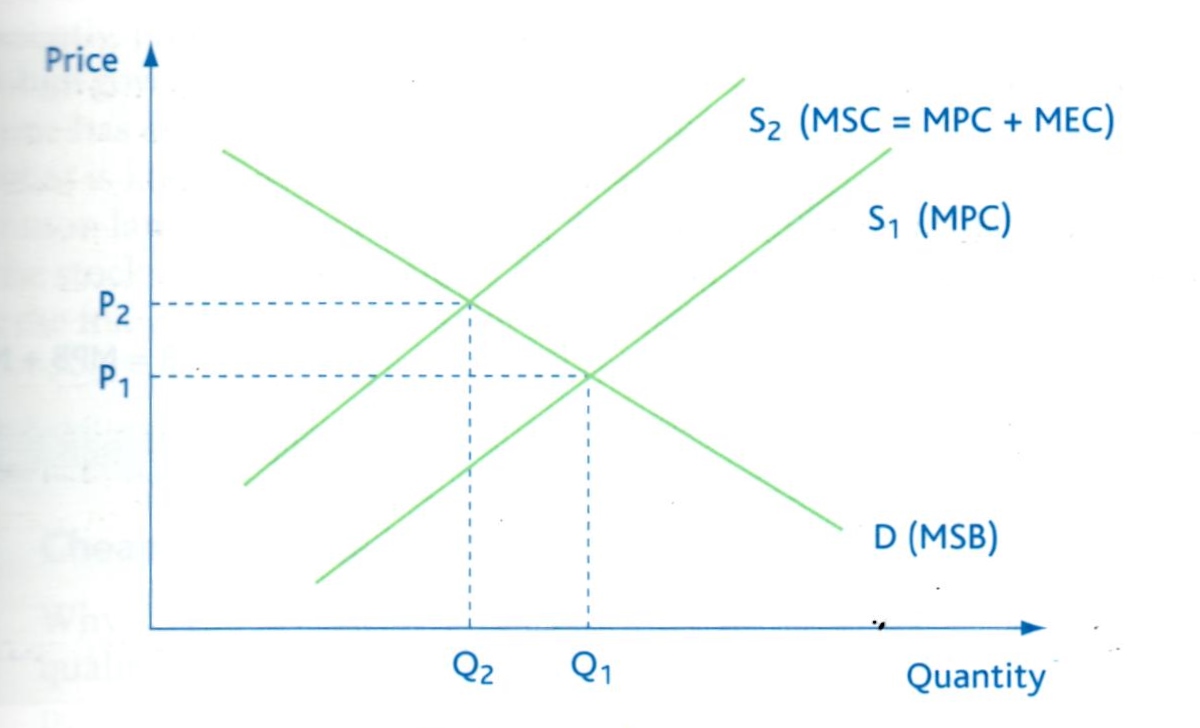
- Negative externalities
- social costs > private costs
- the individual consumer does not take into account
the effect of externalities in their calculations
- e.g. if you make a car journey you only consider the things affecting you like petrol cost and
congestion charges or tolls you must pay, you would not seriously consider additional costs you
may be imposing on others like congestion, pollution or other environmental damage
- marginal social cost= marginal
private cost + marginal external cost
- social costs > private costs
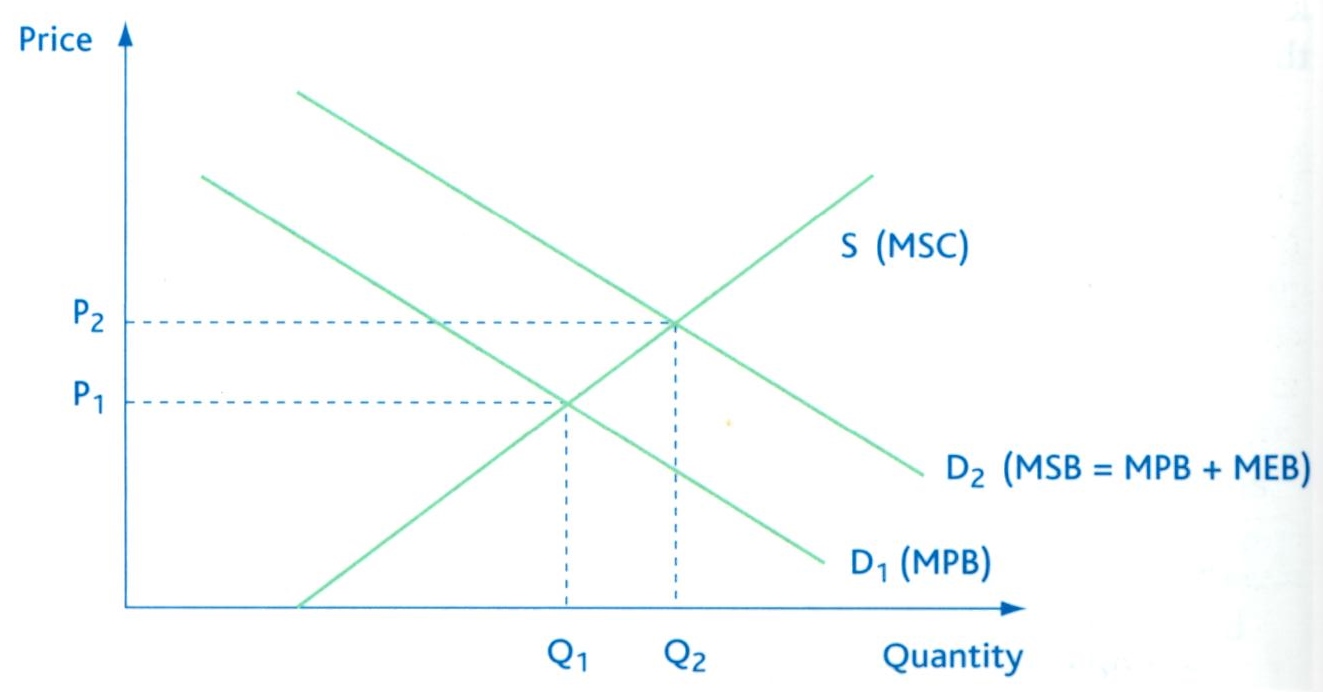
- Positive externalities
- social benefits > private benefits
- e.g. if you go to the doctors and are inoculatd against a disease then
you benefit from not catching the disease, but others who come into
contact with you also benefit as they are less likely to get that disease
- marginal social benefit= marginal private benefit + marginal external benefit
- social benefits > private benefits
- Externalities as market failure
- Externalities will lead to the wrong amount of the product being
produced; goods with negative externalities will be over-produced
and goods with positive externalities will be under-produced
- e.g. a firm running a coal-fired power station will not consider atmospheric pollution when calculating prices
for their electricity, the cost will be lower than if the full social cost (private costs + external costs) were to be considered
- This is OVER-PRODUCTION LEADING TO A NEGATIVE EXTERNALITY
- shifts supply
- This is OVER-PRODUCTION LEADING TO A NEGATIVE EXTERNALITY
- e.g. education may be available but it will be under-consumed
in a free market as people do not consider the full social
benefits (private benefits + external benefits) when consumed
- This is UNDER-PRODUCTION LEADING TO A POSITIVE EXTERNALITY
- shifts demand
- This is UNDER-PRODUCTION LEADING TO A POSITIVE EXTERNALITY
- Externalities will lead to the wrong amount of the product being
produced; goods with negative externalities will be over-produced
and goods with positive externalities will be under-produced
Medienanhänge
Möchten Sie kostenlos Ihre eigenen Mindmaps mit GoConqr erstellen? Mehr erfahren.