
Mindmap
Meiosis
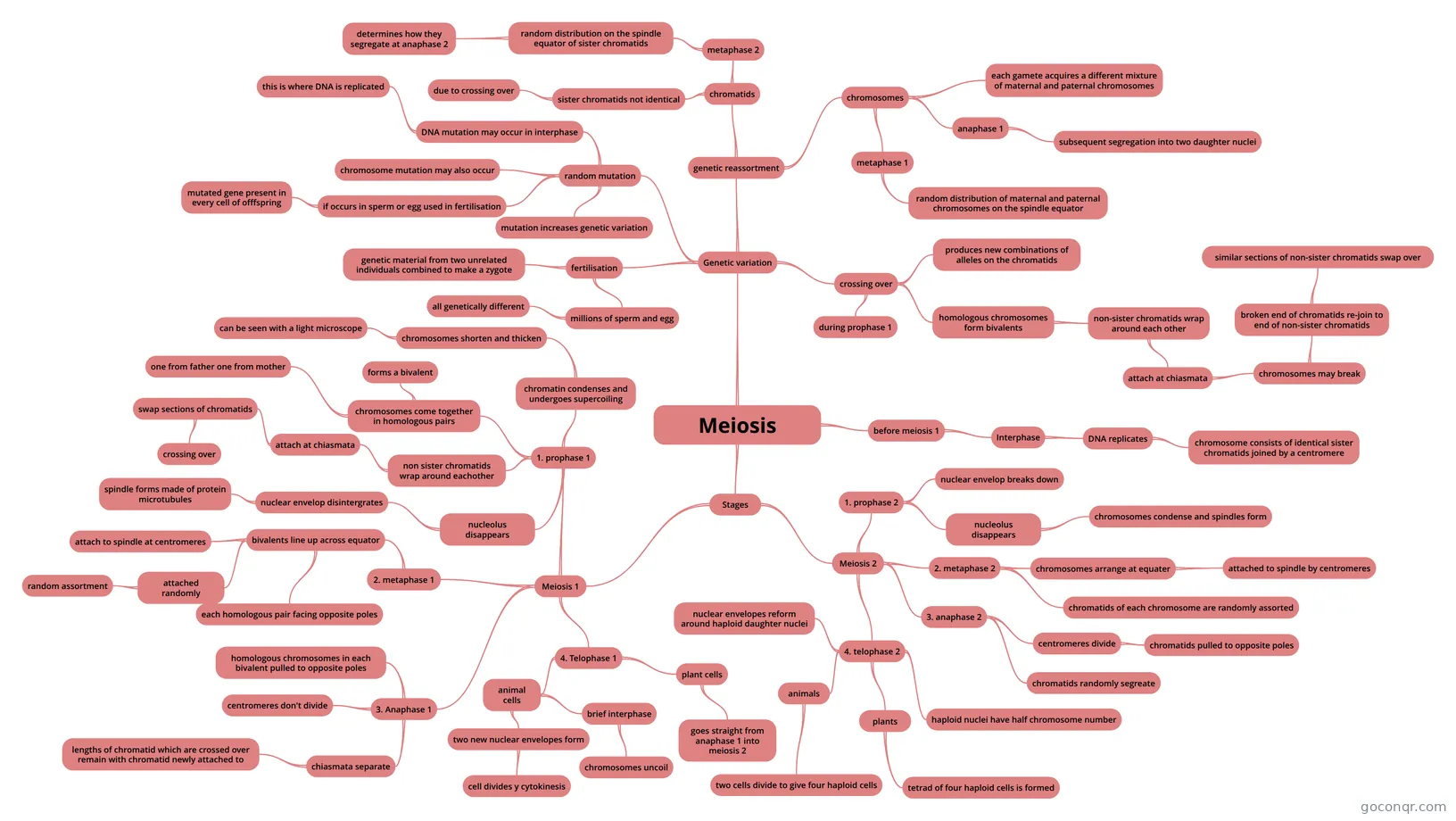
Mind map: Meiosis
Inhalt der Mindmap
Meiosis
Stages
- Meiosis 1
- 1. prophase 1
- chromatin condenses and undergoes supercoiling
- chromosomes shorten and thicken
- can be seen with a light microscope
- chromosomes shorten and thicken
- chromosomes come together in homologous pairs
- forms a bivalent
- one from father one from mother
- non sister chromatids wrap around eachother
- attach at chiasmata
- swap sections of chromatids
- crossing over
- swap sections of chromatids
- attach at chiasmata
- nucleolus disappears
- nuclear envelop disintergrates
- spindle forms made of protein microtubules
- nuclear envelop disintergrates
- chromatin condenses and undergoes supercoiling
- 2. metaphase 1
- bivalents line up across equator
- attach to spindle at centromeres
- attached randomly
- random assortment
- each homologous pair facing opposite poles
- bivalents line up across equator
- 3. Anaphase 1
- homologous chromosomes in each bivalent pulled to opposite poles
- centromeres don't divide
- chiasmata separate
- lengths of chromatid which are crossed over remain with chromatid newly attached to
- 4. Telophase 1
- animal cells
- two new nuclear envelopes form
- cell divides y cytokinesis
- brief interphase
- chromosomes uncoil
- two new nuclear envelopes form
- plant cells
- goes straight from anaphase 1 into meiosis 2
- animal cells
- 1. prophase 1
- Meiosis 2
- 1. prophase 2
- nuclear envelop breaks down
- nucleolus disappears
- chromosomes condense and spindles form
- 2. metaphase 2
- chromosomes arrange at equater
- attached to spindle by centromeres
- chromatids of each chromosome are randomly assorted
- chromosomes arrange at equater
- 3. anaphase 2
- centromeres divide
- chromatids pulled to opposite poles
- chromatids randomly segreate
- centromeres divide
- 4. telophase 2
- nuclear envelopes reform around haploid daughter nuclei
- animals
- two cells divide to give four haploid cells
- plants
- tetrad of four haploid cells is formed
- haploid nuclei have half chromosome number
- 1. prophase 2
- Meiosis 1
Genetic variation
- crossing over
- during prophase 1
- homologous chromosomes form bivalents
- non-sister chromatids wrap around each other
- attach at chiasmata
- chromosomes may break
- broken end of chromatids re-join to end of non-sister chromatids
- similar sections of non-sister chromatids swap over
- broken end of chromatids re-join to end of non-sister chromatids
- chromosomes may break
- attach at chiasmata
- non-sister chromatids wrap around each other
- produces new combinations of alleles on the chromatids
- genetic reassortment
- chromosomes
- metaphase 1
- random distribution of maternal and paternal chromosomes on the spindle equator
- anaphase 1
- subsequent segregation into two daughter nuclei
- each gamete acquires a different mixture of maternal and paternal chromosomes
- metaphase 1
- chromatids
- metaphase 2
- random distribution on the spindle equator of sister chromatids
- determines how they segregate at anaphase 2
- random distribution on the spindle equator of sister chromatids
- sister chromatids not identical
- due to crossing over
- metaphase 2
- chromosomes
- random mutation
- DNA mutation may occur in interphase
- this is where DNA is replicated
- chromosome mutation may also occur
- mutation increases genetic variation
- if occurs in sperm or egg used in fertilisation
- mutated gene present in every cell of offfspring
- DNA mutation may occur in interphase
- fertilisation
- genetic material from two unrelated individuals combined to make a zygote
- millions of sperm and egg
- all genetically different
- crossing over
before meiosis 1
- Interphase
- DNA replicates
- chromosome consists of identical sister chromatids joined by a centromere
- DNA replicates
- Interphase
Informationen
- Beschreibung
- Mindmap am Meiosis, erstellt von david7241 am 22/03/2016.
- Erstellt von
- david7241
- Aufrufe
- 1
- Bewertung