
Mindmap
Salt
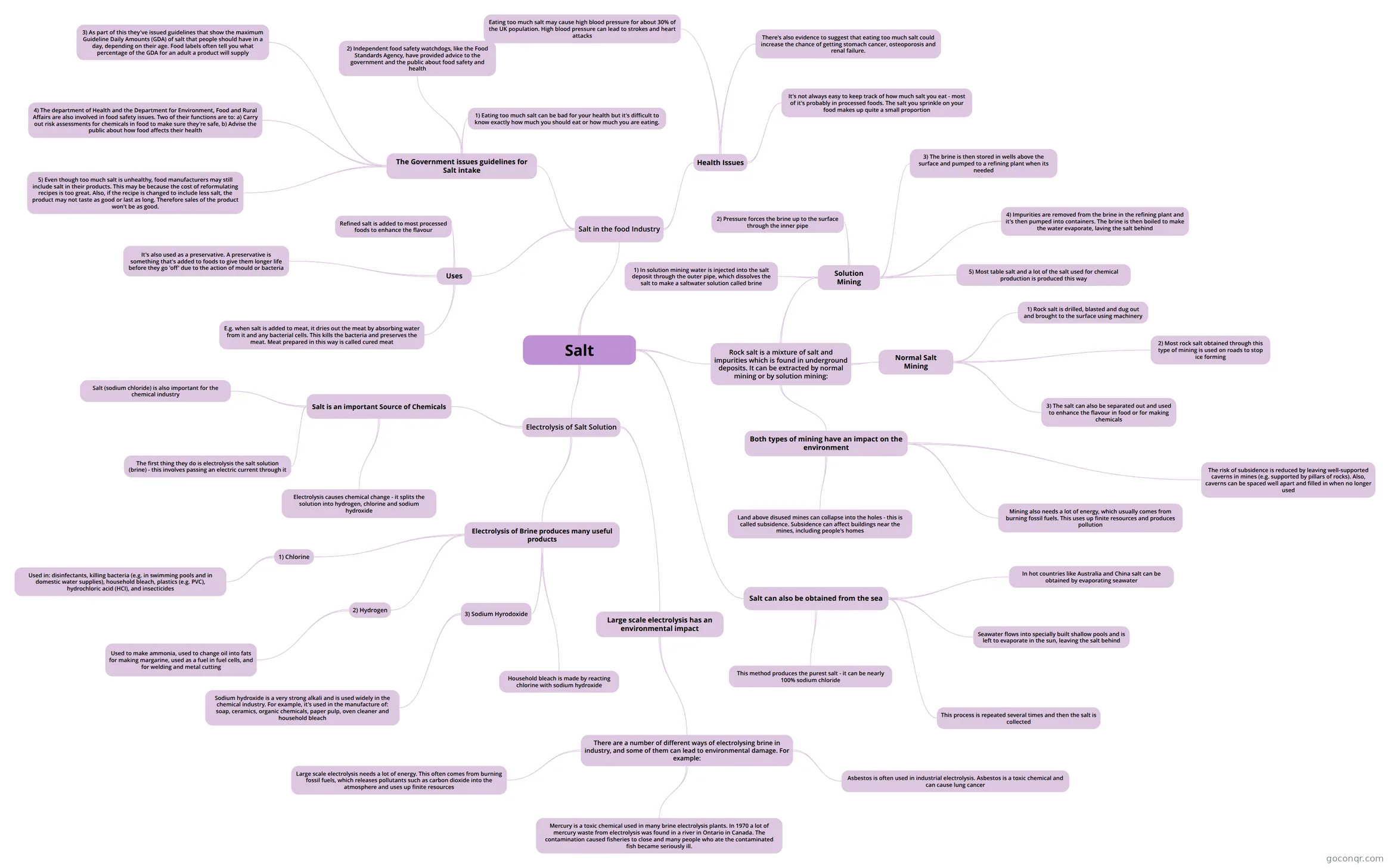
Mind map: Salt extraction and uses
Inhalt der Mindmap
Salt
Rock salt is a mixture of salt and impurities which is found in underground deposits. It can be extracted by normal mining or by solution mining:
- Normal Salt Mining
- 1) Rock salt is drilled, blasted and dug out and brought to the surface using machinery
- 2) Most rock salt obtained through this type of mining is used on roads to stop ice forming
- 3) The salt can also be separated out and used to enhance the flavour in food or for making chemicals
- Solution Mining
- 1) In solution mining water is injected into the salt deposit through the outer pipe, which dissolves the salt to make a saltwater solution called brine
- 2) Pressure forces the brine up to the surface through the inner pipe
- 3) The brine is then stored in wells above the surface and pumped to a refining plant when its needed
- 4) Impurities are removed from the brine in the refining plant and it's then pumped into containers. The brine is then boiled to make the water evaporate, laving the salt behind
- 5) Most table salt and a lot of the salt used for chemical production is produced this way
- Both types of mining have an impact on the environment
- Land above disused mines can collapse into the holes - this is called subsidence. Subsidence can affect buildings near the mines, including people's homes
- The risk of subsidence is reduced by leaving well-supported caverns in mines (e.g. supported by pillars of rocks). Also, caverns can be spaced well apart and filled in when no longer used
- Mining also needs a lot of energy, which usually comes from burning fossil fuels. This uses up finite resources and produces pollution
- Normal Salt Mining
Salt in the food Industry
- Uses
- Refined salt is added to most processed foods to enhance the flavour
- It's also used as a preservative. A preservative is something that's added to foods to give them longer life before they go 'off' due to the action of mould or bacteria
- E.g. when salt is added to meat, it dries out the meat by absorbing water from it and any bacterial cells. This kills the bacteria and preserves the meat. Meat prepared in this way is called cured meat
- Health Issues
- Eating too much salt may cause high blood pressure for about 30% of the UK population. High blood pressure can lead to strokes and heart attacks
- There's also evidence to suggest that eating too much salt could increase the chance of getting stomach cancer, osteoporosis and renal failure.
- It's not always easy to keep track of how much salt you eat - most of it's probably in processed foods. The salt you sprinkle on your food makes up quite a small proportion
- The Government issues guidelines for Salt intake
- 1) Eating too much salt can be bad for your health but it's difficult to know exactly how much you should eat or how much you are eating.
- 2) Independent food safety watchdogs, like the Food Standards Agency, have provided advice to the government and the public about food safety and health
- 3) As part of this they've issued guidelines that show the maximum Guideline Daily Amounts (GDA) of salt that people should have in a day, depending on their age. Food labels often tell you what percentage of the GDA for an adult a product will supply
- 4) The department of Health and the Department for Environment, Food and Rural Affairs are also involved in food safety issues. Two of their functions are to: a) Carry out risk assessments for chemicals in food to make sure they're safe, b) Advise the public about how food affects their health
- 5) Even though too much salt is unhealthy, food manufacturers may still include salt in their products. This may be because the cost of reformulating recipes is too great. Also, if the recipe is changed to include less salt, the product may not taste as good or last as long. Therefore sales of the product won't be as good.
- Uses
Electrolysis of Salt Solution
- Salt is an important Source of Chemicals
- Salt (sodium chloride) is also important for the chemical industry
- The first thing they do is electrolysis the salt solution (brine) - this involves passing an electric current through it
- Electrolysis causes chemical change - it splits the solution into hydrogen, chlorine and sodium hydroxide
- Electrolysis of Brine produces many useful products
- 1) Chlorine
- Used in: disinfectants, killing bacteria (e.g. in swimming pools and in domestic water supplies), household bleach, plastics (e.g. PVC), hydrochloric acid (HCI), and insecticides
- 2) Hydrogen
- Used to make ammonia, used to change oil into fats for making margarine, used as a fuel in fuel cells, and for welding and metal cutting
- 3) Sodium Hyrodoxide
- Sodium hydroxide is a very strong alkali and is used widely in the chemical industry. For example, it's used in the manufacture of: soap, ceramics, organic chemicals, paper pulp, oven cleaner and household bleach
- Household bleach is made by reacting chlorine with sodium hydroxide
- 1) Chlorine
- Large scale electrolysis has an environmental impact
- There are a number of different ways of electrolysing brine in industry, and some of them can lead to environmental damage. For example:
- Large scale electrolysis needs a lot of energy. This often comes from burning fossil fuels, which releases pollutants such as carbon dioxide into the atmosphere and uses up finite resources
- Mercury is a toxic chemical used in many brine electrolysis plants. In 1970 a lot of mercury waste from electrolysis was found in a river in Ontario in Canada. The contamination caused fisheries to close and many people who ate the contaminated fish became seriously ill.
- Asbestos is often used in industrial electrolysis. Asbestos is a toxic chemical and can cause lung cancer
- There are a number of different ways of electrolysing brine in industry, and some of them can lead to environmental damage. For example:
- Salt is an important Source of Chemicals
Salt can also be obtained from the sea
- In hot countries like Australia and China salt can be obtained by evaporating seawater
- Seawater flows into specially built shallow pools and is left to evaporate in the sun, leaving the salt behind
- This process is repeated several times and then the salt is collected
- This method produces the purest salt - it can be nearly 100% sodium chloride
Informationen
- Beschreibung
- Mindmap am Salt, erstellt von ygreent12 am 27/03/2016.
- Erstellt von
- ygreent12
- Aufrufe
- 0
- Bewertung