
512914
Beschreibung

Mindmap von soyyochrissi, aktualisiert more than 1 year ago

|
Erstellt von soyyochrissi
vor etwa 12 Jahre
|
|
4 Team Work
- Group work: amount of task related operations that are carried out by group members
- in order to achieve goal-oriented tasks
- and group goal
- and group goal
- Group as organisational unit
Anmerkungen:
- primary (hierarchichaly defined) vs. secondary organization (social context).
- temporal aspects of
group's existance
- level of involvement
- formality of group
- in order to achieve goal-oriented tasks
- Potential of teams
Anmerkungen:
- small number of people with complementary abilities, pursuing the same goal, define own performance features, proceed with an approach that they feel is the best and harmonize while doing this
- higher performance potential
than in a work group
- degree of structure in group work
- unstructured
- semi-structured
- structured activities
- unstructured
- Group processes
Anmerkungen:
- specifications of information, activities and characteristics of an electronically supported group
- static part
Anmerkungen:
- group goals, organization, protocol, environment
- dynamic part
Anmerkungen:
- documents, activities, status, meetings
- Influencing factors: individual
aspects, organizational
aspects, arrangement aspects
- Group
dynamics
- variables: group dynamics as positive driving force
- negative blocking force
- variables: group dynamics as positive driving force
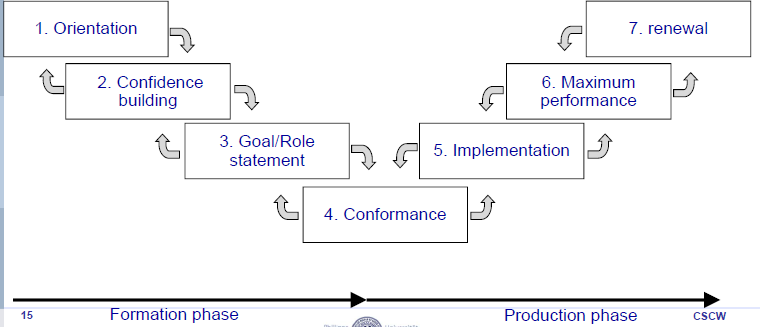
- Team Performance Model
Anmerkungen:
- describes how a team is established and in which state which question is being settled. 7 states of team processes. If task is completed, team reaches new state
- conflict management
- Approaches and Concepts
- Organization theory
Anmerkungen:
- types of working groups: - committee - problem-solving groups - project groups - integrated work groups - leading group
- enterprise as cooperative system
Anmerkungen:
- group organization can contribute to overall company goal
- Organization theory
- Communication in the group
Anmerkungen:
- def: reliable and fast exchange of information objects
- implicit (pull)/synchronous
- explicit (push)/asynchronous
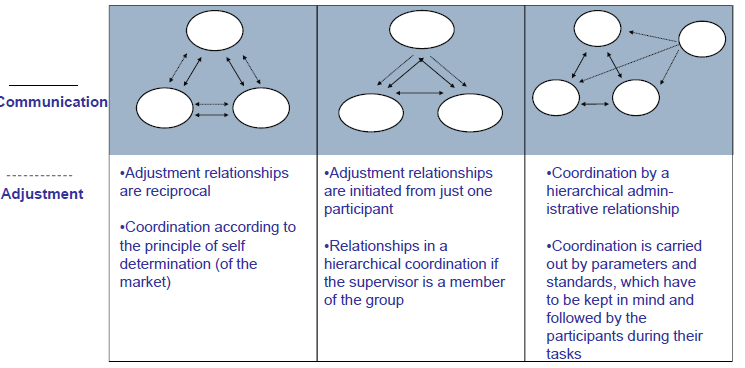
- Coordination
Anmerkungen:
- a set of independet decisions is called coodinated if for each individual decision at least one of the decision-makers has the opinion that the adjustment was better than no decision at all
- need for coordination due to
division of labor and
dependencies between the
activities and distances
- Coordination approach (Kieser)
- Coordination goal
- Interdependencies
- Coordination process and intruments
- concepts to support structured communication
- workflow management systems
- conversational systems
- E.g.: Speech act theory
Anmerkungen:
- Speech acts applied to office communication. Lotus notes: invitation to a meeting can be answered in different ways
- E.g.: Speech act theory
- workflow management systems
- Coordination goal
- Application oriented view:
how are coordination
processes performed
- Coordination through resources
- Participant
- information objects
- Coordination through resources
- Protcols: social or technical
- Cooperation
Anmerkungen:
- Origin lies within the individual abilities and resources
- Main aspects: shared goals,
explicit coordination, shared
material, trust
- Group awareness
Anmerkungen:
- knowledge of what is going on within the group and wht was done in the past e.g. task organization within quickr
- informal awareness
- awareness regarding group structure
- time and space
- social vs. task-oriented group awareness
Medienanhänge
Möchten Sie kostenlos Ihre eigenen Mindmaps mit GoConqr erstellen? Mehr erfahren.