
Mindmap
Risk Management Topics
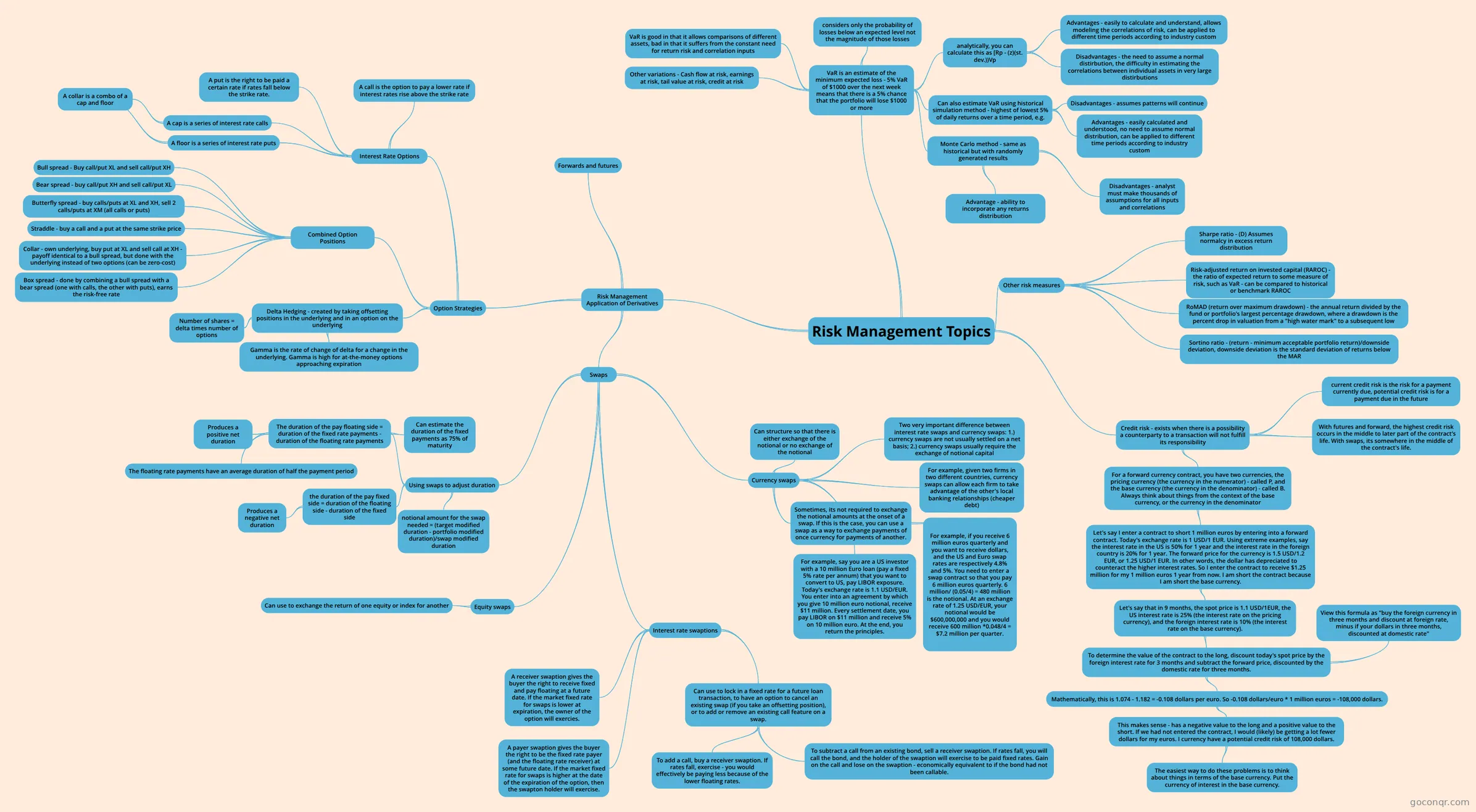
Mind map: Risk management topics
Inhalt der Mindmap
Risk Management Topics
Risk Management Application of Derivatives
- Forwards and futures
- Option Strategies
- Combined Option Positions
- Bull spread - Buy call/put XL and sell call/put XH
- Bear spread - buy call/put XH and sell call/put XL
- Butterfly spread - buy calls/puts at XL and XH, sell 2 calls/puts at XM (all calls or puts)
- Straddle - buy a call and a put at the same strike price
- Collar - own underlying, buy put at XL and sell call at XH - payoff identical to a bull spread, but done with the underlying instead of two options (can be zero-cost)
- Box spread - done by combining a bull spread with a bear spread (one with calls, the other with puts), earns the risk-free rate
- Interest Rate Options
- A call is the option to pay a lower rate if interest rates rise above the strike rate
- A put is the right to be paid a certain rate if rates fall below the strike rate.
- A cap is a series of interest rate calls
- A collar is a combo of a cap and floor
- A floor is a series of interest rate puts
- Delta Hedging - created by taking offsetting positions in the underlying and in an option on the underlying
- Gamma is the rate of change of delta for a change in the underlying. Gamma is high for at-the-money options approaching expiration
- Number of shares = delta times number of options
- Combined Option Positions
- Swaps
- Using swaps to adjust duration
- The duration of the pay floating side = duration of the fixed rate payments - duration of the floating rate payments
- The floating rate payments have an average duration of half the payment period
- Produces a positive net duration
- Can estimate the duration of the fixed payments as 75% of maturity
- the duration of the pay fixed side = duration of the floating side - duration of the fixed side
- Produces a negative net duration
- notional amount for the swap needed = (target modified duration - portfolio modified duration)/swap modified duration
- The duration of the pay floating side = duration of the fixed rate payments - duration of the floating rate payments
- Currency swaps
- Can structure so that there is either exchange of the notional or no exchange of the notional
- For example, say you are a US investor with a 10 million Euro loan (pay a fixed 5% rate per annum) that you want to convert to US, pay LIBOR exposure. Today's exchange rate is 1.1 USD/EUR. You enter into an agreement by which you give 10 million euro notional, receive $11 million. Every settlement date, you pay LIBOR on $11 million and receive 5% on 10 million euro. At the end, you return the principles.
- Two very important difference between interest rate swaps and currency swaps: 1.) currency swaps are not usually settled on a net basis; 2.) currency swaps usually require the exchange of notional capital
- For example, given two firms in two different countries, currency swaps can allow each firm to take advantage of the other's local banking relationships (cheaper debt)
- Sometimes, its not required to exchange the notional amounts at the onset of a swap. If this is the case, you can use a swap as a way to exchange payments of once currency for payments of another.
- For example, if you receive 6 million euros quarterly and you want to receive dollars, and the US and Euro swap rates are respectively 4.8% and 5%. You need to enter a swap contract so that you pay 6 million euros quarterly. 6 million/ (0.05/4) = 480 million is the notional. At an exchange rate of 1.25 USD/EUR, your notional would be $600,000,000 and you would receive 600 million *0.048/4 = $7.2 million per quarter.
- Equity swaps
- Can use to exchange the return of one equity or index for another
- Interest rate swaptions
- A payer swaption gives the buyer the right to be the fixed rate payer (and the floating rate receiver) at some future date. If the market fixed rate for swaps is higher at the date of the expiration of the option, then the swapton holder will exercise.
- A receiver swaption gives the buyer the right to receive fixed and pay floating at a future date. If the market fixed rate for swaps is lower at expiration, the owner of the option will exercies.
- Can use to lock in a fixed rate for a future loan transaction, to have an option to cancel an existing swap (if you take an offsetting position), or to add or remove an existing call feature on a swap.
- To add a call, buy a receiver swaption. If rates fall, exercise - you would effectively be paying less because of the lower floating rates.
- To subtract a call from an existing bond, sell a receiver swaption. If rates fall, you will call the bond, and the holder of the swaption will exercise to be paid fixed rates. Gain on the call and lose on the swaption - economically equivalent to if the bond had not been callable.
- Using swaps to adjust duration
VaR is an estimate of the minimum expected loss - 5% VaR of $1000 over the next week means that there is a 5% chance that the portfolio will lose $1000 or more
- considers only the probability of losses below an expected level not the magnitude of those losses
- analytically, you can calculate this as [Rp - (z)(st. dev.))Vp
- Advantages - easily to calculate and understand, allows modeling the correlations of risk, can be applied to different time periods according to industry custom
- Disadvantages - the need to assume a normal distirbution, the difficulty in estimating the correlations between individual assets in very large distirbutions
- Can also estimate VaR using historical simulation method - highest of lowest 5% of daily returns over a time period, e.g.
- Advantages - easily calculated and understood, no need to assume normal distribution, can be applied to different time periods according to industry custom
- Disadvantages - assumes patterns will continue
- Monte Carlo method - same as historical but with randomly generated results
- Advantage - ability to incorporate any returns distribution
- Disadvantages - analyst must make thousands of assumptions for all inputs and correlations
- VaR is good in that it allows comparisons of different assets, bad in that it suffers from the constant need for return risk and correlation inputs
- Other variations - Cash flow at risk, earnings at risk, tail value at risk, credit at risk
Other risk measures
- Sharpe ratio - (D) Assumes normalcy in excess return distribution
- Risk-adjusted return on invested capital (RAROC) - the ratio of expected return to some measure of risk, such as VaR - can be compared to historical or benchmark RAROC
- RoMAD (return over maximum drawdown) - the annual return divided by the fund or portfolio's largest percentage drawdown, where a drawdown is the percent drop in valuation from a "high water mark" to a subsequent low
- Sortino ratio - (return - minimum acceptable portfolio return)/downside deviation, downside deviation is the standard deviation of returns below the MAR
Credit risk - exists when there is a possibility a counterparty to a transaction will not fulfill its responsibility
- current credit risk is the risk for a payment currently due, potential credit risk is for a payment due in the future
- For a forward currency contract, you have two currencies, the pricing currency (the currency in the numerator) - called P, and the base currency (the currency in the denominator) - called B. Always think about things from the context of the base currency, or the currency in the denominator
- Let's say I enter a contract to short 1 million euros by entering into a forward contract. Today's exchange rate is 1 USD/1 EUR. Using extreme examples, say the interest rate in the US is 50% for 1 year and the interest rate in the foreign country is 20% for 1 year. The forward price for the currency is 1.5 USD/1.2 EUR, or 1.25 USD/1 EUR. In other words, the dollar has depreciated to counteract the higher interest rates. So I enter the contract to receive $1.25 million for my 1 million euros 1 year from now. I am short the contract because I am short the base currency.
- Let's say that in 9 months, the spot price is 1.1 USD/1EUR, the US interest rate is 25% (the interest rate on the pricing currency), and the foreign interest rate is 10% (the interest rate on the base currency).
- To determine the value of the contract to the long, discount today's spot price by the foreign interest rate for 3 months and subtract the forward price, discounted by the domestic rate for three months.
- Mathematically, this is 1.074 - 1.182 = -0.108 dollars per euro. So -0.108 dollars/euro * 1 million euros = -108,000 dollars.
- This makes sense - has a negative value to the long and a positive value to the short. If we had not entered the contract, I would (likely) be getting a lot fewer dollars for my euros. I currency have a potential credit risk of 108,000 dollars.
- The easiest way to do these problems is to think about things in terms of the base currency. Put the currency of interest in the base currency.
- This makes sense - has a negative value to the long and a positive value to the short. If we had not entered the contract, I would (likely) be getting a lot fewer dollars for my euros. I currency have a potential credit risk of 108,000 dollars.
- View this formula as "buy the foreign currency in three months and discount at foreign rate, minus if your dollars in three months, discounted at domestic rate"
- Mathematically, this is 1.074 - 1.182 = -0.108 dollars per euro. So -0.108 dollars/euro * 1 million euros = -108,000 dollars.
- To determine the value of the contract to the long, discount today's spot price by the foreign interest rate for 3 months and subtract the forward price, discounted by the domestic rate for three months.
- Let's say that in 9 months, the spot price is 1.1 USD/1EUR, the US interest rate is 25% (the interest rate on the pricing currency), and the foreign interest rate is 10% (the interest rate on the base currency).
- Let's say I enter a contract to short 1 million euros by entering into a forward contract. Today's exchange rate is 1 USD/1 EUR. Using extreme examples, say the interest rate in the US is 50% for 1 year and the interest rate in the foreign country is 20% for 1 year. The forward price for the currency is 1.5 USD/1.2 EUR, or 1.25 USD/1 EUR. In other words, the dollar has depreciated to counteract the higher interest rates. So I enter the contract to receive $1.25 million for my 1 million euros 1 year from now. I am short the contract because I am short the base currency.
- With futures and forward, the highest credit risk occurs in the middle to later part of the contract's life. With swaps, its somewhere in the middle of the contract's life.
Informationen
- Beschreibung
- 3 CFA Mindmap am Risk Management Topics, erstellt von Ben VanGelder am 31/05/2016.
- Erstellt von
- Ben VanGelder
- Aufrufe
- 0
- Bewertung