
Mindmap
A1: Natural Pop. Change (iii)
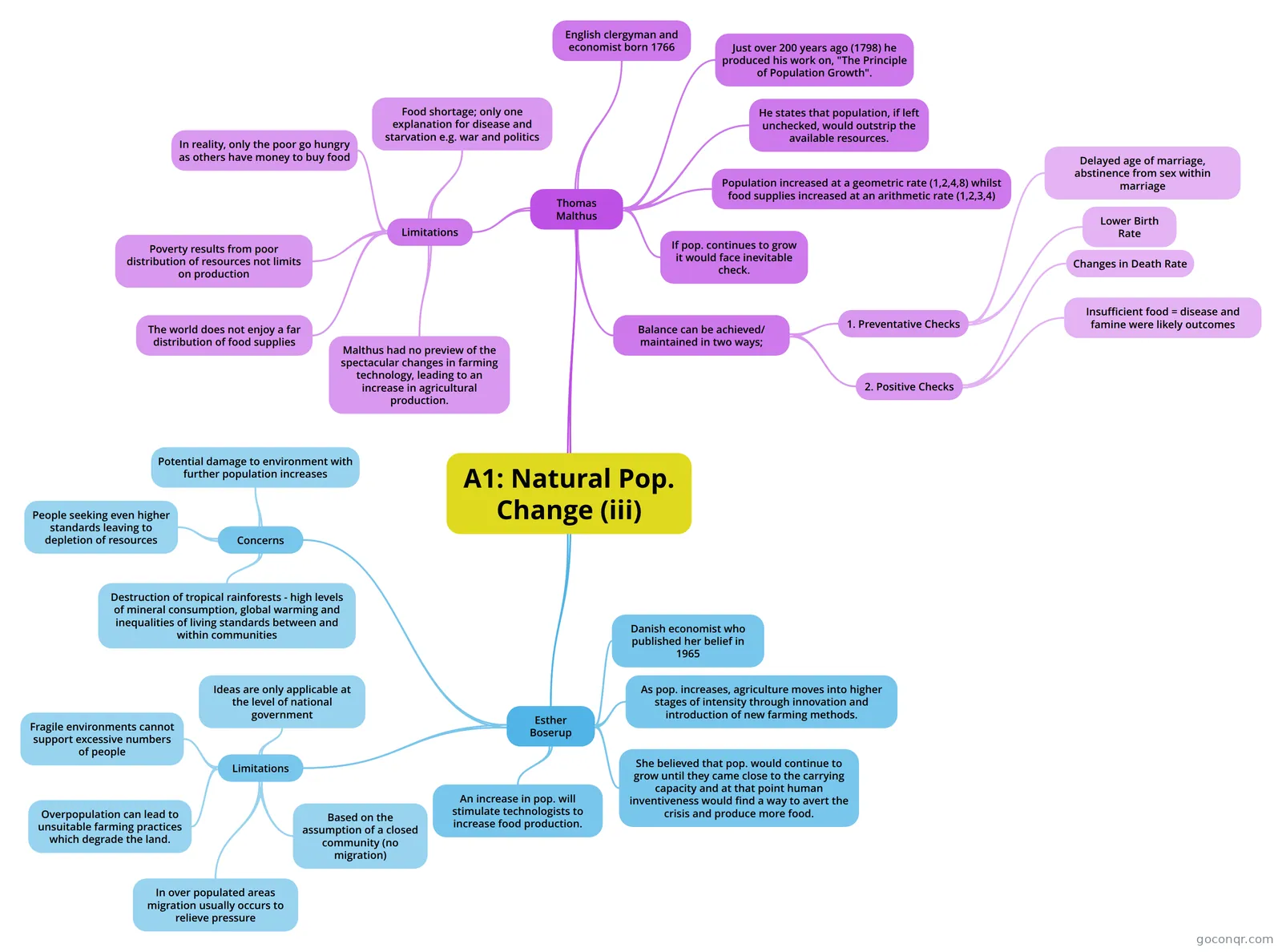
Mind map: Malthus and Boserup population theories
Inhalt der Mindmap
A1: Natural Pop. Change (iii)
Thomas Malthus
- English clergyman and economist born 1766
- Just over 200 years ago (1798) he produced his work on, "The Principle of Population Growth".
- He states that population, if left unchecked, would outstrip the available resources.
- Population increased at a geometric rate (1,2,4,8) whilst food supplies increased at an arithmetic rate (1,2,3,4)
- If pop. continues to grow it would face inevitable check.
- Balance can be achieved/ maintained in two ways;
- 1. Preventative Checks
- Delayed age of marriage, abstinence from sex within marriage
- Lower Birth Rate
- 2. Positive Checks
- Changes in Death Rate
- Insufficient food = disease and famine were likely outcomes
- 1. Preventative Checks
- Limitations
- Food shortage; only one explanation for disease and starvation e.g. war and politics
- In reality, only the poor go hungry as others have money to buy food
- Poverty results from poor distribution of resources not limits on production
- The world does not enjoy a far distribution of food supplies
- Malthus had no preview of the spectacular changes in farming technology, leading to an increase in agricultural production.
Esther Boserup
- Danish economist who published her belief in 1965
- As pop. increases, agriculture moves into higher stages of intensity through innovation and introduction of new farming methods.
- She believed that pop. would continue to grow until they came close to the carrying capacity and at that point human inventiveness would find a way to avert the crisis and produce more food.
- An increase in pop. will stimulate technologists to increase food production.
- Limitations
- Based on the assumption of a closed community (no migration)
- In over populated areas migration usually occurs to relieve pressure
- Overpopulation can lead to unsuitable farming practices which degrade the land.
- Fragile environments cannot support excessive numbers of people
- Ideas are only applicable at the level of national government
- Concerns
- Potential damage to environment with further population increases
- People seeking even higher standards leaving to depletion of resources
- Destruction of tropical rainforests - high levels of mineral consumption, global warming and inequalities of living standards between and within communities
Informationen
- Beschreibung
- Mindmap am A1: Natural Pop. Change (iii), erstellt von Rachel Campbell am 22/02/2014.
- Erstellt von
- Rachel Campbell
- Aufrufe
- 48
- Bewertung
Mehr zu Population Change and Growth