
Mindmap
The Integumentary System_1
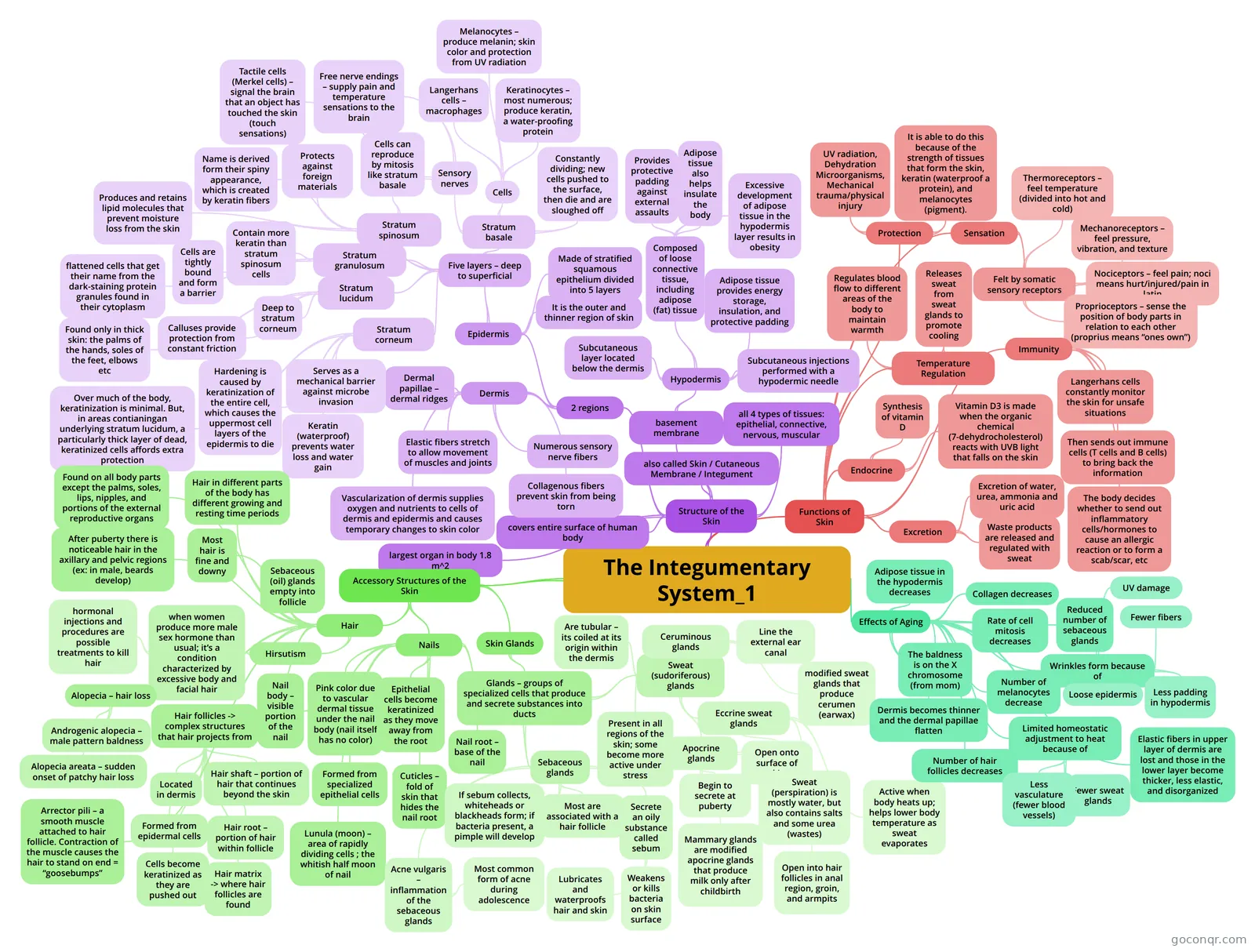
Mind map: The Integumentary System
Inhalt der Mindmap
The Integumentary System_1
Structure of the Skin
- also called Skin / Cutaneous Membrane / Integument
- covers entire surface of human body
- largest organ in body 1.8 m^2
- all 4 types of tissues: epithelial, connective, nervous, muscular
- 2 regions
- Dermis
- Dermal papillae – dermal ridges
- Collagenous fibers prevent skin from being torn
- Elastic fibers stretch to allow movement of muscles and joints
- Vascularization of dermis supplies oxygen and nutrients to cells of dermis and epidermis and causes temporary changes to skin color
- Numerous sensory nerve fibers
- Epidermis
- It is the outer and thinner region of skin
- Made of stratified squamous epithelium divided into 5 layers
- Five layers – deep to superficial
- Stratum corneum
- Over much of the body, keratinization is minimal. But, in areas contianingan underlying stratum lucidum, a particularly thick layer of dead, keratinized cells affords extra protection
- Hardening is caused by keratinization of the entire cell, which causes the uppermost cell layers of the epidermis to die
- Keratin (waterproof) prevents water loss and water gain
- Serves as a mechanical barrier against microbe invasion
- Stratum lucidum
- Deep to stratum corneum
- Found only in thick skin: the palms of the hands, soles of the feet, elbows etc
- Calluses provide protection from constant friction
- Stratum granulosum
- flattened cells that get their name from the dark-staining protein granules found in their cytoplasm
- Cells are tightly bound and form a barrier
- Contain more keratin than stratum spinosum cells
- Stratum spinosum
- Cells can reproduce by mitosis like stratum basale
- Name is derived form their spiny appearance, which is created by keratin fibers
- Protects against foreign materials
- Produces and retains lipid molecules that prevent moisture loss from the skin
- Stratum basale
- Constantly dividing; new cells pushed to the surface, then die and are sloughed off
- Cells
- Keratinocytes – most numerous; produce keratin, a water-proofing protein
- Langerhans cells – macrophages
- Melanocytes – produce melanin; skin color and protection from UV radiation
- Sensory nerves
- Free nerve endings – supply pain and temperature sensations to the brain
- Tactile cells (Merkel cells) – signal the brain that an object has touched the skin (touch sensations)
- Stratum corneum
- Dermis
- basement membrane
- Hypodermis
- Subcutaneous layer located below the dermis
- Composed of loose connective tissue, including adipose (fat) tissue
- Adipose tissue also helps insulate the body
- Provides protective padding against external assaults
- Excessive development of adipose tissue in the hypodermis layer results in obesity
- Adipose tissue provides energy storage, insulation, and protective padding
- Subcutaneous injections performed with a hypodermic needle
- Hypodermis
Functions of Skin
- Sensation
- Felt by somatic sensory receptors
- Mechanoreceptors – feel pressure, vibration, and texture
- Thermoreceptors – feel temperature (divided into hot and cold)
- Nociceptors – feel pain; noci means hurt/injured/pain in latin
- Proprioceptors – sense the position of body parts in relation to each other (proprius means “ones own”)
- Felt by somatic sensory receptors
- Endocrine
- Synthesis of vitamin D
- Vitamin D3 is made when the organic chemical (7-dehydrocholesterol) reacts with UVB light that falls on the skin
- Immunity
- Langerhans cells constantly monitor the skin for unsafe situations
- Then sends out immune cells (T cells and B cells) to bring back the information
- The body decides whether to send out inflammatory cells/hormones to cause an allergic reaction or to form a scab/scar, etc
- Excretion
- Excretion of water, urea, ammonia and uric acid
- Waste products are released and regulated with sweat
- Protection
- UV radiation, Dehydration Microorganisms, Mechanical trauma/physical injury
- It is able to do this because of the strength of tissues that form the skin, keratin (waterproof a protein), and melanocytes (pigment).
- Temperature Regulation
- Releases sweat from sweat glands to promote cooling
- Regulates blood flow to different areas of the body to maintain warmth
- Sensation
Accessory Structures of the Skin
- Hair
- Found on all body parts except the palms, soles, lips, nipples, and portions of the external reproductive organs
- Most hair is fine and downy
- After puberty there is noticeable hair in the axillary and pelvic regions (ex: in male, beards develop)
- Hair in different parts of the body has different growing and resting time periods
- Sebaceous (oil) glands empty into follicle
- Arrector pili – a smooth muscle attached to hair follicle. Contraction of the muscle causes the hair to stand on end = “goosebumps”
- Hair follicles -> complex structures that hair projects from
- Formed from epidermal cells
- Located in dermis
- Cells become keratinized as they are pushed out
- Hair matrix -> where hair follicles are found
- Hair root – portion of hair within follicle
- Hair shaft – portion of hair that continues beyond the skin
- Hirsutism
- when women produce more male sex hormone than usual; it’s a condition characterized by excessive body and facial hair
- hormonal injections and procedures are possible treatments to kill hair
- when women produce more male sex hormone than usual; it’s a condition characterized by excessive body and facial hair
- Alopecia – hair loss
- Alopecia areata – sudden onset of patchy hair loss
- Androgenic alopecia – male pattern baldness
- Nails
- Formed from specialized epithelial cells
- Lunula (moon) – area of rapidly dividing cells ; the whitish half moon of nail
- Pink color due to vascular dermal tissue under the nail body (nail itself has no color)
- Epithelial cells become keratinized as they move away from the root
- Nail root – base of the nail
- Cuticles – fold of skin that hides the nail root
- Nail body – visible portion of the nail
- Skin Glands
- Glands – groups of specialized cells that produce and secrete substances into ducts
- Sweat (sudoriferous) glands
- Present in all regions of the skin; some become more active under stress
- Are tubular – its coiled at its origin within the dermis
- Apocrine glands
- Open into hair follicles in anal region, groin, and armpits
- Begin to secrete at puberty
- Mammary glands are modified apocrine glands that produce milk only after childbirth
- Eccrine sweat glands
- Open onto surface of skin
- Active when body heats up; helps lower body temperature as sweat evaporates
- Sweat (perspiration) is mostly water, but also contains salts and some urea (wastes)
- Ceruminous glands
- modified sweat glands that produce cerumen (earwax)
- Line the external ear canal
- Sebaceous glands
- Most are associated with a hair follicle
- Secrete an oily substance called sebum
- Weakens or kills bacteria on skin surface
- Lubricates and waterproofs hair and skin
- If sebum collects, whiteheads or blackheads form; if bacteria present, a pimple will develop
- Acne vulgaris – inflammation of the sebaceous glands
- Most common form of acne during adolescence
- Sweat (sudoriferous) glands
- Glands – groups of specialized cells that produce and secrete substances into ducts
- Hair
Effects of Aging
- Rate of cell mitosis decreases
- Dermis becomes thinner and the dermal papillae flatten
- Adipose tissue in the hypodermis decreases
- Collagen decreases
- Wrinkles form because of
- Loose epidermis
- Fewer fibers
- Less padding in hypodermis
- UV damage
- Elastic fibers in upper layer of dermis are lost and those in the lower layer become thicker, less elastic, and disorganized
- Number of hair follicles decreases
- The baldness is on the X chromosome (from mom)
- Number of melanocytes decrease
- Limited homeostatic adjustment to heat because of
- Fewer sweat glands
- Less vasculature (fewer blood vessels)
- Reduced number of sebaceous glands
Informationen
- Beschreibung
- Mindmap am The Integumentary System_1, erstellt von nirjhari am 23/02/2014.
- Erstellt von
- nirjhari
- Aufrufe
- 8
- Verlauf
-
- Erstellt von nirjhari · 23 Feb 2014
- Kopiert von nirjhari · 23 Feb 2014
- Bewertung