
Integumentary System
42 resources created by 35 users
This Integumentary System page on GoConqr gathers community-made quizzes, mind maps, flashcards, notes and flowcharts on the skin, its layers, hair, nails and glands. It's built for university students revising a topic or filling gaps, and for teachers after ready-made material. There are over 300 resources here, including more than 70 quizzes, over 110 mind maps and more than 140 flashcards, mostly at university level. Pick a resource, try a quiz to find your gaps, then build your own revision set.
Top Integumentary System resources
-
200 cardsPractice MCQ what is the integumentary system?
-
145 cardsIntegumentary What is the function of skin?
-
238 cardsA&P Lab Final
-
41 questionsA&P CH. 5 The body's first line of defense is formed by the
-
25 questionsIntegumentary System This is test on notes from the Integumentary System in Body Systems 1 from Ashworth College. It is the seco...
-
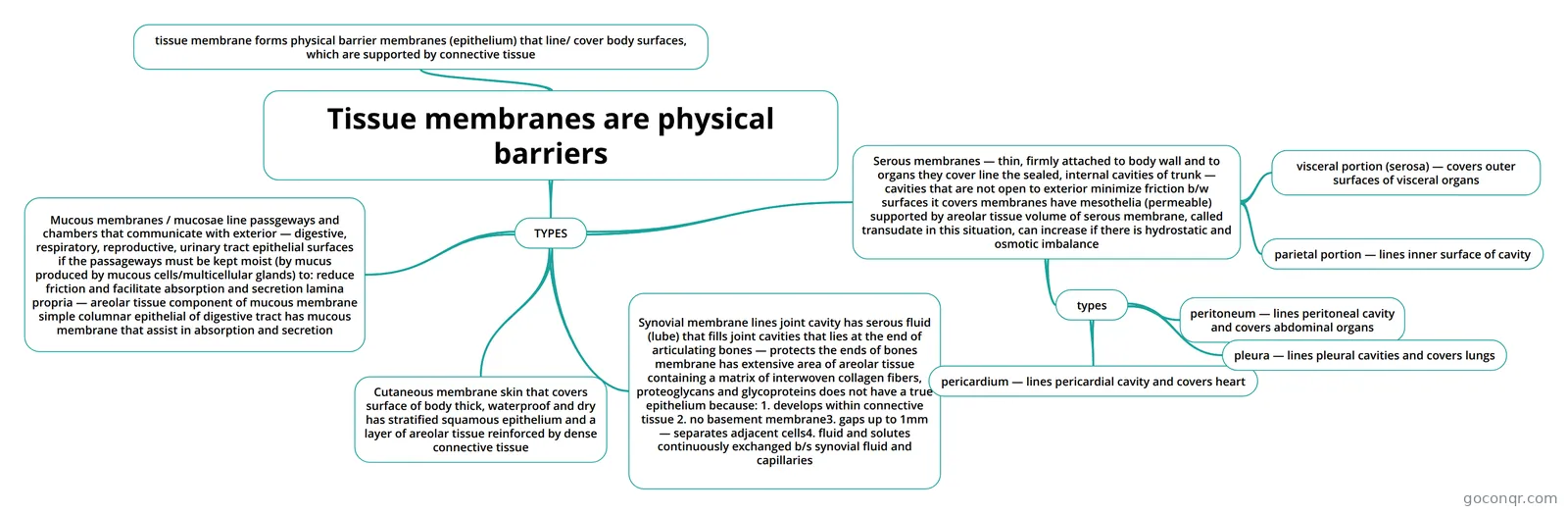 Mind map Tissue membranes are physical barriers chapter 4
-
10 questionsIntegumentary system The major components of the integumentary system are;
-
19 cardsDiagram of the Skin Flash cards of a diagram of the skin.
Quizzes
See all 17 quizzes-
41 questionsA&P CH. 5 The body's first line of defense is formed by the
-
25 questionsIntegumentary System This is test on notes from the Integumentary System in Body Systems 1 from Ashworth College. It is the seco...
-
10 questionsIntegumentary system The major components of the integumentary system are;
-
99 questionsFINAL Which pigment of skin is responsible for a dark brown/black color and absorbs UV rays to protect DNA?
-
48 questionsStructure of Skin What are the functions of skin?
-
49 questionsStudy Guide: Skin Beneath the dermis lies a loose layer of skin rich in fat and areolar tissue called the
-
26 questionsEpidermis Put the layers of the epidermis in order A- Stratum Corneus B- Stratum Basalum C- Stratum Granulosum D- Str...
-
18 questionsHP 101 - Integumentary System Which of the following is not a function of the integumentary system?
Mind maps
See all 10 mind maps-
Tissue membranes are physical barriers chapter 4
-
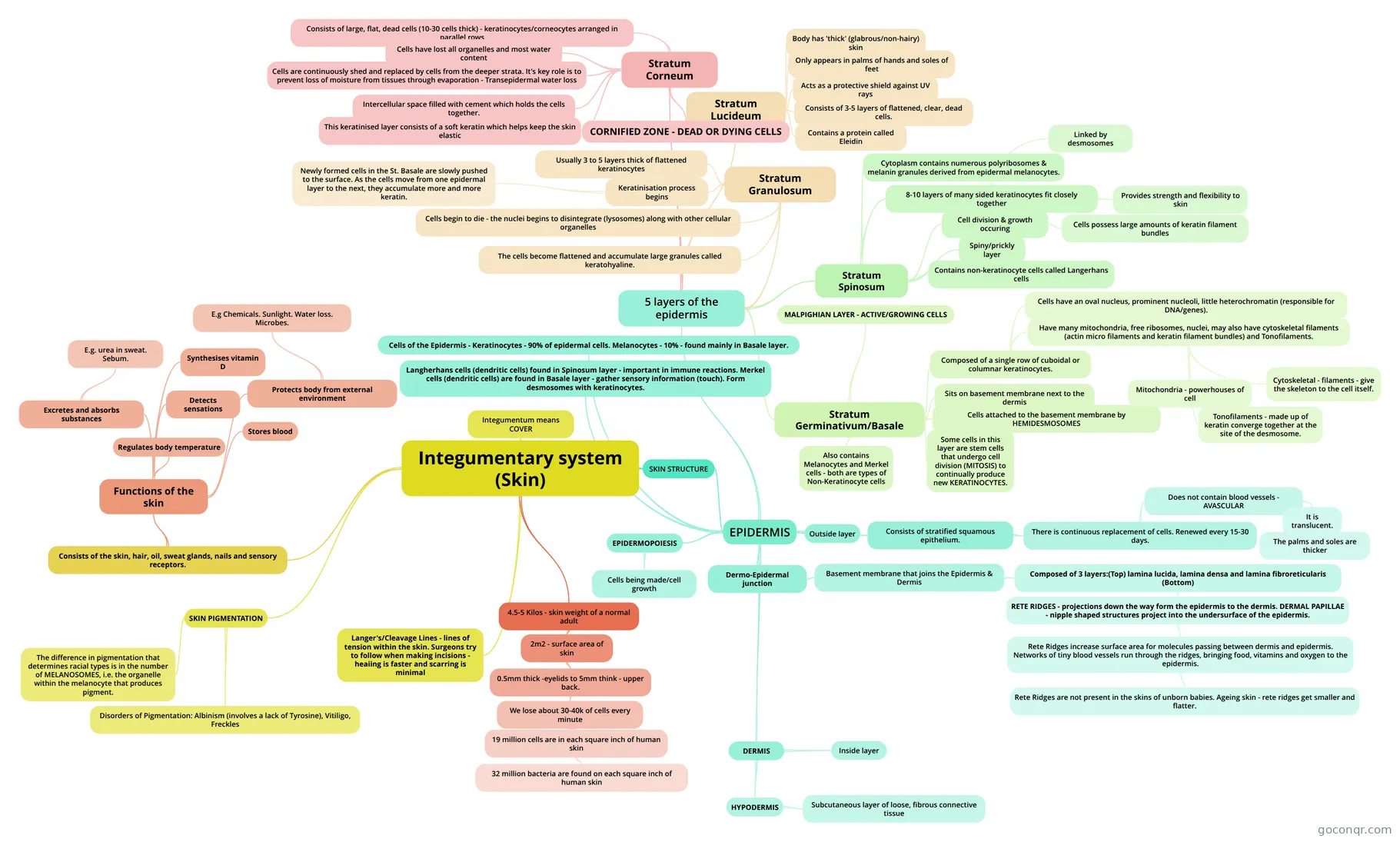 Integumentary system (Skin)
-
A 20 year old women with an ulcer
-
Nadia burns her hand
-
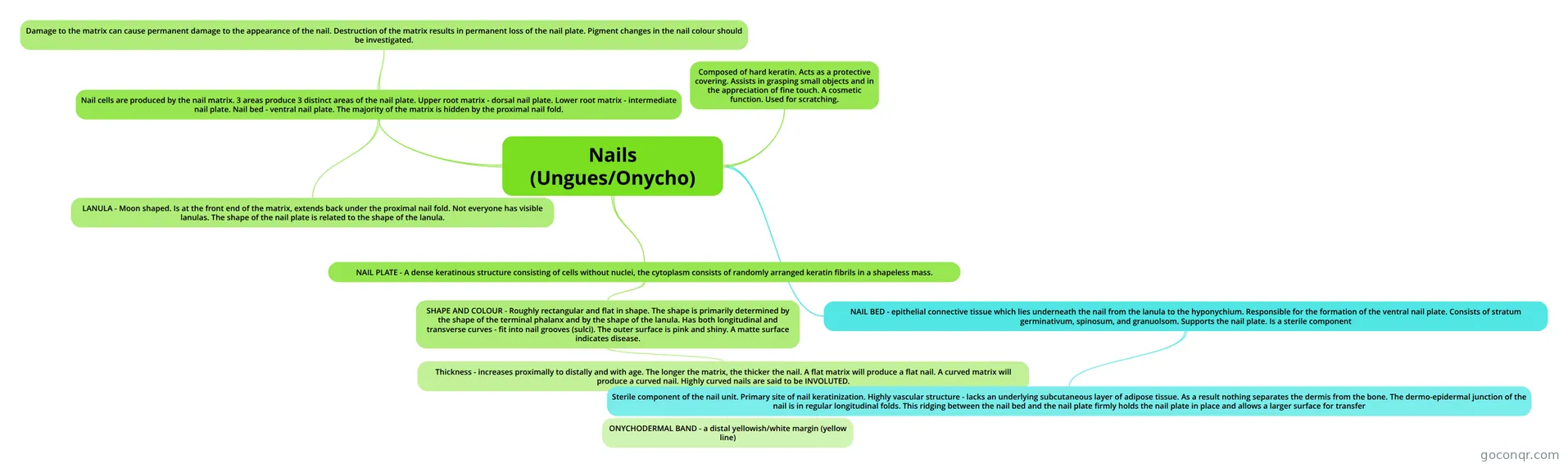 Nails (Ungues/Onycho)
-
Nadia burns her hand
-
Integumentary System Sistema tegumentario
-
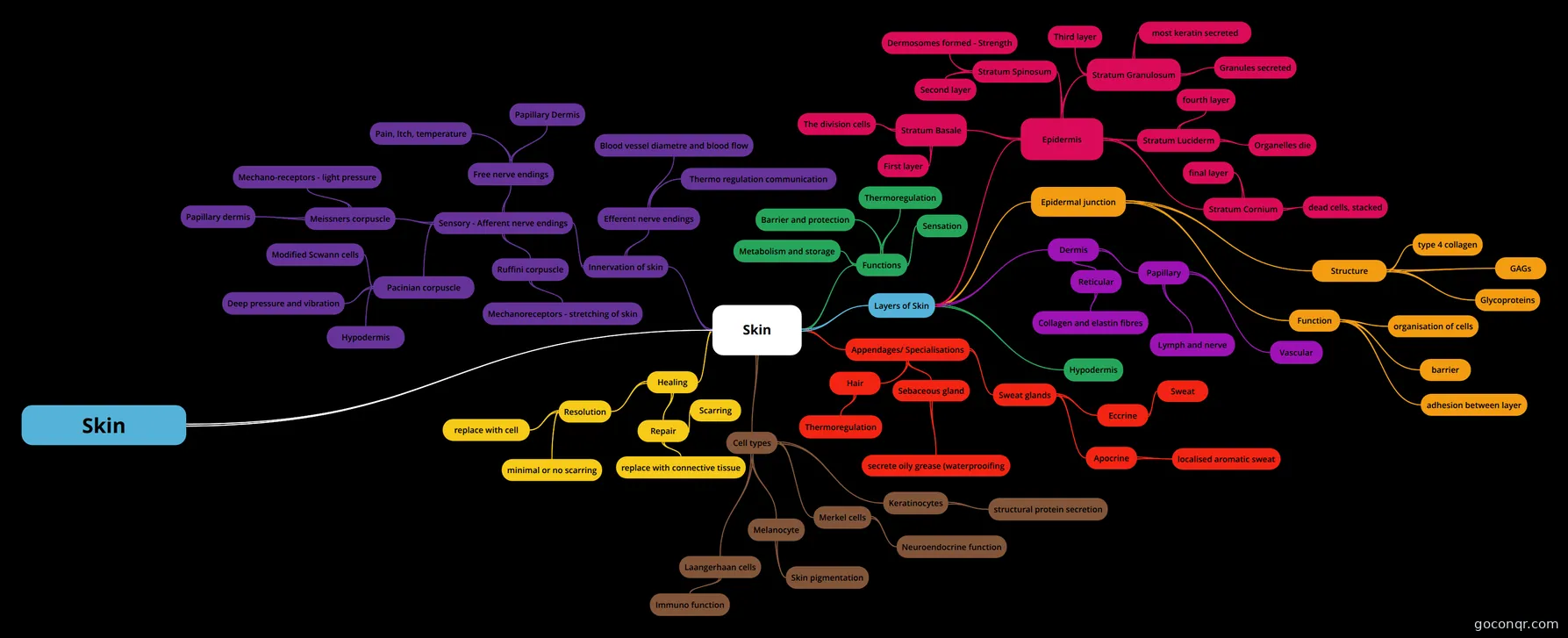 Skin A brief breakdown of the layers, innervation and function of skin and its specialisations
Flashcards
See all 14 flashcards-
200 cardsPractice MCQ what is the integumentary system?
-
145 cardsIntegumentary What is the function of skin?
-
238 cardsA&P Lab Final
-
19 cardsDiagram of the Skin Flash cards of a diagram of the skin.
-
94 cardsSkin Give 4 main functions of skin
-
27 cardsA&P CH6 This is the largest organ of the body and is approximately 15% of total body weight
-
56 cardsintegumentary system study of the skin
-
40 cardsIntegumentary System Lab review ch 7
Notes
More Anatomy topics
About Integumentary System
GoConqr OriginalWhat the resources cover
The unit is about the skin and its partners. The listed resources look at the epidermis, the dermis, skin colour and pigments, hair and hair follicles, nails, and the sweat and oil glands. Some also cover body membranes and how the skin acts as a barrier.
Where to start
Begin with the big picture. The mind map called Integumentary System branches into skin layers, pigments, pathology, hair, nails, glands and homeostasis. The mind map Integumentary system (Skin) lists the skin's functions, such as regulating body temperature and protecting the body from external threats.
Next, check the vocabulary with flashcards. Diagram of the Skin is a labelled-structure deck covering the arrector pili muscle, hair follicle, Meissner's corpuscle and Pacinian corpuscle. The deck Integumentary asks about the two major layers of skin, the subcutaneous layer and keratinocytes.
Using quizzes and maps together
- Read a mind map and try to say each branch aloud.
- Take a quiz such as Integumentary System, which uses fill-in-the-blank questions on skin, nails and glands.
- Note which questions you missed and go back to the matching map branch.
- Retry the quiz, then move to a narrower one such as Epidermis or The Dermis.
The quiz A&P CH. 5 goes wider, with questions on the first line of defence, pigments and hair layers.
For teachers
Teachers can pick from the quizzes, notes, slide set and flowcharts, including the flowchart Keratinization, and use them as ready-made starters or revision tasks. All were made by GoConqr users.
Where it sits
This unit belongs to the strand Integument, Circulation and Respiration in Anatomy, within the Health area. Pick one resource that matches what you are studying today and open it.
Frequently asked questions
Which resource should I open first?
Start with the mind map called Integumentary System. It gives an overview of skin layers, pigments, hair, nails, glands and homeostasis. Then try the quiz Integumentary System, which checks the basics: that the system is made up of skin, nails and glands.
What do the mind maps on this page cover?
They cover the skin and its parts: the layers of the epidermis, skin appendages, nails, sweat glands, tissue membranes and the skin's functions. Some are short, such as Skin, while others, like the Integumentary System map, branch into pathology and physiology.
Are the resources free to use?
Yes. Every resource listed here is free to open, study and take, with no account needed. A free account also saves your quiz scores and lets you make your own quizzes, mind maps, flashcards and notes.
Who made these resources?
They were made by GoConqr users, not by GoConqr itself. That means styles and course names vary, from chapter-based quizzes to topic notes. If one doesn't match your course, try another on the same page.
Which levels are these resources for?
Most are at university level, with a small share aimed at professional study. They suit university students revising skin anatomy, and teachers looking for ready-made material they can share with a class.
What if I can't find a topic I need?
Try a related title first, such as Skin, Epidermis, Nails or Skin Appendages, since topics are often grouped under different names. If it is still missing, you can build your own flashcards or mind map from what you have.