
Mindmap
Standard Electrode Potentials
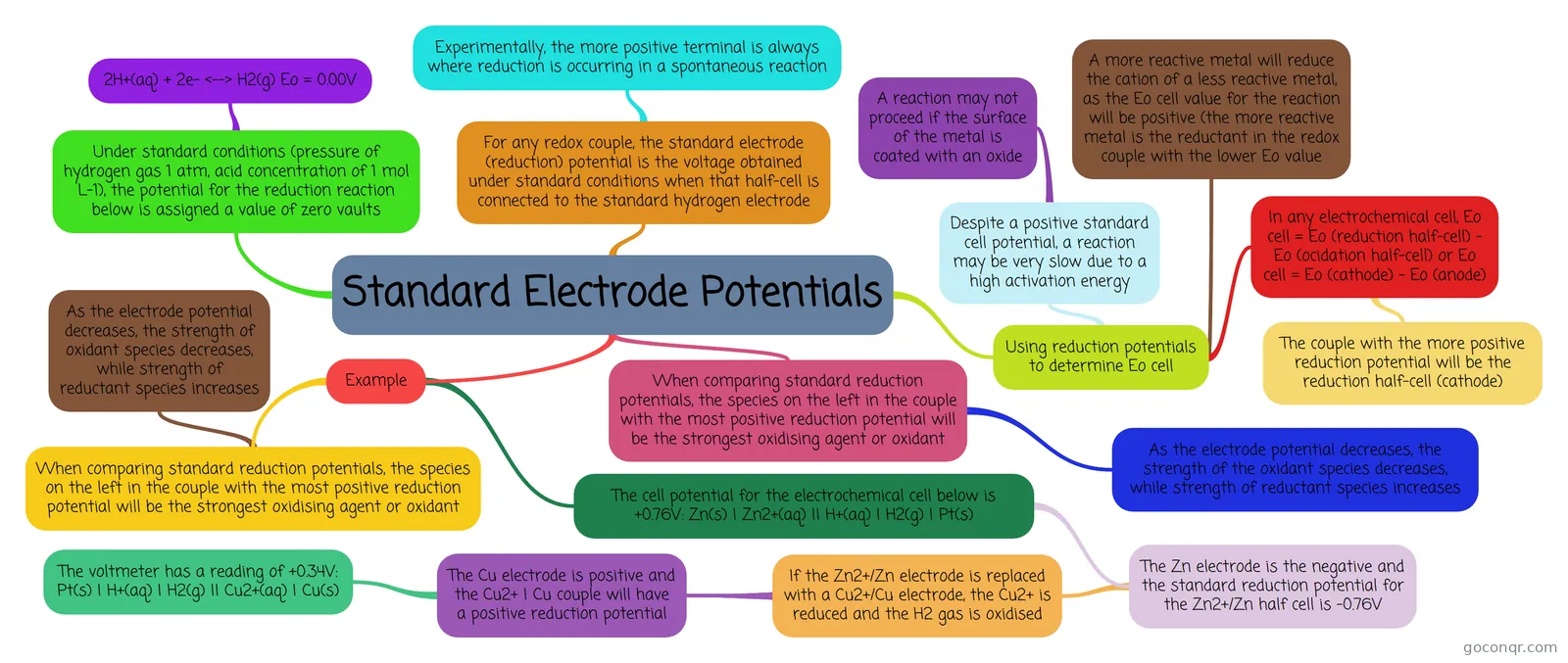
Mind map: standard electrode potentials
Inhalt der Mindmap
Standard Electrode Potentials
Under standard conditions (pressure of hydrogen gas 1 atm, acid concentration of 1 mol L-1), the potential for the reduction reaction below is assigned a value of zero vaults
- 2H+(aq) + 2e- <--> H2(g) Eo = 0.00V
For any redox couple, the standard electrode (reduction) potential is the voltage obtained under standard conditions when that half-cell is connected to the standard hydrogen electrode
- Experimentally, the more positive terminal is always where reduction is occurring in a spontaneous reaction
Example
- The cell potential for the electrochemical cell below is +0.76V: Zn(s) | Zn2+(aq) || H+(aq) | H2(g) | Pt(s)
- The Zn electrode is the negative and the standard reduction potential for the Zn2+/Zn half cell is -0.76V
- If the Zn2+/Zn electrode is replaced with a Cu2+/Cu electrode, the Cu2+ is reduced and the H2 gas is oxidised
- The Cu electrode is positive and the Cu2+ | Cu couple will have a positive reduction potential
- The voltmeter has a reading of +0.34V: Pt(s) | H+(aq) | H2(g) || Cu2+(aq) | Cu(s)
- The Cu electrode is positive and the Cu2+ | Cu couple will have a positive reduction potential
- If the Zn2+/Zn electrode is replaced with a Cu2+/Cu electrode, the Cu2+ is reduced and the H2 gas is oxidised
- The Zn electrode is the negative and the standard reduction potential for the Zn2+/Zn half cell is -0.76V
- When comparing standard reduction potentials, the species on the left in the couple with the most positive reduction potential will be the strongest oxidising agent or oxidant
- As the electrode potential decreases, the strength of oxidant species decreases, while strength of reductant species increases
- The cell potential for the electrochemical cell below is +0.76V: Zn(s) | Zn2+(aq) || H+(aq) | H2(g) | Pt(s)
When comparing standard reduction potentials, the species on the left in the couple with the most positive reduction potential will be the strongest oxidising agent or oxidant
- As the electrode potential decreases, the strength of the oxidant species decreases, while strength of reductant species increases
Using reduction potentials to determine Eo cell
- In any electrochemical cell, Eo cell = Eo (reduction half-cell) - Eo (ocidation half-cell) or Eo cell = Eo (cathode) - Eo (anode)
- The couple with the more positive reduction potential will be the reduction half-cell (cathode)
- A more reactive metal will reduce the cation of a less reactive metal, as the Eo cell value for the reaction will be positive (the more reactive metal is the reductant in the redox couple with the lower Eo value
- Despite a positive standard cell potential, a reaction may be very slow due to a high activation energy
- A reaction may not proceed if the surface of the metal is coated with an oxide
- In any electrochemical cell, Eo cell = Eo (reduction half-cell) - Eo (ocidation half-cell) or Eo cell = Eo (cathode) - Eo (anode)
Informationen
- Beschreibung
- NZ Scholarship Scholarship Chemistry (Oxidation-Reduction) Mindmap am Standard Electrode Potentials, erstellt von Eilidh Young am 16/08/2016.
- Erstellt von
- Eilidh Young
- Aufrufe
- 11
- Bewertung