
Redox and Electrochemistry
134 resources created by 103 users
This Redox and Electrochemistry page on GoConqr gathers community-made quizzes, mind maps, flashcards and notes, from oxidation numbers and redox equations to electrolysis, electroplating, electrode potentials and fuel cells. It's built for school students revising a topic, and for teachers after ready-made material. There are over 800 resources here, including more than 40 quizzes, over 400 mind maps and over 300 flashcard sets, mostly at GCSE, IGCSE, A-level and IB level. Pick a topic, try a quiz to find your gaps, then make it your own.
Top Redox and Electrochemistry resources
-
80 cardsC6 Flash cards What is made at the cathode during copper electrolysis?
-
38 questionsChapter 17 - Electrochemistry What is the oxidation number of bromine in the BrO3- ion?
-
20 questionsPractical Test: Faraday's Law Which electrode are connected at anode?
-
39 cardsChemistry 30 Flash Cards {5} Redox Reactions and Electrochemistry
-
14 questions0654 Electricty & Chemistry Quiz The diagram shows a section of an overhead power cable. Which statement explains why a particular substance...
-
16 questionsIGCSE Redox Reactions Aluminium reacts with iron(III) oxide as shown. iron(III) oxide + aluminium → iron + aluminium oxide Which ...
-
Mind map Electrolysis
-
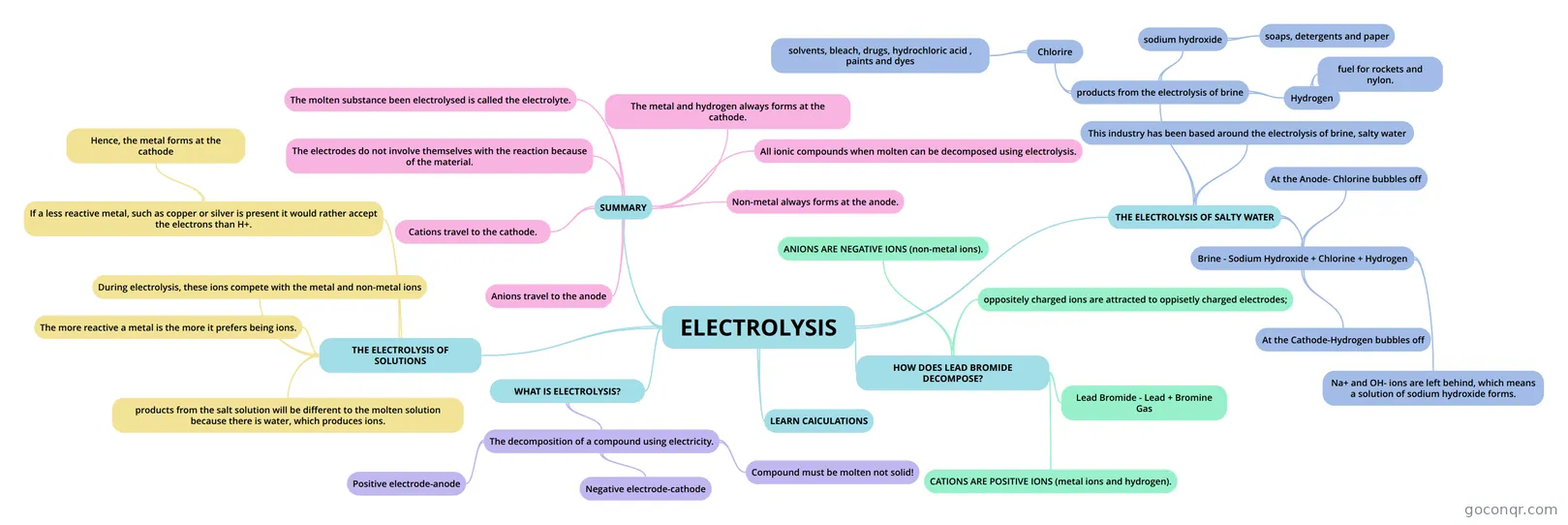 Mind map ELECTROLYSIS gcbse
Quizzes
See all 17 quizzes-
38 questionsChapter 17 - Electrochemistry What is the oxidation number of bromine in the BrO3- ion?
-
20 questionsPractical Test: Faraday's Law Which electrode are connected at anode?
-
14 questions0654 Electricty & Chemistry Quiz The diagram shows a section of an overhead power cable. Which statement explains why a particular substance...
-
16 questionsIGCSE Redox Reactions Aluminium reacts with iron(III) oxide as shown. iron(III) oxide + aluminium → iron + aluminium oxide Which ...
-
6 questionsOrganic Chemistry 1 Primer: Lesson II.12 Organic Chemistry 1 Primer: Lesson II.12
-
18 questionsIGCSE Coordinated Science Metals & Reactivity Quiz An electrolysis reaction is :
-
22 questionsAdditional Science Chemistry Some coins are made from an alloy of aluminium . Aluminium is manufactured by the electrolysis of a molten ...
-
11 questionsElectrolysis Quiz What does the cathode attract?
Mind maps
See all 41 mind maps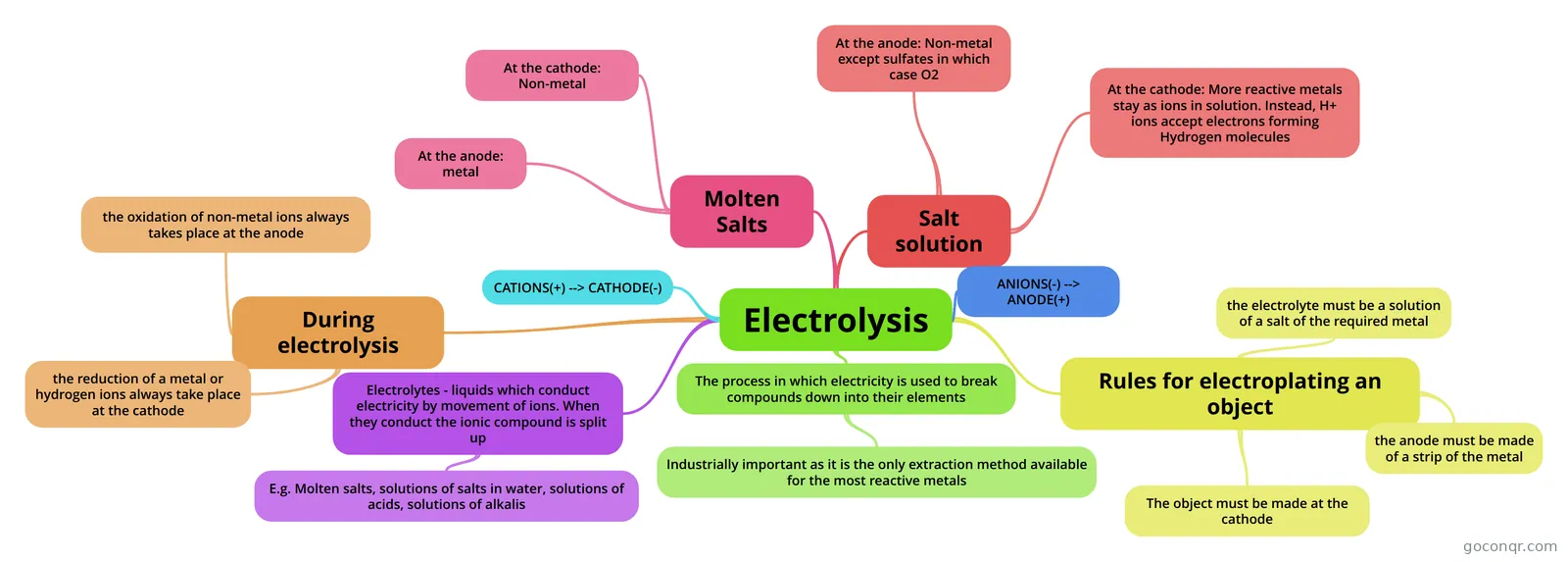
Flashcards
See all 52 flashcards-
80 cardsC6 Flash cards What is made at the cathode during copper electrolysis?
-
39 cardsChemistry 30 Flash Cards {5} Redox Reactions and Electrochemistry
-
23 cardsOxidation numbers
-
15 cardsElectrolysis - electroplating - the construction & operation of electrolytic cells
-
16 cardsChemistry C3.3 A - What is electrolysis? What is electrolysis?
-
42 cardsRedox Colour changes Colour Changes for the redox reactions in the internal
-
6 cardsCathode vs Anode The NEGATIVE ELECTRODE is also known as ...
-
5 cardsUnit 4 Chemistry AOS2 What type of reaction occurs at the anode?
Notes
See all 21 notes-
Chemistry: Further Redox: Standard Electrode Potential Standard Electrode (Redox) Potential Revision of Oxidation and ReductionThere are two very useful definitions of oxidation and reduction. One is in terms of loss or gain of electrons. The other is in terms of changes ...
-
Electrolysis of Acidified Water To improve the conductivity of water, sulphuric acid is added. The electrolysis of water allows for water to be broken up into its 2 component gases, Hydrogen and Oxygen. The hydrolysis of water is carried out using a...
-
Electrochemistry- The electrochemical series The The electrochemical series is defined as a list of elements in order of their standard electrode potentials. The series lists elements in order of their ability to be oxidised, ie their ability to lose elect...
-
Electrolysis of Na2SO4 An electric current is passed through a dilute solution of Na2SO4 using platinum electrodes. Current is conducted through movement of ions. A few drops of universal indicator solution are added to the solution to indi...
-
Batteries and Fuel Cells Electrochemical cells are used as batteries Batteries are types of electrochemical cells which provide the electricity we use to power things like watches and mobile phones. Some types of cell are rechargeable while o...
-
🔹 Unit 1: Electrochemistry & Battrychemistry🔹 🔹 Electrochemistry : A branch of science that explores the connection between electrical current and chemical reactions, linking them together. - Looking ahead, 🧪Electrochemical cells are classified into two mai...
-
Electrolysis ElectrolysisElectrolysis is the process by which ionic substances are broken down into simpler substances using electricity.During electrolysis, metals and gases may form at the electrodes. What is electrolysis? Ionic...
-
Chapter 7 - Oxidation, reduction and redox reactions 7.1 - Oxidation and reduction 7.1 - Oxidation and reductionRedox reactions:-short for reduction-oxidation-if one reagent is reduced, it itself is an oxidising agentAlso called electron transfer reactions.-if a reagent...
Slides
More Chemistry topics
About Redox and Electrochemistry
GoConqr OriginalWhat the page covers
The resources fall into two main strands: redox itself and electrolysis. On the redox side, the mind map Oxidation and Reduction sets out the basics: oxidation is an increase in oxidation number, reduction is a decrease, and uncombined elements are zero. Flashcard decks such as Oxidation numbers and Redox Colour changes help you drill the rules.
On the electrolysis side, several mind maps explain that a compound must be molten or in solution to conduct, that the cathode is negative and the anode is positive, and how salt solutions differ from molten salts. Notes cover the electrolysis of aluminium, acidified water and Na2SO4, plus the chlor-alkali industry.
Where to start
- Read the mind map Oxidation and Reduction to fix the definitions.
- Go through the Oxidation numbers flashcards until the rules feel automatic.
- Try the IGCSE Redox Reactions quiz, which asks you to judge statements about the reaction of aluminium with iron(III) oxide.
- Move on to an electrolysis mind map, then a quiz such as Electrolysis Quiz.
Going further
For A-level and IB readers, the notes on standard electrode potential cover electrochemical cells and thermodynamic feasibility. Other resources include Redox and Electrode Potentials, Cells and half cells and Batteries and Fuel Cells. A small number of resources, such as the quiz Chapter 17 - Electrochemistry, suit university students who need to fill a gap.
Using maps and quizzes together
Read a map first, then close it and take a quiz on the same idea. Wrong answers show you which branch to revisit. Flashcards then help with the small facts, such as which electrode gains or loses electrons.
Where it sits
This unit belongs to the Chemical Reactions and Quantities strand in Chemistry. Teachers can pick maps or slide sets such as Electrolysis to use as ready-made material. Choose one resource and start there.
Frequently asked questions
Which resource should I open first?
Start with the mind map Oxidation and Reduction, which gives the definitions and oxidation number rules. Then try the IGCSE Redox Reactions quiz to test them. If electrolysis is your focus, open one of the Electrolysis mind maps first and follow it with a quiz.
What do the electrolysis mind maps cover?
They explain that electrolysis splits a compound using direct current, that the electrolyte must be molten or dissolved, and that the cathode is negative while the anode is positive. Some compare molten salts with salt solutions, where less reactive products form at each electrode.
Are the resources free to use?
Yes. Every resource on this page is free to open, study and take, with no account needed. They were made by GoConqr users rather than by GoConqr itself, so it is worth checking a resource against your own course notes.
Which exams and levels do these suit?
Most resources suit secondary students, and the listed ones mention GCSE Chemistry, A-level Chemistry, IB Chemistry, IGCSE Chemistry and SACE Chemistry. A few also mention the MCAT, and a small share suit university students.
Can I save my scores or make my own materials?
A free account saves your quiz scores and lets you build your own quizzes, mind maps, flashcards and notes. That is handy if you want to turn a long set of notes on electrode potentials into short revision cards.
What if I can't find the topic I need?
Try a nearby term. Corrosion, electroplating, fuel cells and the electrochemical series each have their own resources. If your exact topic is still missing, make your own map or flashcards and use the existing ones as a model.