
Mindmap
Prototyping
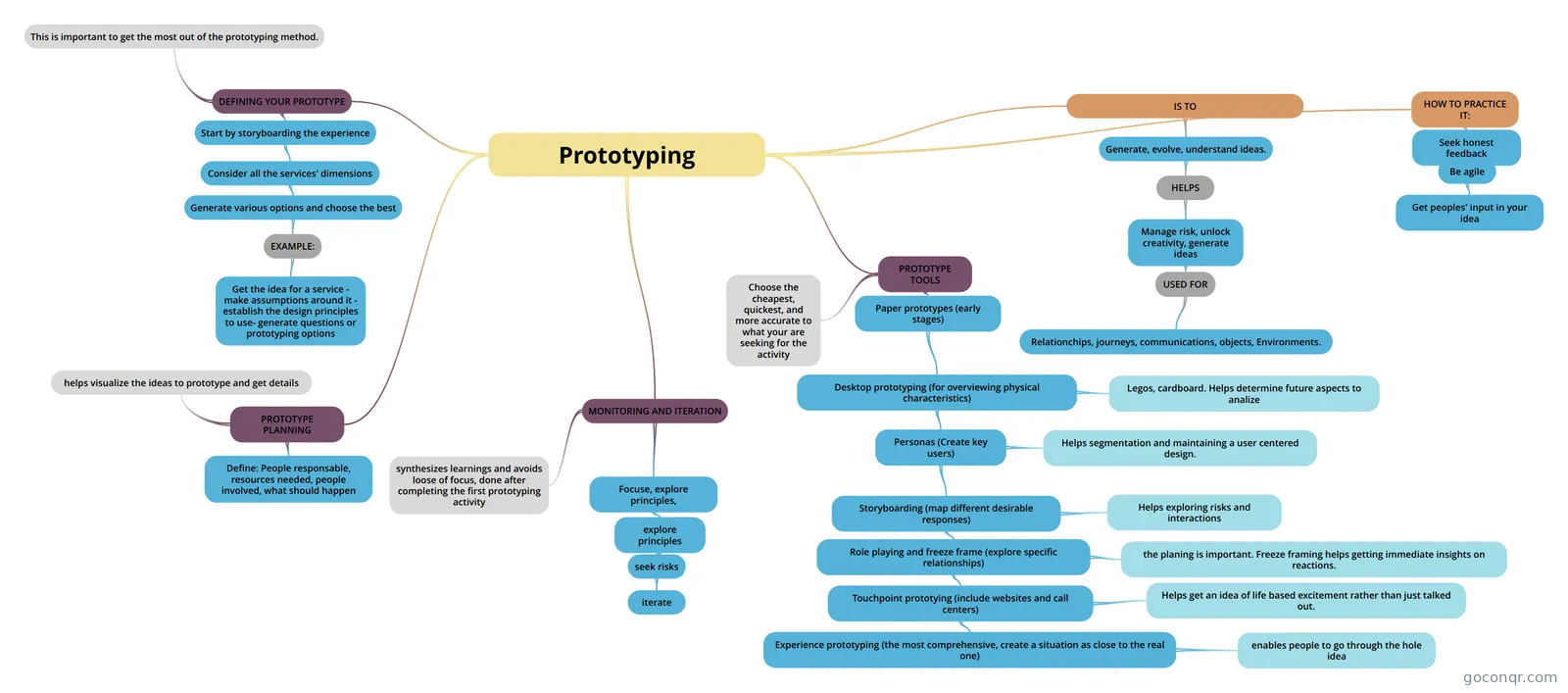
Mind map: Prototyping
Inhalt der Mindmap
Prototyping
IS TO
- Generate, evolve, understand ideas.
- HELPS
- Manage risk, unlock creativity, generate ideas
- USED FOR
- Relationchips, journeys, communications, objects, Environments.
- USED FOR
- Manage risk, unlock creativity, generate ideas
- HELPS
- Generate, evolve, understand ideas.
HOW TO PRACTICE IT:
- Seek honest feedback
- Be agile
- Get peoples' input in your idea
- Be agile
- Seek honest feedback
DEFINING YOUR PROTOTYPE
- This is important to get the most out of the prototyping method.
- Start by storyboarding the experience
- Consider all the services' dimensions
- Generate various options and choose the best
- EXAMPLE:
- Get the idea for a service - make assumptions around it - establish the design principles to use- generate questions or prototyping options
- EXAMPLE:
- Generate various options and choose the best
- Consider all the services' dimensions
PROTOTYPE PLANNING
- helps visualize the ideas to prototype and get details
- Define: People responsable, resources needed, people involved, what should happen
MONITORING AND ITERATION
- synthesizes learnings and avoids loose of focus, done after completing the first prototyping activity
- Focuse, explore principles,
- explore principles
- seek risks
- iterate
- seek risks
- explore principles
PROTOTYPE TOOLS
- Choose the cheapest, quickest, and more accurate to what your are seeking for the activity
- Paper prototypes (early stages)
- Desktop prototyping (for overviewing physical characteristics)
- Legos, cardboard. Helps determine future aspects to analize
- Personas (Create key users)
- Helps segmentation and maintaining a user centered design.
- Storyboarding (map different desirable responses)
- Helps exploring risks and interactions
- Role playing and freeze frame (explore specific relationships)
- the planing is important. Freeze framing helps getting immediate insights on reactions.
- Touchpoint prototying (include websites and call centers)
- Helps get an idea of life based excitement rather than just talked out.
- Experience prototyping (the most comprehensive, create a situation as close to the real one)
- enables people to go through the hole idea
- Desktop prototyping (for overviewing physical characteristics)