
Mindmap
FASB Conceptual Framework
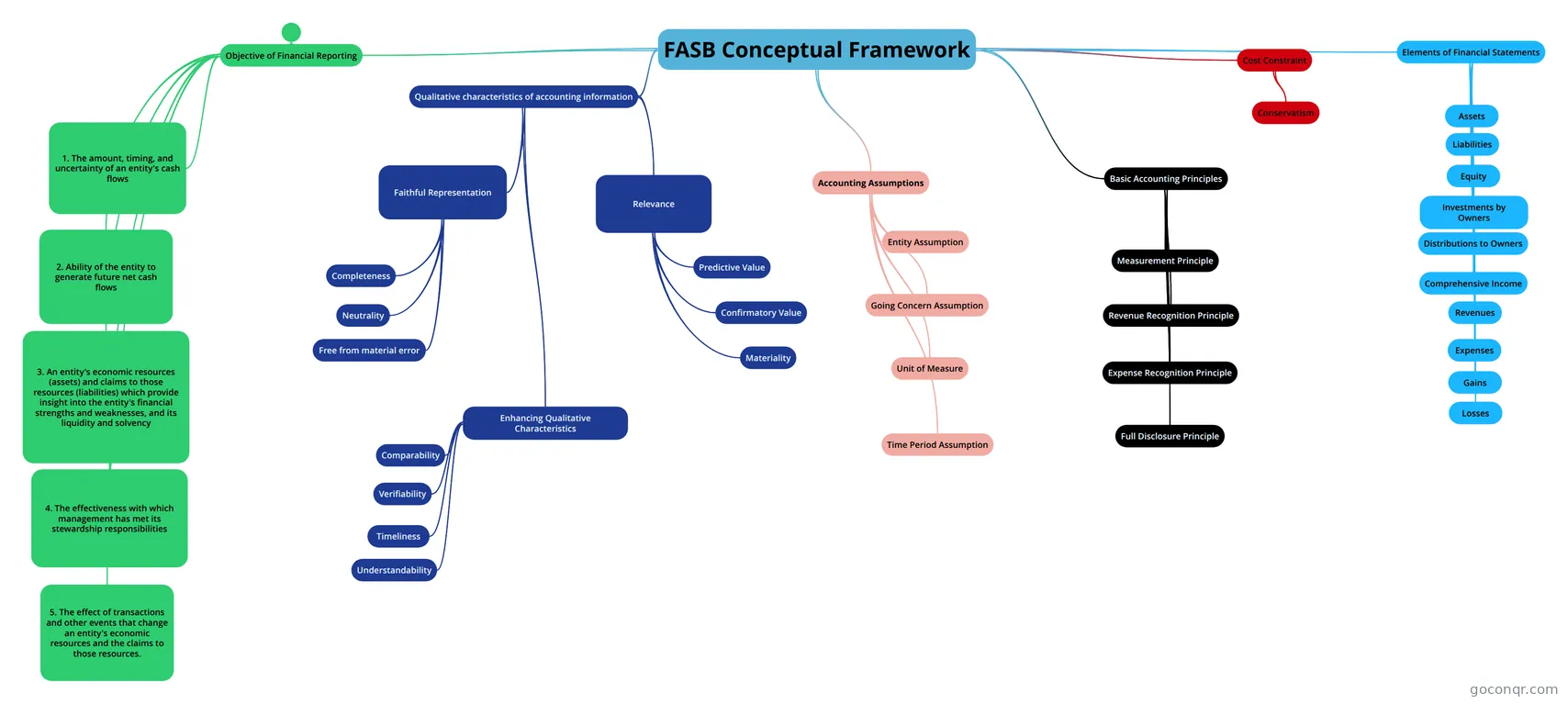
Mind map: FASB Conceptual Framework
Inhalt der Mindmap
FASB Conceptual Framework
Objective of Financial Reporting
- provide info about entity that is useful to current/future investors/creditors in making decisions as capital providers
- 1. The amount, timing, and uncertainty of an entity's cash flows
- 2. Ability of the entity to generate future net cash flows
- 3. An entity's economic resources (assets) and claims to those resources (liabilities) which provide insight into the entity's financial strengths and weaknesses, and its liquidity and solvency
- 4. The effectiveness with which management has met its stewardship responsibilities
- 5. The effect of transactions and other events that change an entity's economic resources and the claims to those resources.
Qualitative characteristics of accounting information
- Faithful Representation
- Faithful representation (primary characteristic) -- Information faithfully represents an economic condition or situation when the reported measure and the condition or situation are in agreement. Financial information that faithfully represents an economic phenomenon portrays the economic substance of the phenomenon. Information is representationally faithful when it is complete, neutral, and free from material error. Faithful representation replaces reliability as a primary qualitative characteristic.
- Completeness
- Completeness: information is complete if it includes all data necessary to be faithfully representative.
- Neutrality
- Neutral: information is neutral when it is free from any bias intended to attain a prespecified result, or to encourage or discourage certain behavior.
- Free from material error
- Free from error: information is free from error if there are no omissions or errors.
- Relevance
- Relevance (primary characteristic) -- Information is relevant if it makes a difference to decision makers in their role as capital providers. Information is relevant when it has predictive value, confirmatory value, or both.
- Predictive Value
- Information has predictive value if it assists capital providers in forming expectations about future events
- Confirmatory Value
- Information has confirmatory value if it confirms or changes past (or present) expectations based on previous evaluations. For example, if reported earnings for a period bear out market expectations, then it has confirmatory value.
- Materiality
- information that is material will impact a user's decision. Materiality is somewhat pervasive throughout the objectives of financial reporting in the sense that the financial statements should present material information because it is decision useful. The FASB believes that materiality is an entity specific attribute and that material information is relevant to the decision maker. Therefore, materiality is an attribute of relevance.
- Enhancing Qualitative Characteristics
- These are complementary to the primary characteristics and enhance the decision usefulness of financial reporting information that is relevant and faithfully represented.
- Comparability
- The quality of information that enables users to identify similarities and differences between sets of information. Consistency in application of recognition and measurement methods over time enhances comparability.
- Verifiability
- Verifiability -- Information is verifiable if different knowledgeable and independent observers could reach similar conclusions based on the information.
- Timeliness
- Timeliness -- Information is timely if it is received in time to make a difference to the decision maker. Timeliness can also enhance the faithful representation of information.
- Understandability
- Understandability -- Information is understandable if the user comprehends it within the decision context at hand. Users are assumed to have a reasonable understanding of business and accounting and are willing to study the information with reasonable diligence.
- Faithful Representation
Accounting Assumptions
- Every Girl Uses Tampons Enity Going Concern Unit Measure Time
- Entity Assumption
- It is assumed there is a separate accounting entity for each business organization.
- Going Concern Assumption
- In the absence of information to the contrary, a business is assumed to have an indefinite life, that is, it will continue to be a going concern. Therefore, we do not show items at their liquidation or exit values.
- This assumption, also called the continuity assumption, supports the historical cost principle for many assets. Income measurement is based on historical cost of assets because assets provide value through use, rather than disposal. Thus, net income is the difference between revenue and the historical cost of assets used in generating that revenue. Without the going concern principle, historical cost would not be an appropriate valuation basis
- Unit of Measure
- Assets, liabilities, equities, revenues, expenses, gains, losses, and cash flows are measured in terms of the monetary unit of the country in which the business is operated. Price level changes cause the application of this assumption to weaken the relevance of certain disclosures.
- Time Period Assumption
- The indefinite life of a business is broken into smaller time frames, typically a year, for evaluation purposes and reporting purposes. For accounting information to be relevant, it must be timely. The reliability of the information often must be sacrificed to provide relevant disclosures. The use of estimates is required for timely reporting but also implies a possible loss of reliability.
Basic Accounting Principles
- Measurement Principle
- At the time of origination, assets and liabilities are recorded at the market value of the item on the date of acquisition, usually the cash equivalent . This origination value is referred to as historical cost. For many assets and liabilities, this value is not changed even though market value changes. Other assets, such as plant assets and intangibles, are disclosed at historical cost less accumulated depreciation or amortization. Given the going concern assumption, revaluation to market value is inappropriate for plant assets, because the value of these assets is derived through use, rather than from disposal
- Revenue Recognition Principle
- Revenues are recognized when the entity completes its performance obligation to a customer and the revenue is earned and realized (or realizable). The performance obligation is completed when the goods or services are delivered (revenue earned) and cash or promise of cash is received (realized).
- Expense Recognition Principle
- Addresses when to recognize expenses and is sometimes referred to as the Matching Principle.The matching principle says: recognize expenses only when expenditures help to produce revenues. Revenues are recognized when earned and realized or realizable; the related expenses are recognized, and the revenues and expenses are "matched" to determine net income or loss.
- Full Disclosure Principle
- Financial statements should present all information needed by an informed reader to make an economic decision. This principle is sometimes referred to as the adequate disclosure principle.
- Measurement Principle
Cost Constraint
- The cost constraint on GAAP limits recognition and disclosure if the cost of providing the information exceeds its benefit. Firms may not omit disclosures if they are material and mandated by GAAP.
- Conservatism
- Conservatism (also called prudence) is the reporting of less optimistic amounts (lower income, net assets) under conditions of uncertainty or when GAAP provides a choice from among recognition or measurement methods.
- If estimates of an outcome are not equally likely, the preferred approach is to report the most likely estimate, rather than the more conservative estimate, if the latter is less likely.
Elements of Financial Statements
- Assets
- Resources that 1. have probable future benefits to the firm 2. are controlled by management 3. are a result of past transactions
- Liabilities
- Probable future sacrifices of economic benefits arising from present obligations of an entity to transfer assets (Accounts Payable) or provide services (Unearned Revenue) to other entities as a result of past transactions or events.
- Equity
- Residual interest in the firm's assets, also known as net assets. Equity is primarily comprised of past investor contributions and retained earnings.
- Investments by Owners
- Increases in net assets of an entity from transfers to it by existing owners or parties seeking ownership interest.
- Distributions to Owners
- Decreases in net assets of an entity from the transfer of assets, provision of services, or incurrence of liabilities by the enterprise to owners.
- Comprehensive Income
- Accounting income (transaction based) plus certain holding gains and losses and other items. It includes all changes in equity other than investments by owners and distributions to owners.
- Revenues
- Increases in assets or settlements of liabilities of an entity by providing goods or services.
- Expenses
- Decreases in assets or incurrences of liabilities of an entity by providing goods or services. Expenses provide a benefit to the firm.
- Gains
- Increases in equity or net assets from peripheral or incidental transactions
- Losses
- Decreases in equity or net assets from peripheral or incidental transactions. Losses provide no benefit to the firm.
- Assets
Informationen
- Beschreibung
- CPA Accounting (Framework: 2. Financial: Concep Framework of Financial Repor) Mindmap am FASB Conceptual Framework, erstellt von Winston Maxwell am 28/09/2016.
- Erstellt von
- Winston Maxwell
- Aufrufe
- 5
- Bewertung