
Mindmap
Atoms, elements and compounds (Test 1)
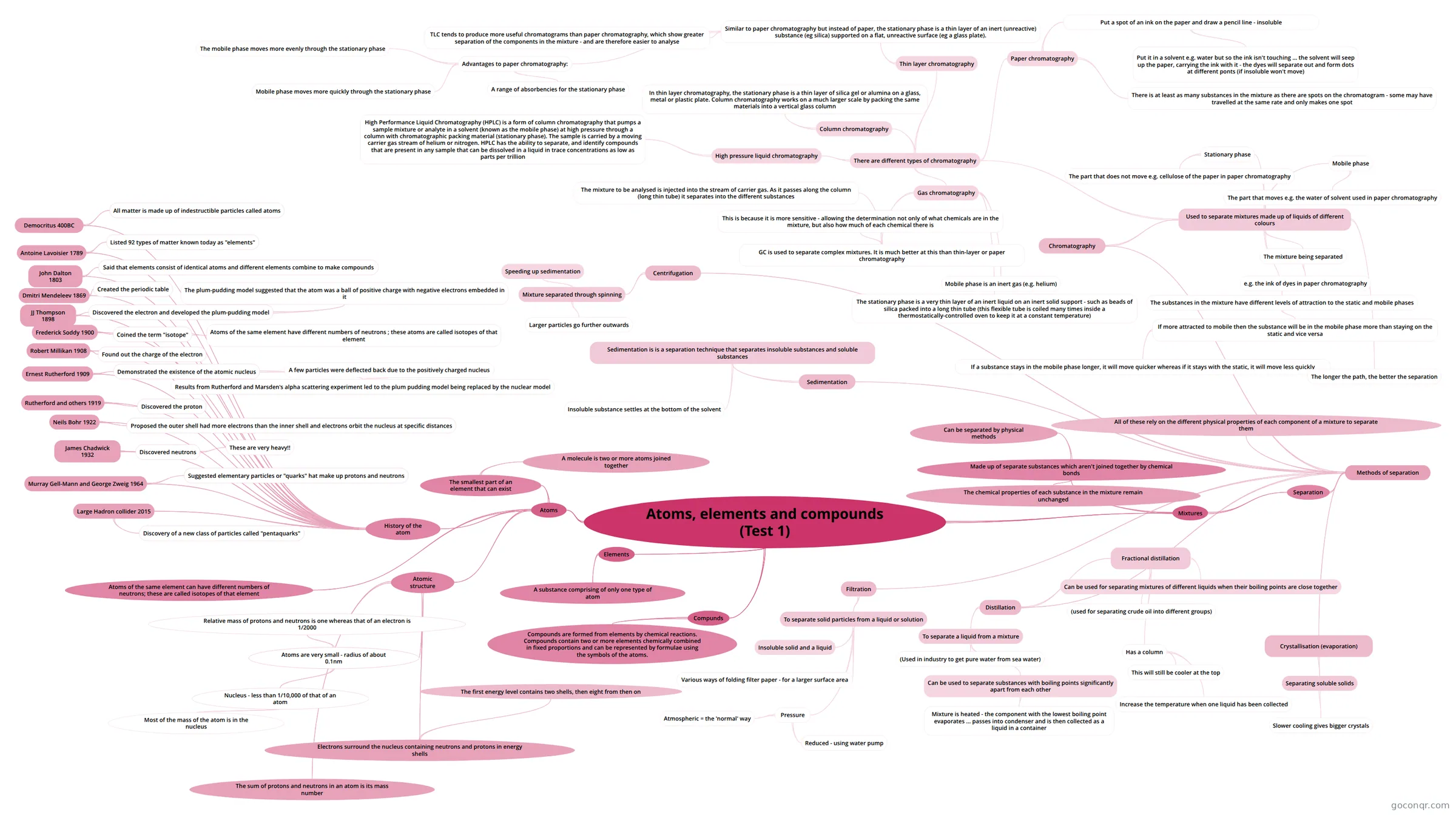
Mind map: Atoms, elements and compounds
Inhalt der Mindmap
Atoms, elements and compounds (Test 1)
Atoms
- History of the atom
- Democritus 400BC
- All matter is made up of indestructible particles called atoms
- Antoine Lavoisier 1789
- Listed 92 types of matter known today as "elements"
- John Dalton 1803
- Said that elements consist of identical atoms and different elements combine to make compounds
- Dmitri Mendeleev 1869
- Created the periodic table
- JJ Thompson 1898
- Discovered the electron and developed the plum-pudding model
- The plum-pudding model suggested that the atom was a ball of positive charge with negative electrons embedded in it
- Discovered the electron and developed the plum-pudding model
- Frederick Soddy 1900
- Coined the term "isotope"
- Atoms of the same element have different numbers of neutrons ; these atoms are called isotopes of that element
- Coined the term "isotope"
- Robert Millikan 1908
- Found out the charge of the electron
- Ernest Rutherford 1909
- Demonstrated the existence of the atomic nucleus
- Results from Rutherford and Marsden's alpha scattering experiment led to the plum pudding model being replaced by the nuclear model
- A few particles were deflected back due to the positively charged nucleus
- Results from Rutherford and Marsden's alpha scattering experiment led to the plum pudding model being replaced by the nuclear model
- Demonstrated the existence of the atomic nucleus
- Rutherford and others 1919
- Discovered the proton
- Neils Bohr 1922
- Proposed the outer shell had more electrons than the inner shell and electrons orbit the nucleus at specific distances
- James Chadwick 1932
- Discovered neutrons
- These are very heavy!!
- Discovered neutrons
- Murray Gell-Mann and George Zweig 1964
- Suggested elementary particles or "quarks" hat make up protons and neutrons
- Large Hadron collider 2015
- Discovery of a new class of particles called "pentaquarks"
- Democritus 400BC
- Atomic structure
- Atoms are very small - radius of about 0.1nm
- Nucleus - less than 1/10,000 of that of an atom
- Most of the mass of the atom is in the nucleus
- Relative mass of protons and neutrons is one whereas that of an electron is 1/2000
- Nucleus - less than 1/10,000 of that of an atom
- Electrons surround the nucleus containing neutrons and protons in energy shells
- The first energy level contains two shells, then eight from then on
- The sum of protons and neutrons in an atom is its mass number
- Atoms are very small - radius of about 0.1nm
- The smallest part of an element that can exist
- A molecule is two or more atoms joined together
- Atoms of the same element can have different numbers of neutrons; these are called isotopes of that element
- History of the atom
Mixtures
- Separation
- Methods of separation
- Filtration
- To separate solid particles from a liquid or solution
- Various ways of folding filter paper - for a larger surface area
- Pressure
- Atmospheric = the 'normal' way
- Reduced - using water pump
- Insoluble solid and a liquid
- To separate solid particles from a liquid or solution
- Crystallisation (evaporation)
- Separating soluble solids
- Slower cooling gives bigger crystals
- Separating soluble solids
- Distillation
- Fractional distillation
- Can be used for separating mixtures of different liquids when their boiling points are close together
- (used for separating crude oil into different groups)
- Has a column
- Increase the temperature when one liquid has been collected
- This will still be cooler at the top
- To separate a liquid from a mixture
- (Used in industry to get pure water from sea water)
- Can be used to separate substances with boiling points significantly apart from each other
- Mixture is heated - the component with the lowest boiling point evaporates ... passes into condenser and is then collected as a liquid in a container
- Fractional distillation
- Chromatography
- Used to separate mixtures made up of liquids of different colours
- There are different types of chromatography
- Paper chromatography
- Put a spot of an ink on the paper and draw a pencil line - insoluble
- Put it in a solvent e.g. water but so the ink isn't touching ... the solvent will seep up the paper, carrying the ink with it - the dyes will separate out and form dots at different ponts (if insoluble won't move)
- There is at least as many substances in the mixture as there are spots on the chromatogram - some may have travelled at the same rate and only makes one spot
- Put a spot of an ink on the paper and draw a pencil line - insoluble
- Thin layer chromatography
- Similar to paper chromatography but instead of paper, the stationary phase is a thin layer of an inert (unreactive) substance (eg silica) supported on a flat, unreactive surface (eg a glass plate).
- TLC tends to produce more useful chromatograms than paper chromatography, which show greater separation of the components in the mixture - and are therefore easier to analyse
- Advantages to paper chromatography:
- Mobile phase moves more quickly through the stationary phase
- The mobile phase moves more evenly through the stationary phase
- A range of absorbencies for the stationary phase
- Similar to paper chromatography but instead of paper, the stationary phase is a thin layer of an inert (unreactive) substance (eg silica) supported on a flat, unreactive surface (eg a glass plate).
- Column chromatography
- In thin layer chromatography, the stationary phase is a thin layer of silica gel or alumina on a glass, metal or plastic plate. Column chromatography works on a much larger scale by packing the same materials into a vertical glass column
- High pressure liquid chromatography
- High Performance Liquid Chromatography (HPLC) is a form of column chromatography that pumps a sample mixture or analyte in a solvent (known as the mobile phase) at high pressure through a column with chromatographic packing material (stationary phase). The sample is carried by a moving carrier gas stream of helium or nitrogen. HPLC has the ability to separate, and identify compounds that are present in any sample that can be dissolved in a liquid in trace concentrations as low as parts per trillion
- Gas chromatography
- Mobile phase is an inert gas (e.g. helium)
- GC is used to separate complex mixtures. It is much better at this than thin-layer or paper chromatography
- This is because it is more sensitive - allowing the determination not only of what chemicals are in the mixture, but also how much of each chemical there is
- The mixture to be analysed is injected into the stream of carrier gas. As it passes along the column (long thin tube) it separates into the different substances
- The stationary phase is a very thin layer of an inert liquid on an inert solid support - such as beads of silica packed into a long thin tube (this flexible tube is coiled many times inside a thermostatically-controlled oven to keep it at a constant temperature)
- Paper chromatography
- Stationary phase
- The part that does not move e.g. cellulose of the paper in paper chromatography
- Mobile phase
- The part that moves e.g. the water of solvent used in paper chromatography
- The mixture being separated
- e.g. the ink of dyes in paper chromatography
- The substances in the mixture have different levels of attraction to the static and mobile phases
- If more attracted to mobile then the substance will be in the mobile phase more than staying on the static and vice versa
- If a substance stays in the mobile phase longer, it will move quicker whereas if it stays with the static, it will move less quickly
- If more attracted to mobile then the substance will be in the mobile phase more than staying on the static and vice versa
- The longer the path, the better the separation
- There are different types of chromatography
- Used to separate mixtures made up of liquids of different colours
- Centrifugation
- Mixture separated through spinning
- Larger particles go further outwards
- Speeding up sedimentation
- Mixture separated through spinning
- Sedimentation
- Sedimentation is is a separation technique that separates insoluble substances and soluble substances
- Insoluble substance settles at the bottom of the solvent
- Sedimentation is is a separation technique that separates insoluble substances and soluble substances
- All of these rely on the different physical properties of each component of a mixture to separate them
- Filtration
- Methods of separation
- Made up of separate substances which aren't joined together by chemical bonds
- Can be separated by physical methods
- The chemical properties of each substance in the mixture remain unchanged
- Separation
Elements
- A substance comprising of only one type of atom
Compunds
- Compounds are formed from elements by chemical reactions. Compounds contain two or more elements chemically combined in fixed proportions and can be represented by formulae using the symbols of the atoms.
Informationen
- Beschreibung
- Year 10 (Chemistry) Mindmap am Atoms, elements and compounds (Test 1), erstellt von Emily H am 01/10/2016.
- Erstellt von
- Emily H
- Aufrufe
- 11
- Bewertung