
Mindmap
Particle Physics
Inhalt der Mindmap
Particle Physics
1 - Constituents of the Atom
- -Proton and Neutron Mass: 1.67x10^-27 kg -Electron Mass: 9.11x10^-31 kg -Proton Charge: +1.6x10^-19 C -Electron Charge: -1.6x10^-19 C
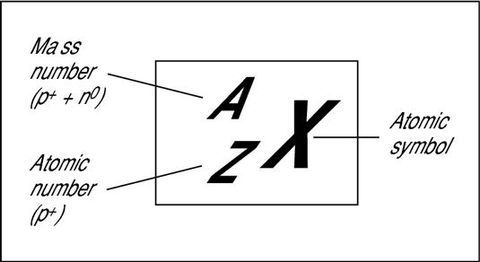
- Ion - Atom which has lost or gained electron to become charged. Isotope - Atoms with the same number of protons but a different number of neutrons
- Specific Charge (or charge-to-mass ratio) is a property that can be described for any charged particle. Specific Charge (kg^-1) = Charge (C)/Mass (Kg)
2 - Stable and Unstable Nuclei
- An atomic nucleus is typically 0.1 nano-meters (1 nm = 10^-9 m). Stable nuclei are held together by the strong nuclear force.
- The Strong Nuclear Force: Between 0 fm and 0.5 fm - Repulsive, Between 0.5 fm and 3 fm - Attractive, After 3 fm - Negledgable
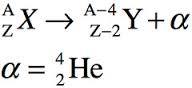
- Gamma is emitted from a nucleus in an 'excited state', typically just after alpha or beta decay. It doesn't have any affect on A or Z.
3 - Particles, Antiparticles and Photons
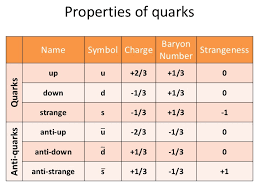
- All particles have a corresponding antiparticle. They have the same mass but opposite baryon numbers, lepton numbers, charges and strangeness.
- Only particles with a charge are affected by the electromagnetic force.
- EM radiation exhibits both WAVE and PARTICLE properties.
- Photons have no mass, are the exchange particles for the EM force and travel at the speed of light in a vacuum. Their speed is related to their frequency and wavelength as shown by c = fλ.
- Energy (E) is proportional to frequency (f). Proportional relationships can be made equal relationships by using a constant. In E = hf, 'h' is the Planck constant (6.63x10^-34).
- When a particle and its antiparticle come into contact, they will annihalate each other, converting all their mass into energy.
- A high energy photon can sometimes create a particle-antiparticle pair. This is pair production.
4 - Particle Interactions
- EM exchange particle: Photon, SNF exchange particle: Pion, WNF exchange particles: W and Z bosons.
5 - Classification of Particles
- Only hadrons experience the strong nuclear force. Hadrons include baryons (3 quarks) and mesons (quark-antiquark pair).
- All baryons (with the exception of the proton) are unstable which means they will all eventually decay into the proton.
- Leptons experience the weak interaction but not the strong interaction, They are divided into 3 families (electron, muon and tau). They include the respective neutrinos.
6 - Quarks and Antiquarks
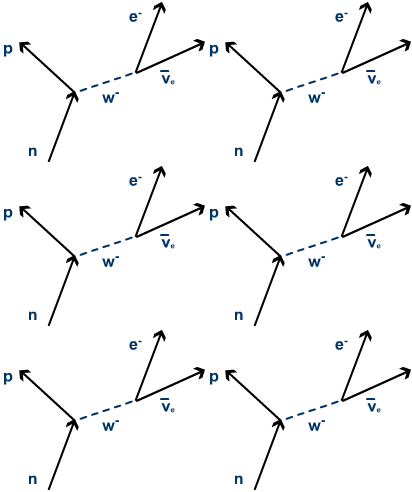
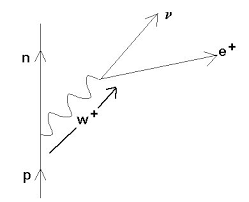
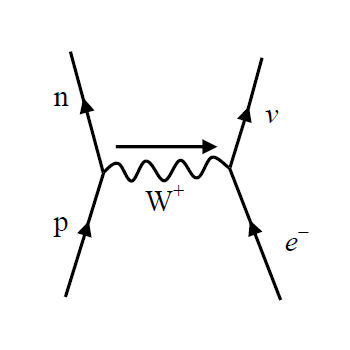
- Only the weak interaction can change the flavour of a quark.
- Energy, momentum, charge, baryon and lepton numbers are ALWAYS conserved.
- Strangeness is only conserved in a weak interaction.
- Particles containing strange quarks tend to have a slightly longer lifetime than similar particles without strange quarks.
Bilder und Dateien der Mindmap

Informationen
- Beschreibung
- A level Physics (Particles and Radiation) Mindmap am Particle Physics, erstellt von Joe O'Dwyer am 14/10/2016.
- Erstellt von
- Joe O'Dwyer
- Aufrufe
- 0
- Bewertung