
Mindmap
Rethinking Neanderthals
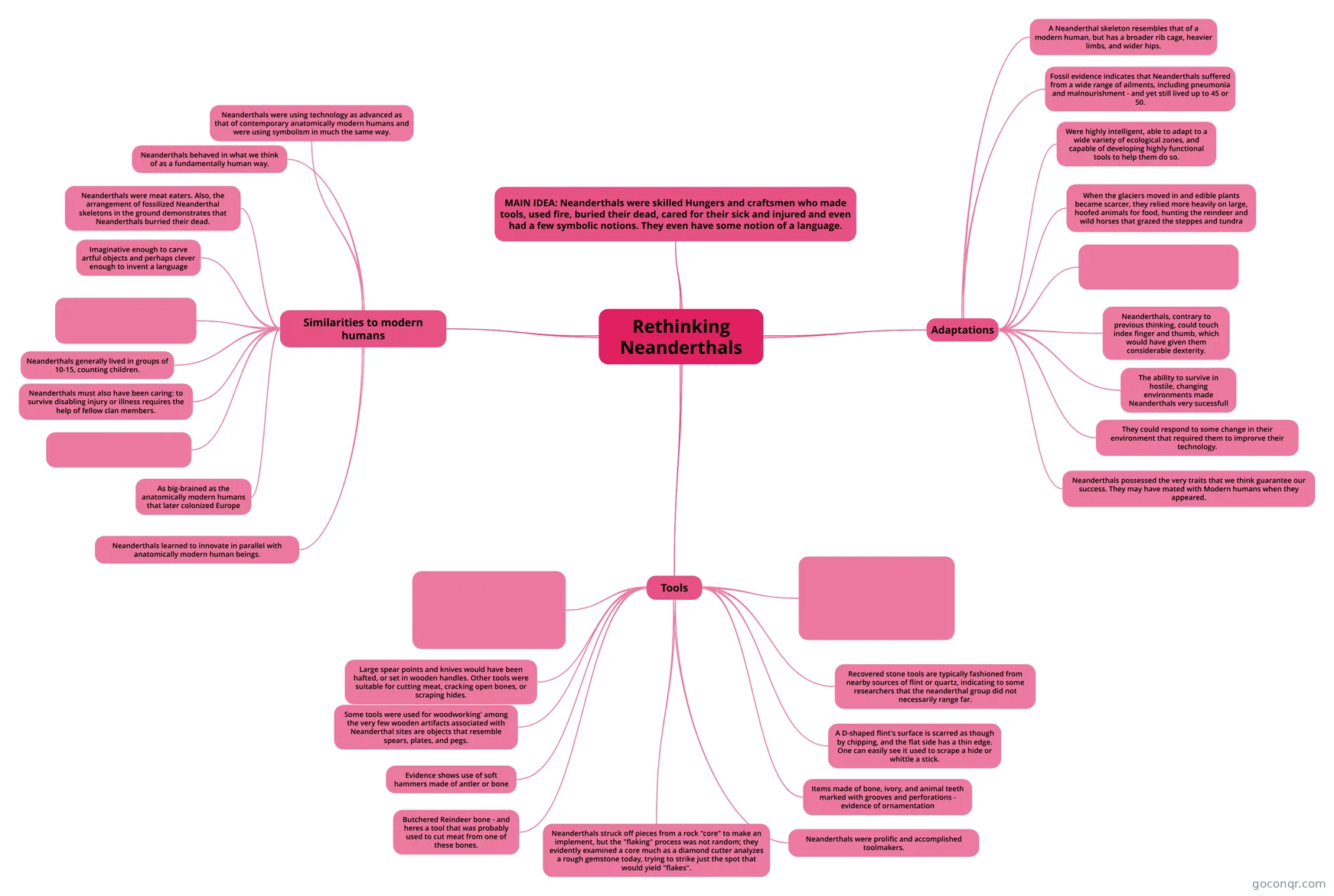
Mind map: Rethinking Neanderthals
Inhalt der Mindmap
Rethinking Neanderthals
Adaptations
- The ability to survive in hostile, changing environments made Neanderthals very sucessfull
- Neanderthals, contrary to previous thinking, could touch index finger and thumb, which would have given them considerable dexterity.
- When the glaciers moved in and edible plants became scarcer, they relied more heavily on large, hoofed animals for food, hunting the reindeer and wild horses that grazed the steppes and tundra
- Fossil evidence indicates that Neanderthals suffered from a wide range of ailments, including pneumonia and malnourishment - and yet still lived up to 45 or 50.
- Were highly intelligent, able to adapt to a wide variety of ecological zones, and capable of developing highly functional tools to help them do so.
- They could respond to some change in their environment that required them to improrve their technology.
- Neanderthals possessed the very traits that we think guarantee our success. They may have mated with Modern humans when they appeared.
- A Neanderthal skeleton resembles that of a modern human, but has a broader rib cage, heavier limbs, and wider hips.
Similarities to modern humans
- Imaginative enough to carve artful objects and perhaps clever enough to invent a language
- Neanderthals were meat eaters. Also, the arrangement of fossilized Neanderthal skeletons in the ground demonstrates that Neanderthals burried their dead.
- Neanderthals behaved in what we think of as a fundamentally human way.
- Neanderthals must also have been caring: to survive disabling injury or illness requires the help of fellow clan members.
- As big-brained as the anatomically modern humans that later colonized Europe
- Neanderthals generally lived in groups of 10-15, counting children.
- Neanderthals were using technology as advanced as that of contemporary anatomically modern humans and were using symbolism in much the same way.
- Neanderthals learned to innovate in parallel with anatomically modern human beings.
Tools
- Butchered Reindeer bone - and heres a tool that was probably used to cut meat from one of these bones.
- Recovered stone tools are typically fashioned from nearby sources of flint or quartz, indicating to some researchers that the neanderthal group did not necessarily range far.
- Large spear points and knives would have been hafted, or set in wooden handles. Other tools were suitable for cutting meat, cracking open bones, or scraping hides.
- Some tools were used for woodworking' among the very few wooden artifacts associated with Neanderthal sites are objects that resemble spears, plates, and pegs.
- A D-shaped flint's surface is scarred as though by chipping, and the flat side has a thin edge. One can easily see it used to scrape a hide or whittle a stick.
- Evidence shows use of soft hammers made of antler or bone
- Items made of bone, ivory, and animal teeth marked with grooves and perforations - evidence of ornamentation
- Neanderthals were prolific and accomplished toolmakers.
- Neanderthals struck off pieces from a rock "core" to make an implement, but the "flaking" process was not random; they evidently examined a core much as a diamond cutter analyzes a rough gemstone today, trying to strike just the spot that would yield "flakes".
MAIN IDEA: Neanderthals were skilled Hungers and craftsmen who made tools, used fire, buried their dead, cared for their sick and injured and even had a few symbolic notions. They even have some notion of a language.
Informationen
- Beschreibung
- Mindmap am Rethinking Neanderthals , erstellt von sarahmarie am 24/03/2014.
- Erstellt von
- sarahmarie
- Aufrufe
- 50
- Tags
- Bewertung